MAPS OF HISTORY · The Cold War · ALL CHAPTERS · CHAPTER 11
CHAPTER 11 · 1985–1989 · NOV 1989
Gorbachev and the Unraveling
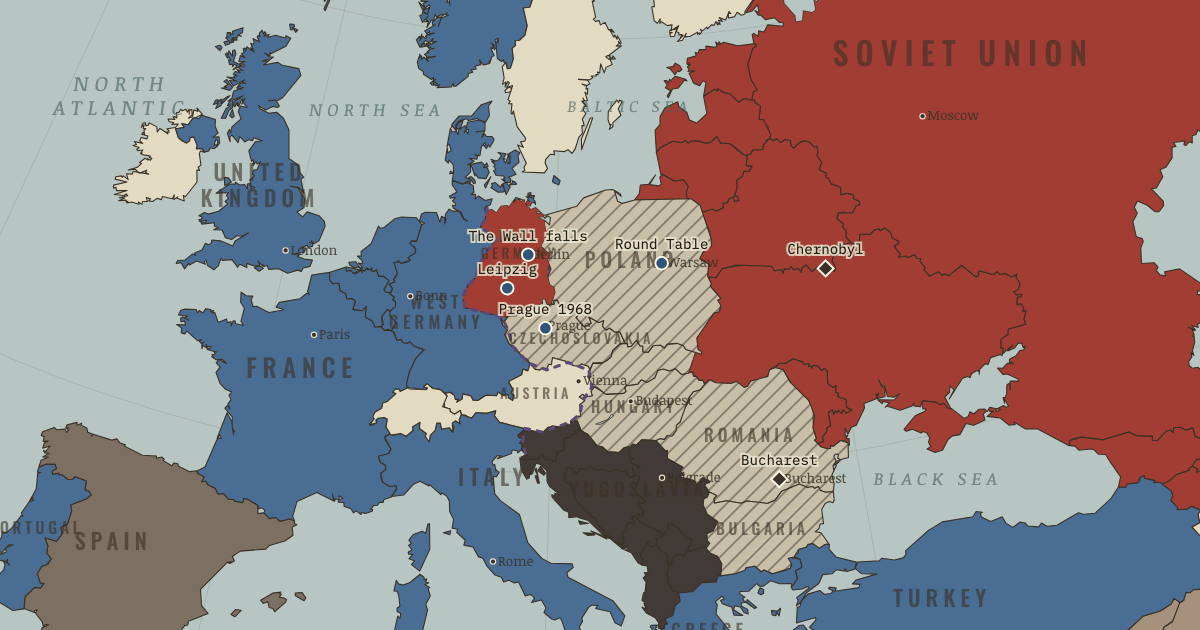
The map above is the world of NOV 1989 — The wave.
BRIEF EXPLANATION — THE ESSENTIAL ARGUMENT
Gorbachev came to power in 1985 determined to save the Soviet system rather than to end it, through perestroika, the restructuring of the economy, and glasnost, a new openness in public life. Reform exposed the system’s failures far faster than it could repair them. The Chernobyl disaster of 1986, and the collapse of the official cover-up that followed, made secrecy itself a central political problem and pushed glasnost toward genuine truth-telling.
Abroad, Gorbachev eased the confrontation and, decisively, renounced the use of force to keep Eastern Europe’s communist regimes in place. In 1989 organised opposition, mass protest and open borders spread across the bloc within months. The critical difference from 1956 and 1968 was that Soviet tanks stayed in their barracks, and it was local organisation that turned that restraint into a genuine transformation.
GUIDED EXPLANATION
When Gorbachev took power in 1985 the economy was barely growing, its technology lagged badly, and defence consumed a crushing share of national output. He intended renewal rather than dissolution, and abroad he moved with striking speed: the INF Treaty of 1987 abolished an entire class of missiles, the first true reduction of the arms race, and his 1988 speech at the United Nations cut Soviet forces and signalled that the bloc’s members could now choose their own path.
Eastern Europeans promptly tested whether he meant it, and the crises of 1989 chained together. Poland’s Round Table produced elections that Solidarity swept, Hungary opened its border with Austria and handed East Germans an escape route, and Leipzig’s Monday demonstrations swelled once the security forces declined to fire. On 9 November a confused announcement sent crowds to Berlin’s checkpoints, where local officers opened the gates. Czechoslovakia changed peacefully while Romania did not. The pattern is what matters most: organised opposition and rapid public learning accelerated events, but it was Soviet non-intervention that removed the force which had held the bloc together for forty years.
By the early 1980s Soviet growth was ~1% and possibly negative (the statistics themselves were fiction). Grain imports ran 30–40 million tons a year. The computer gap was unbridgeable inside a system where copying machines were licensed like weapons. Oil’s 1986 collapse removed the last cushion. Gorbachev’s generation. The “men of the Sixties,” shaped by the Secret Speech and the Prague Spring they watched crushed. Concluded the system must open to survive. They were reformers, not liquidators. The tragedy-or-miracle of 1989–91 is that the system could not be half-opened.
Eleven months from wall to unification (3 October 1990): Kohl outruns every ally’s caution, Bush backs him, and Gorbachev. Against his generals, for DM 55 billion in credits and pledges. Accepts a united Germany inside NATO. The Two-Plus-Four treaty formally closes the Second World War. What was promised about NATO beyond Germany, and in what form, becomes one of the most litigated memory disputes of the next century. The documents show assurances spoken, not signed.
DEEP EXPLANATION — EVIDENCE & INTERPRETATION
Why partial opening became systemic change
Gorbachev faced a sequencing problem that proved impossible to solve. Economic restructuring demanded accurate information and local initiative, yet the political system had spent decades punishing exactly those things, so glasnost was meant to expose manageable problems and rally support for reform. It created an uncontrolled feedback loop instead. Honest reporting on Chernobyl, on Stalinist terror, on the Afghan casualty lists and on the secret protocols of 1939 steadily dissolved the historical claims on which party authority rested, while new elections and independent organisations gave criticism a durable institutional form and mounting economic disruption discredited reformers alongside conservatives. China’s later path of market reform under continued political repression makes comparison tempting, but the Soviet Union laboured under different constraints: a militarised economy, a multinational federation whose constitution nominally allowed secession, and an external empire in Eastern Europe. Openness let national movements make real use of rights that had existed only on paper. Reform did not mechanically require collapse, yet it removed the old controls before any new economic or federal settlement could earn legitimacy of its own.
The non-decision that changed Europe
Eastern Europe’s regimes had survived their earlier crises because Soviet force set an outer limit that everyone understood, as Budapest in 1956 and Prague in 1968 had shown. Gorbachev’s refusal to intervene changed those expectations even before each government fully grasped what had happened. Opposition groups could now organise with far less fear of invasion, and local armies and police grew unwilling to kill for a regime that Moscow would no longer guarantee. Television and cross-border movement then let publics update rapidly from events in neighbouring states, producing a cascade rather than an automatic row of falling dominoes. The distinction is important, because Solidarity’s underground institutions, the churches, civic groups and reform circles had spent years preparing alternatives, and individual acts of restraint at Leipzig and at the Berlin checkpoints still had to be chosen. Romania’s bloodshed is the reminder of what coercion could still accomplish where it was attempted. The revolutions were made by local actors working inside an international constraint that Gorbachev deliberately chose to lift.
New here? Chapters 1–2 of every atlas are free to sample, and the WW2 atlas is free in full. One membership opens all thirteen — the Cartographer’s Circle.
THE SITES
ON THIS DAY
WHY IT HAPPENED
Why reform — the numbers Gorbachev read. By the early 1980s Soviet growth was ~1% and possibly negative (the statistics themselves were fiction). Grain imports ran 30–40 million tons a year. The computer gap was unbridgeable inside a system where copying machines were licensed like weapons. Oil’s 1986 collapse removed the last cushion. Gorbachev’s generation. The “men of the Sixties,” shaped by the Secret Speech and the Prague Spring they watched crushed. Concluded the system must open to survive. They were reformers, not liquidators. The tragedy-or-miracle of 1989–91 is that the system could not be half-opened.
Chernobyl as accelerant. Reactor 4’s explosion (26 April 1986) was met with reflexive lying. Kyiv’s May Day parade marched under fallout while Moscow said little for days until Swedish sensors forced disclosure. Gorbachev drew the maximal lesson: secrecy was not protecting the system, it was killing it. Literally, radioactively. Glasnost after Chernobyl stopped being managed candor and became open season: within two years the press was printing Stalin’s crimes, the Afghan casualty lists, and finally the secret protocol of the Molotov–Ribbentrop Pact. Which detonated the Baltics. A state built on controlled history cannot survive uncontrolled history.
The Brezhnev Doctrine repealed — and believed. Renouncing intervention was cheap to say. 1989 was expensive proof. Mechanism matters: once Moscow declined to shoot for Honecker or Jakeš, every bloc regime stood revealed as owning no legitimacy of its own. Ch. 5’s lesson (tanks were the system’s only argument) executed in reverse. The satellite armies would not fire on their own crowds without Soviet cover (Leipzig, 9 October, is the decisive non-order), and the crowds, watching each other on television. Including West German television East Germans had always received. Updated in real time. Hence the dominoes’ speed: it was one system failing everywhere, not six coincidences.
The West’s underrated role: steadiness, and a partner. Reagan’s pivot to negotiation gave Gorbachev a counterpart worth risking concessions on. Thatcher’s early verdict (“we can do business together”) mattered in allied capitals. Bush, mocked at the time for caution, declined to gloat or destabilize as the wave broke (“I’m not going to dance on the Wall”). And Helsinki’s machinery gave every 1989 movement its legal script. The West did not engineer 1989. The peoples of Eastern Europe did. But it had built the doorframe the exits walked through.
THE TURN
Berlin, 9 November 1989, 18:53. Asked when new travel rules take effect, Politburo spokesman Schabowski shuffles his notes and guesses: “immediately, without delay.” Tens of thousands converge on the checkpoints. Lieutenant Colonel Jäger at Bornholmer Straße, phoning superiors who offer nothing, opens the gate at 23:30 rather than crush the crowd. The era’s most fortified symbol falls to a press-conference error and one officer’s refusal to use force. A fitting inversion of 13 August 1961, and a reminder that history’s hinges swing on individuals precisely when systems abdicate. Twenty-eight years of the wall. One evening of the door.
WHAT IT CHANGED
Germany reunifies — inside the West. Eleven months from wall to unification (3 October 1990): Kohl outruns every ally’s caution, Bush backs him, and Gorbachev. Against his generals, for DM 55 billion in credits and pledges. Accepts a united Germany inside NATO. The Two-Plus-Four treaty formally closes the Second World War. What was promised about NATO beyond Germany, and in what form, becomes one of the most litigated memory disputes of the next century. The documents show assurances spoken, not signed.
The union catches the contagion. Glasnost has already awakened the Baltics (the two-million-person human chain of August 1989 answers the published Pact protocol), Armenia–Azerbaijan is in undeclared war, and miners strike from Donbas to Kuzbass. In March 1990 Lithuania declares independence outright. Eastern Europe’s exit taught the Soviet republics the method. And taught Gorbachev’s hardliners that only force could stop it. Both lessons detonate in 1991.
Romania’s warning label. The one violent exit shows what 1989 would have looked like everywhere if the Leipzig order had been given: state gunfire, then army defection, then summary execution. Revolution reverting to 1789 type. That five of six transitions stayed peaceful was not structural luck. It was thousands of individual refusals to fire, made easier by Moscow’s abdication and by oppositions (Solidarity, Charter 77, the churches) that had spent years rehearsing nonviolence. Peaceful revolutions are made, not found.
FIELD QUESTION — Could a Soviet leader other than Gorbachev have held the bloc together — and for how long?
A Chinese-road counterfactual is on the table: Tiananmen happened the same June as Poland’s election, and shooting demonstrably worked there. A Soviet Deng. Market reform plus repression. Might have bought the empire a decade. Andropov, had his kidneys lasted, might have tried exactly that. The obstacles: the USSR’s economy was oil-cursed and militarized in ways China’s was not. Its empire was external (garrisoning six unwilling nations) and its federation nominally voluntary, with secession written into the constitution glasnost let people read. And repression at 1989’s required scale would have meant firing on Europe under the West’s cameras mid-negotiation. Most historians land here: coercion could have postponed, not prevented. At rising cost and rising blood. But “postponed” is not nothing. Ask East Germans whether a decade matters. The deeper finding of 1989: systems whose only argument is force are stable right up until the moment the force is doubted. Then they are nothing at all. Watch for regimes making that bet today.
AN INTERESTING FACT
The border opening had a dress rehearsal disguised as a picnic. On 19 August 1989, at a “Pan-European Picnic” near Sopron organized under the patronage of Otto von Habsburg and the reformer Imre Pozsgay, a gate to Austria was to stand open for three symbolic hours — and some 600 East Germans, tipped off by leaflets, rushed through it in the largest mass escape since the Wall went up. The Hungarian officer on duty, Lieutenant Colonel Árpád Bella, decided in seconds not to give the order to stop them. Three weeks later Hungary opened the border outright.
THE DISPATCH
One short letter when a new atlas opens — and the printable study guide for The Cold War is yours now, free.
NO TRACKING · YOUR ADDRESS IS USED FOR THE DISPATCH AND NOTHING ELSE · UNSUBSCRIBE ANYTIME