MAPS OF HISTORY · The Crusades · ALL CHAPTERS · CHAPTER 10
CHAPTER 10 · 1218–1270 · 1229
The Crusades of Kings
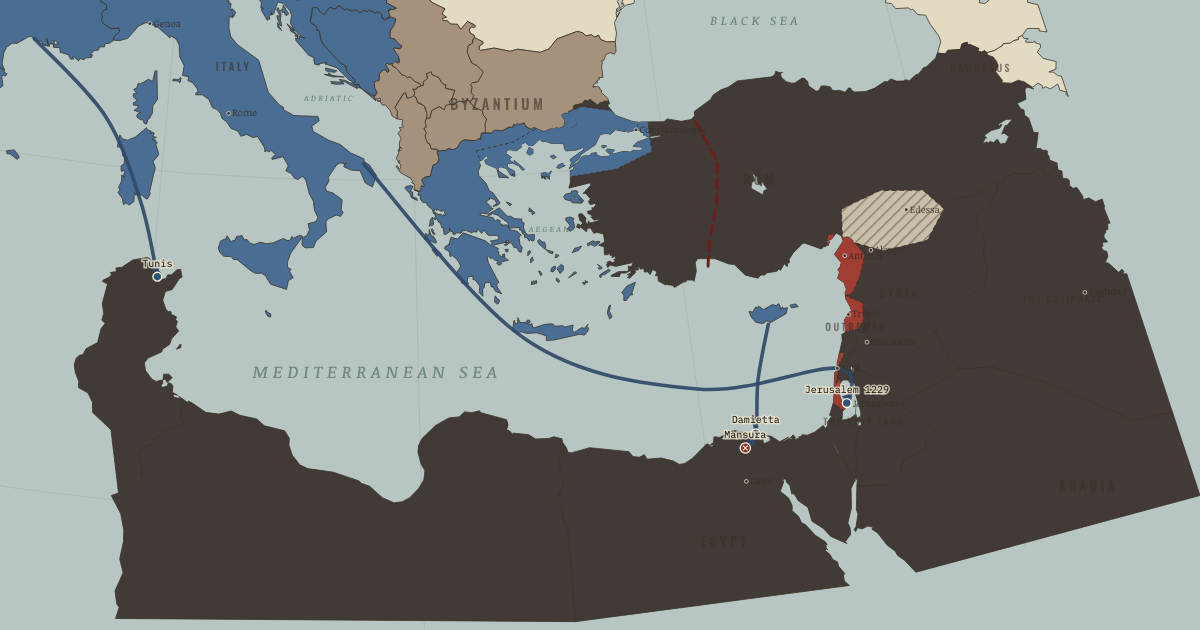
The map above is the world of 1229 — Frederick’s Jerusalem, by treaty.
BRIEF EXPLANATION — THE ESSENTIAL ARGUMENT
By the thirteenth century every strategist accepted Richard’s conclusion that Jerusalem could only be secured by whoever controlled Egypt, whose wealth sustained Muslim power in the region. The great royal crusades therefore aimed at the Nile. The Fifth Crusade captured the fortress of Damietta, then refused a remarkable offer to exchange it for Jerusalem, advanced toward Cairo at the wrong season and was trapped and destroyed by the annual Nile flood. A sound strategic target had been undone by poor timing and divided command.
The later royal crusades repeated the pattern in different keys. The excommunicated emperor Frederick II recovered Jerusalem by treaty in 1229, exploiting a rivalry within the Muslim ruling house, and was distrusted by the Church for winning it without a battle. Louis IX of France attacked Egypt in 1249, was defeated and captured near Mansura, and later died of disease at Tunis in 1270. Their careers show that piety could supply enormous commitment but could not substitute for logistics or for political flexibility.
GUIDED EXPLANATION
The strategy of the thirteenth-century crusades was correct, and it kept delivering their armies into the one environment where their strengths counted for least. Richard’s insight had hardened into orthodoxy, so the great expeditions aimed at Egypt, whose taxes, grain and fleets underwrote Muslim control of Jerusalem. The Fifth Crusade took Damietta, the fortress guarding the eastern branch of the Nile, in 1219, then rejected the sultan al-Kamil’s astonishing offer to trade Egypt for Jerusalem, marched on Cairo and was trapped by the annual flood, forced to hand back everything it had won. The target made strategic sense, but the delta itself, divided among channels, mud and defended crossings that local forces understood far better, was the graveyard of the plan.
The sharpest irony of the age is that the one ruler the Church had condemned was the one who recovered the Holy City. The emperor Frederick II, brilliant and Arabic-speaking but excommunicated by the very pope who should have sponsored him, regained Jerusalem in 1229 not by battle but by negotiation with al-Kamil, who needed peace in order to deal with his own relatives. His own side denounced the achievement because it had been won by diplomacy rather than by blood. Louis IX tried Egypt again in 1249 with unmatched devotion and careful preparation, only to be defeated and captured near Mansura, after which Mamluk officers soon seized Egypt for themselves, and his second expedition ended with his death from disease near Tunis in 1270.
The contrast between these campaigns exposes the central tension of the later crusades. The Nile made Egypt far harder to conquer than the short distances on the map suggested, because an army arriving by sea could seize a port like Damietta yet grow dangerously exposed as it moved inland away from its ships, and divided command made every adaptation slower. Frederick’s treaty worked through a different mechanism entirely, since both rulers valued time against their other rivals more than the immediate possession of sacred ground, and diplomacy briefly achieved what invasion could not. Yet crusading ideology, which generated such extraordinary commitment, also carried a preference for sanctified war that made a negotiated success hard to accept or to sustain. Frederick’s Jerusalem was fragile and short-lived, and the movement honoured the devout failure of Louis far more readily than the awkward achievement of an excommunicate who had simply talked the city back into Christian hands.
DEEP EXPLANATION — EVIDENCE & INTERPRETATION
Why Egypt Defeated Crusading Armies
Egypt was the correct strategic centre of gravity because its taxes, grain and fleets sustained regional power, and it was at the same time an exceptionally difficult place to campaign. The Nile delta divided any advance among channels and marshes, seasonal flooding rewrote the roads and campsites, and an army that had arrived by sea and taken Damietta became increasingly vulnerable as it pushed inland and left its ships behind. The local rulers understood the water, the supply routes and the value of delay, while the crusading coalitions arrived with divided leadership and a finite campaigning season. Both the Fifth Crusade and Louis IX repeated the same error because holding a port bred a confidence that was not matched by control of the river system beyond it. This is a geography-and-logistics trap, in which the prize that must be taken is difficult to hold for precisely the reasons that make it so valuable, and no amount of correct strategic reasoning could manufacture the local capacity needed to conquer it.
When Success Violated the Script
Frederick II’s treaty with al-Kamil returned Jerusalem, Bethlehem and a corridor to the coast for a fixed term, while Muslim control of the sacred precincts and the surrounding strongpoints continued, and the arrangement suited the immediate interests of both rulers. Yet his excommunication, his running conflict with the papacy and his very willingness to negotiate made the achievement suspect in the eyes of Church leaders. Louis IX, by contrast, failed militarily and was later made a saint, because sanctity was measured through devotion, conduct and suffering rather than through territorial results. The comparison reveals that the crusade was never simply foreign policy dressed in religious language. It was a penitential practice in which the authorized method genuinely mattered, and that created a real tradeoff, since diplomacy might secure access to the holy places more cheaply while failing to satisfy an institution that gave spiritual meaning to armed sacrifice. Frederick’s success was therefore politically real and ideologically awkward at the same time.
New here? Chapters 1–2 of every atlas are free to sample, and the WW2 atlas is free in full. One membership opens all thirteen — the Cartographer’s Circle.
THE SITES
ON THIS DAY
WHY IT HAPPENED
The Egypt-first doctrine. Richard’s insight (Ch. 7) hardened into orthodoxy: the road to a secure Jerusalem ran through Cairo. It was correct in principle — and it repeatedly delivered crusading armies into the one environment, the flooding Nile delta, where their strengths counted for least and local knowledge counted for most.
Diplomacy could do what war could not. Frederick II regained Jerusalem because al-Kamil, embroiled in a family power-struggle, found a treaty more useful than a war. The episode shows that the crusaders’ goal was sometimes obtainable — just not by the holy-war methods the movement was built to celebrate. Interests, aligned, opened the city that armies could not.
The gap between piety and power. Louis IX brought unmatched devotion, careful preparation and personal courage — and failed, because none of it substituted for the logistics of campaigning in Egypt. His crusades are the definitive proof that holiness and competence are different virtues, and that the venture kept confusing them.
THE TURN
Jerusalem regained by treaty, 18 February 1229. The most revealing moment of the later crusades: an excommunicate emperor recovers the Holy City without a battle, by negotiation — and is condemned for it by the Church that preached the crusade. It exposes a contradiction at the heart of the movement: the crusade’s own logic valued holy war so highly that it could not celebrate the peaceful achievement of its central aim. What worked was precisely what the ideology could not honour.
WHAT IT CHANGED
A treaty-held Jerusalem, then gone. Frederick’s Jerusalem was undefended and short-lived; in 1244 Khwarezmian mercenaries sacked it and an allied army was destroyed at La Forbie (watch the corridor vanish). The city was lost for the rest of the crusading period.
The Mamluks made. Louis IX’s defeat at Mansura was the making of the slave-soldier officers who, weeks later, overthrew the Ayyubid dynasty and took Egypt for themselves. The crusade that aimed at Egypt instead forged the military state that would destroy Outremer.
The centre of gravity moves to kings — and then away. Great royal expeditions replaced the baronial crusades of the twelfth century. But kings had kingdoms to run, and when they stopped coming, the crusader states were left with no one to relieve them. The road to Acre 1291 runs through the exhaustion of royal crusading.
FIELD QUESTION — Frederick II took Jerusalem by treaty and was condemned; Louis IX fought, failed, and was made a saint. What does that reveal about what the crusade was for?
It reveals that the crusade was judged by piety and method, not by results. Frederick achieved the movement’s stated central aim — a Christian-held Jerusalem — but did it as an excommunicate, through negotiation with Muslims, and so his success was treated as almost scandalous; Louis pursued the aim with perfect devotion, failed utterly, and was canonized. If the crusade had been a rational instrument of policy, Frederick would be its hero and Louis its cautionary tale. That the reverse is true tells us the crusade was fundamentally a religious and penitential act — a way of performing holiness through suffering and holy war — in which the manner mattered more than the outcome. Which is also why it kept failing at the practical task of holding territory: it was never only, or even mainly, about the territory.
AN INTERESTING FACT
The Damascene chronicler Ibn Wasil preserves the most telling hour of Frederick’s Jerusalem. Staying overnight in the city in March 1229, the emperor noticed the muezzins had gone silent — the qadi of Nablus had suspended the call to prayer out of courtesy to the imperial guest — and objected: he had spent the night in Jerusalem, he said, chiefly to hear it. From the excommunicate who had just recovered the city for Christendom by treaty, the remark scandalized both sides — which is exactly why the Muslim sources kept it.
THE DISPATCH
One short letter when a new atlas opens — and the printable study guide for The Crusades is yours now, free.
NO TRACKING · YOUR ADDRESS IS USED FOR THE DISPATCH AND NOTHING ELSE · UNSUBSCRIBE ANYTIME