MAPS OF HISTORY · The Crusades · ALL CHAPTERS · CHAPTER 4
CHAPTER 4 · THE MILITARY ORDERS · 1150
Europe’s First Standing Institutions
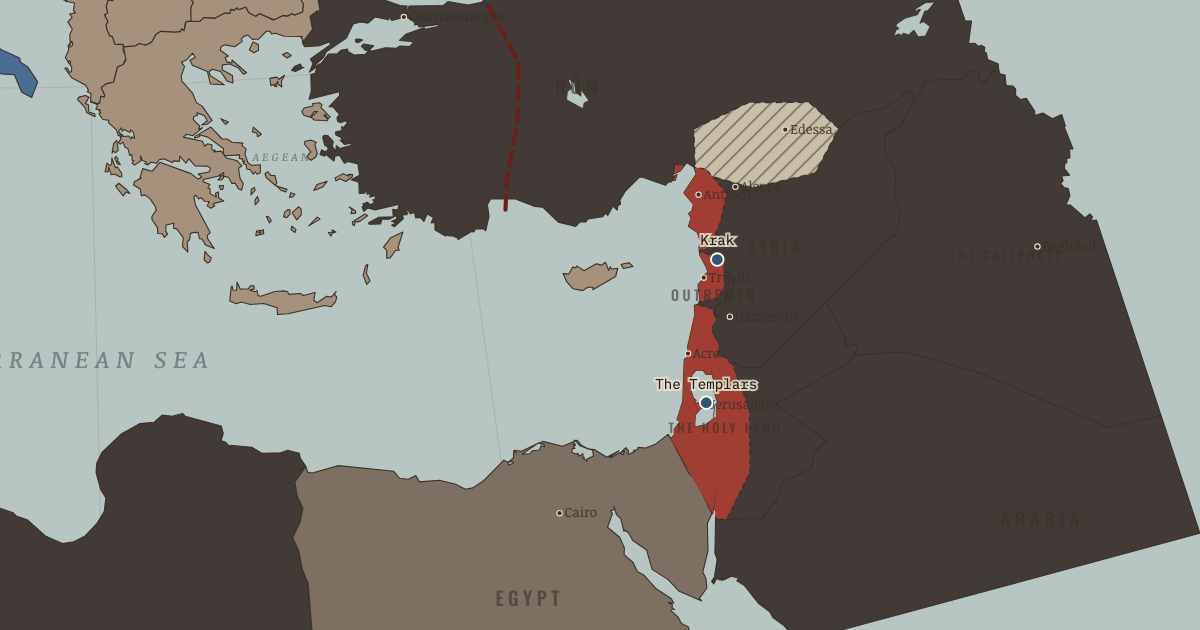
The map above is the world of 1153 — Ascalon — the peak of Outremer.
BRIEF EXPLANATION — THE ESSENTIAL ARGUMENT
The crusader states faced a shortage that ordinary feudal society could not fix, because most crusaders went home once their vows were fulfilled, while the castles needed trained soldiers every year. The military orders solved this by joining monastic vows to permanent military service, producing brotherhoods of monks who were also professional fighters. Donations across Europe, international recruitment and special papal privileges let the Templars and Hospitallers outlast any single lord or dynasty. They guarded pilgrims on dangerous roads, held the great frontier castles and moved money safely between Europe and the eastern Mediterranean.
The same independence that made the orders so durable also made them difficult to command. Because they answered to the pope, guarded their own resources and competed with one another, no king of Jerusalem could direct them as ordinary troops. The features that gave them permanence therefore made coordinated strategy harder in a shared emergency, and the rivalry between Templars and Hospitallers could damage the kingdom at the worst moments. An institution can outlive its founders and still depend on the powerful sponsors who protect it.
GUIDED EXPLANATION
The military orders began around 1120, when a handful of knights vowed to protect pilgrims on the murderous roads of the Holy Land and were given quarters on the Temple Mount, from which they took the name Templars. A second brotherhood, the Hospitallers, grew out of a Jerusalem hospital into a fighting order beside them. These were genuinely new institutions for which Christian society had no ready category, since they were monks bound by vows of poverty and obedience who were also trained to kill, and it took the theology of Bernard of Clairvaux to justify the combination.
What the orders built was remarkable for its age. A written rule and recruitment across the whole of Christendom gave them a permanence no dynasty could match, donations from every Latin kingdom gave them wealth, and to move that wealth safely to the front they created a network of fortified houses that worked much like an early bank, so that a pilgrim could deposit funds in Paris and draw on them in Acre. Above all they solved Outremer’s garrison problem, because it was the orders who held the great frontier castles, including Krak des Chevaliers, that the kings could never permanently staff. The reason was structural, since property belonged to the corporation rather than to a family, so an order’s estates stayed attached to its mission across generations instead of being scattered by inheritance.
The independence that made the orders effective was also what made them divisive, and both flowed from the same papal privilege. Exemption from local taxes and bishops kept them stable enough to defend a fortress for a century, yet it also meant that a king could request their cooperation without being able to compel it. Each order kept its own castles, revenues, intelligence and diplomacy, so their independent judgement could correct a weak ruler while their rivalry could produce conflicting decisions, as it did in the campaign before Hattin. This is a recurring institutional tension rather than a failure of proud personalities, because the very autonomy that let the orders preserve expertise and outlast any leader was the same autonomy that made common action hard in a crisis. Their later history proved the point, for the orders survived the loss of the Holy Land itself, until Philip IV of France, exploiting their wealth and their weak political protection, destroyed the Templars from 1307.
DEEP EXPLANATION — EVIDENCE & INTERPRETATION
The Technology Was Routine
The true novelty of the orders was not simply that monks fought, but that their written rules turned high ideals into repeatable behaviour, specifying clothing, meals, horses, discipline, prayer and the chain of command in exhaustive detail. Houses scattered across Europe recruited members and raised money, while commanders in the East spent those resources at permanent fortresses, and the result was institutional continuity, meaning the ability to keep acting long after any single leader had died. Ordinary medieval lordships tended to fragment through inheritance, whereas an order’s property belonged to the corporation and remained tied to its mission. That structure is what made long garrisons possible, and it also explains the orders’ financial services, because a network already moving donations and personnel across long distances could record a deposit in one place and authorize payment in another, sparing travellers the danger of carrying coin. The wider pattern is that grand ideals become durable only through administration, and it was regulation as much as zeal that let the orders behave in the same recognizable way in Paris and in Acre for two hundred years.
Independence and Coordination
Papal exemption shielded the orders from local rulers who might otherwise have seized their wealth or commandeered their men, and that same protection is what limited any collective command over them. A king of Jerusalem could ask for cooperation, but he could not treat the orders as ordinary royal troops, because each of them held its own castles, intelligence, diplomatic ties and institutional memory. Their independent judgement could usefully check a weak king, yet the rivalry between them could also generate contradictory decisions in the field. This is a version of what economists call a principal–agent problem, in which a community needs specialized agents but those agents control the resources and information that make them hard to direct. The tension was built into the structure rather than caused by arrogant individuals. Stripping the orders of their autonomy might well have destroyed the permanence that made them valuable in the first place, while preserving that autonomy meant living with the risk of poor coordination. Hattin made the risk plainly visible, but it should not obscure the decades in which the orders had held the states together.
New here? Chapters 1–2 of every atlas are free to sample, and the WW2 atlas is free in full. One membership opens all thirteen — the Cartographer’s Circle.
THE SITES
WHY IT HAPPENED
The demographic gap demanded permanence. Ordinary crusaders went home; the kingdom needed troops who would not. Monastic vows produced exactly that: a standing garrison force, celibate and disciplined, renewed by recruitment rather than birth. The orders exist because Outremer’s knights were too few and too transient (Ch. 3).
Papal privilege built a supranational body. Exempted from tithes and from the authority of local bishops and kings, the orders answered only to Rome. That autonomy let them accumulate lands and money across every Latin kingdom and act as a single institution spanning the whole of Christendom — a genuine novelty in a world of local lordship.
The need to move money safely. Financing a war two thousand miles from home, across bandit roads and pirate seas, created a problem the orders solved with letters of credit and a network of fortified houses. Almost by accident, holy war invented international banking.
THE TURN
Krak des Chevaliers — permanence in stone. The Hospitallers’ great castle is the physical meaning of the orders: where kings and crusades were transient, the orders were permanent, and a fortress held for over a century by a rotating garrison of monk-knights was something no ordinary lordship could sustain. Krak stands for the orders’ genius — and, when it finally falls in 1271 to a forged order, for the moment even permanence runs out.
WHAT IT CHANGED
Standing armies before the state. The orders modelled institutional power — continuity, finance, discipline independent of any single ruler’s life — generations before national states managed the same. In the long history of how organizations outlast individuals, they are a landmark.
Rivalry that could be fatal. The very independence that made the orders strong made them ungovernable in the field. Templar and Hospitaller competition, and the orders’ readiness to act on their own judgement, contributed directly to disasters like the Springs of Cresson — bleeding the kingdom weeks before Hattin.
The idea outlives the Holy Land. When Outremer falls, the orders survive it: the Hospitallers on Rhodes and then Malta, the Teutonic Knights in Prussia, the Templars — until a French king destroys them in 1307–14. Institutions, once built, migrate and endure past the purpose that created them.
FIELD QUESTION — How could the military orders be at once the most effective and the most divisive institution in Outremer?
Both flow from the same source: their independence. Because they answered to the Pope and drew on all of Christendom, they had the money, permanence and discipline that the fragile, cash-poor kingdoms lacked — they were the backbone of the defence, holding castles and providing the only reliable heavy cavalry. But that same autonomy meant they pursued their own strategies, guarded their own privileges, and competed bitterly with each other and with the crown, so that at the decisive moments the kingdom could not compel them to act in concert. The orders are a study in a permanent institutional tension: the qualities that make a body strong enough to be indispensable — independence, self-perpetuation, its own resources — are the same qualities that make it hard to command.
AN INTERESTING FACT
The Templars’ Rule survives, and it is startlingly granular. From the seventy-odd clauses approved at Troyes in 1129 it grew to nearly seven hundred, fixing a knight’s allowance at three horses and one squire, banning pointed shoes and shoelaces as worldly vanity, forbidding chess — and forbidding hunting, with a single exception: the lion. Read it and you see what the orders really invented: not zeal, which Europe had in surplus, but regulation — the unglamorous machinery that makes an institution behave the same way in Paris and in Acre for two hundred years.
THE DISPATCH
One short letter when a new atlas opens — and the printable study guide for The Crusades is yours now, free.
NO TRACKING · YOUR ADDRESS IS USED FOR THE DISPATCH AND NOTHING ELSE · UNSUBSCRIBE ANYTIME