MAPS OF HISTORY · WWI · ALL CHAPTERS · CHAPTER 3
CHAPTER 3 · THE SYSTEM, 1914–1918 · DEC 1914
The Trench
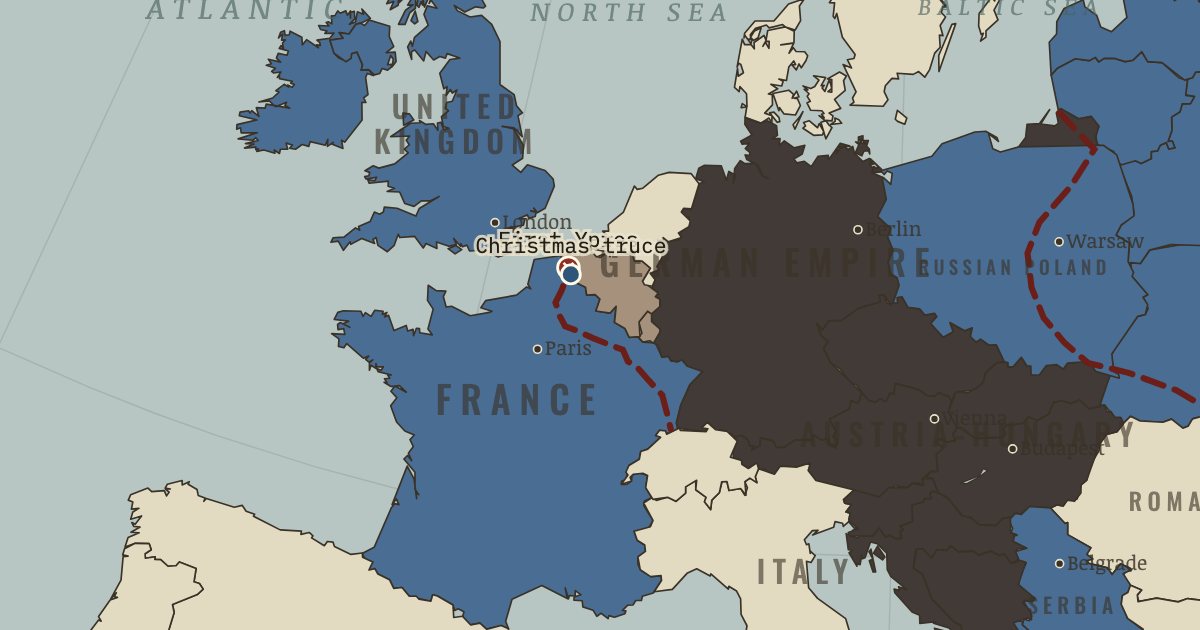
The map above is the world of NOV 1914 — The Ottomans enter.
BRIEF EXPLANATION — THE ESSENTIAL ARGUMENT
The central puzzle of the Western Front is why, after the swift movements of 1914, the fighting settled into a line that barely shifted for almost four years. The explanation is that the weapons of the day could stop movement far faster than any army could restore it. Machine guns, barbed wire and quick-firing artillery gave a defender enormous killing power over any exposed attack, so that troops advancing across open ground were cut down before they could break through. Railways then made the deadlock worse for the attacker, because a defender could rush fresh reserves to a threatened sector faster than the attacker could struggle forward across the shattered ground he had just captured.
A trench was therefore a whole defensive system rather than a single ditch, built in depth so that no one blow could pierce it. The forward lines were backed by support and reserve trenches, linked by communication trenches and dug-outs, an arrangement that spread the risk and kept millions of men supplied in the field. Commanders kept attacking despite the cost, because leaving the enemy in possession of captured territory, and failing to relieve hard-pressed allies, carried heavy military and political penalties. The resulting deadlock shaped everything that followed, from the way armies learned and adapted to the way whole societies were mobilized to feed the front.
GUIDED EXPLANATION
The dashed line on the map runs about seven hundred kilometres from the North Sea to the Swiss border, and it stayed almost fixed because defensive firepower had grown stronger than battlefield movement. Machine guns, barbed wire and artillery could break an exposed attack before it crossed the open ground between the trenches. Railways then allowed a defender to bring reserves to a threatened sector far faster than infantry could advance across shelled and broken earth. The combination locked the front in place for years.
A single trench was only one part of a much larger defensive system of fire, support and reserve lines connected by communication trenches and deep dug-outs. Soldiers rotated through this system and endured long stretches of boredom broken by disease, raids and sudden violence, while the Christmas truce of 1914 happened on parts of the front rather than everywhere along it. Armies kept attacking because leaving captured land in enemy hands, and honouring obligations to hard-pressed allies, made waiting politically costly. The war therefore became a contest in adaptation that consumed the resources of whole societies.
The heart of the problem was exploitation, meaning the ability to turn a breach in the enemy line into lasting movement beyond it. Artillery could smash a first line, but the same bombardment destroyed the roads over which an advance had to continue, so attackers pressed forward on foot beyond the range of their own guns and telephones. Defenders used lateral railways behind the front to feed reserves into a second line, which meant that every success weakened the attacker faster than the defender. This pattern was strongest in the densely manned west, while the longer and thinner Eastern Front still moved. Armies answered with gas, mines, creeping barrages, aircraft, small-unit tactics and tanks, and each method solved part of the puzzle while the defenders adapted in turn. The trench was therefore evidence of a problem that demanded several technical and organizational solutions at once, at a time when governments still required attacks before those solutions were ready, rather than proof that commanders had learned nothing.
DEEP EXPLANATION — EVIDENCE & INTERPRETATION
The gap between firepower and movement
Industrial armies entered 1914 carrying weapons that vastly multiplied defensive fire, yet without any reliable means of moving through that fire once it was unleashed. Magazine rifles, machine guns and recoil-controlled artillery could halt exposed infantry at long range, and although attackers could smother a first position with shells, their communications almost always failed the moment the troops advanced. Runners were slow, field telephones depended on wires that shellfire cut, and radios were still rare and bulky. The guns themselves also had to be dragged across cratered ground before they could support the next step forward. The result was a temporary gap between the ability to blast a breach and the ability to exploit it before the enemy could seal it, rather than any permanent superiority of the defence. By 1918 predicted artillery fire, tanks, aircraft, looser infantry tactics and better logistics had narrowed that gap, which is why the trench war is best understood as a technological and organizational transition paid for in lives.
Learning under constraint
The slogan that the soldiers were lions led by donkeys turns a genuinely hard historical problem into a moral verdict. Some commanders were rigid, hid their failures or accepted losses too readily, while others changed their methods quickly, and the real difficulty was that all of this learning had to happen inside political and coalition constraints. France could not simply accept the permanent German occupation of its territory, Britain had to support allies under pressure, and Germany needed a decision before the blockade and its enemies’ greater resources took full effect. Armies experimented with gas, mining, creeping artillery barrages, small-unit tactics and tanks, and the defenders adapted to each in turn, so that innovation produced an arms race rather than an immediate cure. A fair assessment asks whether the objectives, the preparation and the willingness to adapt justified the risks understood at the time, rather than asking only whether attacks caused casualties, which industrial war made almost certain. That standard still leaves ample room for criticism.
New here? Chapters 1–2 of every atlas are free to sample, and the WW2 atlas is free in full. One membership opens all thirteen — the Cartographer’s Circle.
THE SITES
ON THIS DAY
WHY IT HAPPENED
Firepower outran mobility by a generation. Between 1870 and 1914 firepower multiplied — magazine rifles, machine guns, recoil-absorbing artillery — while battlefield mobility stayed at horse and boot, and battlefield command at whistle, runner and cuttable wire. Armies could tear holes but not move through them faster than the enemy could seal them. The internal-combustion answer (tank, truck, ground-attack aircraft) existed by 1918 only; the gap between those dates is the trench war.
The defender’s railway advantage. The Western Front sat in Europe’s densest rail country, and lateral lines let a defender shift a division overnight. The attacker’s advance destroyed the very infrastructure he needed to continue — roads shelled by his own barrage, rail gauges to convert, ammunition hauled by horse over a moonscape. Success was self-limiting: the deeper you broke in, the weaker you got and the stronger the defense grew.
Density: no flanks to turn. In the west, millions of men held 700 km — enough to be strong everywhere. Compare the Eastern Front on this map: twice the length, similar numbers, so it bent and swung in ways the west never could. Deadlock was not universal law but force-to-space ratio; where density fell (Palestine, Macedonia in 1918), maneuver returned.
Attack anyway: the political imperative. Germany stood on French and Belgian soil; no French government could sit still, and coalition politics demanded offensives to relieve allies — Verdun pulled British attacks, Russia’s straits pulled Gallipoli. Many bloody offensives were less military judgment than alliance payments. Judge the generals inside that constraint, then judge the ones who refused to learn inside it too.
THE TURN
First Ypres, October–November 1914. The last chance of open warfare in the west dies in Flanders: the outnumbered BEF’s regulars — riflemen so fast the Germans reported machine guns — stop the final German drive for the Channel ports and are effectively destroyed doing it. When the fighting gutters out in the November rain, the line is continuous from sea to Alps. The door has shut; the siege of Europe begins.
WHAT IT CHANGED
Attrition becomes the strategy. If the line cannot be broken, kill the men holding it faster than they are replaced: 1916 makes this explicit doctrine at Verdun and the Somme. The war’s center of gravity moves from the map to the census and the factory ledger.
The siege workshop. Deadlock breeds innovation on a monstrous scale: poison gas (Chapter 4), mining and counter-mining, aerial photography and sound-ranging, creeping barrages, and at last the tank — each a key tried against the same lock, each answered within months. The 1918 combination that finally works is assembled from these failures.
Total war reaches home. Holding the line consumed nations: conscription spread (Britain, the volunteers’ nation, adopted it in 1916), women entered war industry by the million, food was rationed, dissent policed. The distinction between soldier and civilian — already dying at Louvain — eroded everywhere. Remember this when the blockade chapter asks who a legitimate target is.
FIELD QUESTION — “Lions led by donkeys” — is the contempt for First World War generals deserved?
Hold two truths at once. Real incompetence and callousness existed — commanders who repeated failed methods for years, staffs that never saw the mud. But the caricature explains nothing: every army on every front, brilliant or stupid, produced the same deadlock, because the problem was structural — firepower without mobility, offense politically mandatory. And the armies demonstrably learned: compare the Somme’s first day to the BEF’s 1918 all-arms method (Chapter 10). The fair question for any commander is not “did men die for meters?” but “did he adapt at the speed the evidence allowed?” Some did; some did not; the system guaranteed the tuition would be paid in lives either way.
AN INTERESTING FACT
The Christmas truce of 1914 was real — and it was a patchwork, not a miracle of the whole front: mostly British and German sectors around Ypres, while elsewhere the shelling never paused. Letters home describe carols answered across no-man’s-land, joint burial parties, swapped buttons and tobacco — and football, though the famous organized match with its 3–2 score rests on thin, secondhand testimony; what the evidence firmly supports is a few improvised kickabouts. The high commands took no chances the next year: Christmas 1915 brought orders threatening courts-martial (a Scots Guards captain actually faced one) and artillery shoots timed for the day itself.
THE DISPATCH
One short letter when a new atlas opens — and the printable study guide for WWI is yours now, free.
NO TRACKING · YOUR ADDRESS IS USED FOR THE DISPATCH AND NOTHING ELSE · UNSUBSCRIBE ANYTIME