MAPS OF HISTORY · Rome · ALL CHAPTERS · CHAPTER 2
CHAPTER 2 · 218–201 BC · 216 BC
The Punic Wars: Hannibal
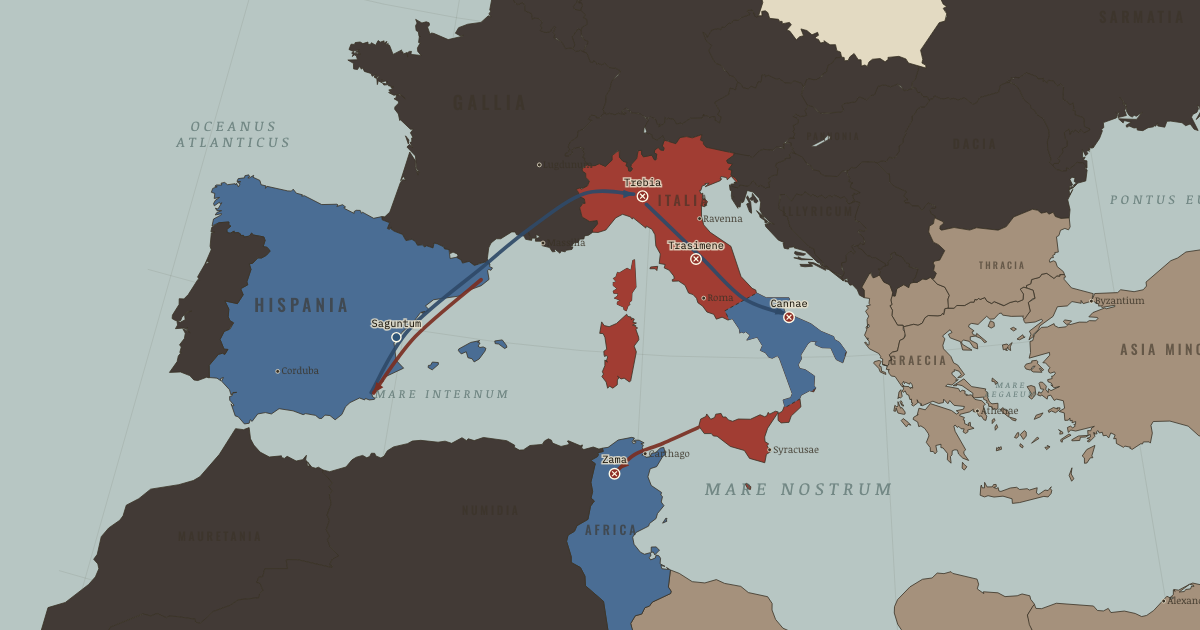
The map above is the world of 216 BC — Hannibal in Italy.
BRIEF EXPLANATION — THE ESSENTIAL ARGUMENT
The puzzle of this war is why the finest general of the age could win nearly every battle and still lose it, and the answer lies in what Hannibal was really attacking. He saw that Rome’s true strength was its network of Italian allies, the communities that kept supplying its soldiers. His plan was therefore to break that alliance from the inside rather than to capture the city itself. So he carried the war into Italy, crossing the Alps in 218 BC and destroying one Roman army after another at the Trebia, at Lake Trasimene and, most completely, at Cannae. Several southern peoples did defect to him. Yet the central Italian core held firm, and that is the fact that decided everything: shattering an army in the field did not make the alliance behind it dissolve.
Rome won by refusing the kind of war Hannibal was good at and forcing on him the kind he could not sustain. Rather than risk another great battle, it wore his invasion down inside Italy while striking at the sources of Carthaginian power abroad. It took the silver mines and recruiting grounds of Spain, and then it carried the fight to Africa, where Scipio’s landing compelled Hannibal to sail home and defend Carthage. At Zama in 202 BC that returning army was beaten, and Carthage gave up its fleet, its empire and its freedom of action. The war proved a lesson that echoes through the rest of this atlas: a state that can keep replacing its losses will finally defeat a commander who can only keep winning battles.
GUIDED EXPLANATION
The campaign Hannibal launched in 218 BC was one of the most daring in history, and its purpose explains its shape. Leaving Carthaginian Spain with a large army, he crossed the Rhône and then the Alps in autumn snow, losing most of his men on the way and reaching Italy with perhaps 26,000 survivors. It was enough, because he did not need numbers so much as victories that would persuade Italy to abandon Rome. At the Trebia he lured a Roman army across an icy river and destroyed it; at Lake Trasimene he trapped another in fog and killed it, consul and all; and at Cannae in 216 BC he let his centre give way on purpose, closed his cavalry around the Roman flanks, and annihilated the largest force Rome had ever fielded, with ancient estimates of the dead ranging from about 48,000 to 70,000. Much of southern Italy defected to him, and by the ordinary rules of ancient warfare the war was over.
Rome survived because its power lived in its political system rather than in any single army, and the system did not break. The Senate refused to negotiate, declined even to ransom its captured soldiers, and raised fresh legions by recruiting below the usual property qualification and by arming enslaved men with the promise of freedom. Most of the central Italian allies, bound to Rome by intermarriage, shared citizenship and the expectation of future gain, stayed loyal even after Cannae. This was the flaw in Hannibal’s whole design. He could destroy Roman armies, but he could not make the alliance that produced them come apart, and without that collapse his victories bought him time rather than triumph.
Rome then changed the kind of war it was fighting and won by widening it. Fabius avoided the pitched battles Hannibal wanted and let attrition work, while other Roman armies attacked the resources that fed the invasion. Scipio seized New Carthage in Spain in 209 BC, cutting off Carthaginian silver and reinforcements, and in 204 he carried the war into Africa and won the Numidian cavalry to his side, which forced Hannibal to abandon Italy and come home. At Zama in 202 BC Hannibal was defeated, and Carthage became a disarmed client state burdened with a vast indemnity. The victory left Rome dominant across the western Mediterranean, but it also carried costs that would matter later, because devastated farms, mass enslavement and the long extraordinary commands granted to generals like Scipio all strained the republican rules that were supposed to keep any one man in check.
DEEP EXPLANATION — EVIDENCE & INTERPRETATION
Hannibal’s Real Target
Hannibal did not have to capture Rome if he could dismantle the alliance that fed its armies, and this is the key to reading his whole campaign. His victories were arguments addressed to the Italian communities: Rome could not shield them, while Carthage would free their prisoners and respect their independence. The argument worked in places, since Capua and several southern peoples went over to him after Cannae, so the strategy was far from foolish. It failed where Roman integration ran deepest. The Latin colonies and central Italian allies were tied to Rome by intermarriage, legal privileges, shared campaigns and the expectation of future plunder, so their loyalty rested on interest as well as fear. Hannibal also lacked the siege equipment and the steady reinforcements he would have needed to reduce every loyal stronghold. His battlefield genius therefore ran into a political limit, and the lesson is not that battles fail to matter but that their effect depends on the institutions standing behind the beaten army.
Counting and Remembering Cannae
Ancient writers put the Roman dead at Cannae somewhere between roughly 48,000 and 70,000, with Livy and Polybius giving different figures, and modern historians cannot recover an exact number. What they agree on is that the destruction was extraordinary. The uncertainty is worth dwelling on, because ancient casualty totals often served a literary purpose, magnifying the victor, the disaster, or Rome’s endurance. The institutional response is far better recorded than the body count. Rome limited public mourning, refused to negotiate, and mobilised groups it had never armed before, and later writers turned that refusal itself into the source of eventual victory. Such a memory can hide the coercion involved, from the burden placed on allies to the enslaved men pressed into service and the families left to grieve in silence. Yet it points to the real mechanism, which is that Rome’s political system kept turning people and resources into armies long after the battlefield logic of its rivals said the war should already have ended.
New here? Chapters 1–2 of every atlas are free to sample, and the WW2 atlas is free in full. One membership opens all thirteen — the Cartographer’s Circle.
THE SITES
ON THIS DAY
WHY IT HAPPENED
A treaty written in resentment. The peace of 241 was harsh; the seizure of Sardinia in 238 — legally naked opportunism while Carthage fought its own mutinous mercenaries — made it insulting. Barcid Spain was built explicitly to fund and man a rematch. Polybius, who knew the players, called Roman bad faith over Sardinia the war’s true cause. Punitive peaces breed second wars: file the principle away.
Saguntum: the tripwire city. Rome took the small Spanish town of Saguntum under its protection — deep inside Carthage’s agreed sphere. When Hannibal stormed it in 219, Rome demanded his surrender; Carthage’s council backed him. Both sides had constructed a casus belli they could not climb down from — Messana all over again, and both knew it.
Hannibal’s theory of victory. He knew Rome’s strength was the socii, so his strategy was not to sack Rome — he never seriously tried — but to shatter the alliance by demonstration: destroy the legions in the field, parade Italian prisoners freed without ransom, and wait for Italy to defect. It was the right theory about the wrong alliance: the Latin core, bound by citizenship and intermarriage rather than fear, held.
Command by committee, annually. Rome’s yearly consular elections — its strength in depth — was its tactical weakness: aggressive amateurs like Varro at Cannae repeatedly gave Hannibal the pitched battles he wanted. Only when Rome suspended its own norms (repeated commands for Fabius and Marcellus, a private-citizen proconsul in Scipio) did the asymmetry close. Note the cost: bending the constitution to fight Hannibal set precedents ambition would remember.
THE TURN
Cannae, 2 August 216 BC. The hinge is not the battle but the response. Any Hellenistic state that lost 60,000 men — an eighth of its adult male citizens and allies within reach — would negotiate; that was what battle was for. Rome instead lowered the property qualification, armed slaves and criminals, forbade public mourning past thirty days, and refused even to ransom its own prisoners. Hannibal’s officer Maharbal allegedly told him: “You know how to win a victory; you do not know how to use one.” The judgment is unfair to Hannibal and exactly right about Rome — Cannae proved the Republic could not be beaten by any means its enemies understood.
WHAT IT CHANGED
The Mediterranean’s center of gravity moves west. Carthage’s fall to client status leaves Rome as the only major naval power west of Greece. Watch the tan of the African hinterland turn grey too: Numidia under Masinissa becomes Rome’s ally and Carthage’s tormentor. Spain’s silver mines now flow into Roman hands and provide the war chest for everything that follows.
A generation trained by catastrophe. The men who fought Hannibal for seventeen years came home with professional-grade experience and a conviction of Roman invincibility earned the hard way. Within three years of Zama they were aimed at Macedon. The Hellenistic east, which had watched the western duel as spectators, was about to meet the winner.
Italy’s countryside begins to change. Seventeen years of armies living off Italy ruined smallholders; war captives flooded in as slaves; the wealthy bought up devastated land into estates. The social crisis that kills the Republic in Chapter 4 is usually traced to this decade — argued by historians from Appian to today, and visible on no map until it explodes.
The third war: a memorial, not a chapter. Fifty years later, with Carthage revived commercially but militarily harmless, Cato ended every Senate speech with “Carthage must be destroyed.” In 149 Rome manufactured a pretext; in 146 the city fell after a three-year siege — its people killed or enslaved, its site cursed. Find the ◆ marker on the map and read it: this was not strategy but the extermination of a fear.
FIELD QUESTION — Rome lost perhaps one adult male citizen in eight at Cannae — in one afternoon — and kept fighting. Why could it, when any contemporary state would have sued for peace?
Assemble the machine from the previous chapter. Demography: the socii network gave Rome a recruiting pool near three-quarters of a million, so even 100,000 dead in three years was survivable arithmetic, however unbearable humanly. Politics: annual magistracies meant no irreplaceable commander, and a senatorial culture where negotiation after defeat was social death. Alliance design: Hannibal’s whole strategy required Italian defection, but Rome’s core allies were bound by citizenship, marriage and shared plunder, not fear — the south defected, the center never did. Compare Carthage, whose mercenary armies were exactly as loyal as its treasury was full. The transferable lesson: wars of attrition are won by whichever side’s political system can metabolize loss — a lesson that will reappear when you reach the Goths, and again whenever you read a modern war.
AN INTERESTING FACT
Zama did not finish Hannibal — peace did something stranger with him. Elected suffete (chief magistrate) of Carthage in 196 BC, he audited the books and broke the embezzling oligarchs so effectively that within five years Carthage offered to pay off its fifty-year indemnity in one lump sum; Rome refused — the leash mattered more than the money — then hounded him from court to court across the east until he took poison in Bithynia rather than be extradited, around 183 BC. By Livy’s reckoning, Scipio Africanus died the same year, in bitter self-imposed exile from an ungrateful Rome. The ancient historians noticed the symmetry; so should you.
THE DISPATCH
One short letter when a new atlas opens — and the printable study guide for Rome is yours now, free.
NO TRACKING · YOUR ADDRESS IS USED FOR THE DISPATCH AND NOTHING ELSE · UNSUBSCRIBE ANYTIME