MAPS OF HISTORY · The Russian Revolution · ALL CHAPTERS · CHAPTER 2
CHAPTER 2 · 1914–MARCH 1917 · FEB 1917
The War Breaks the State
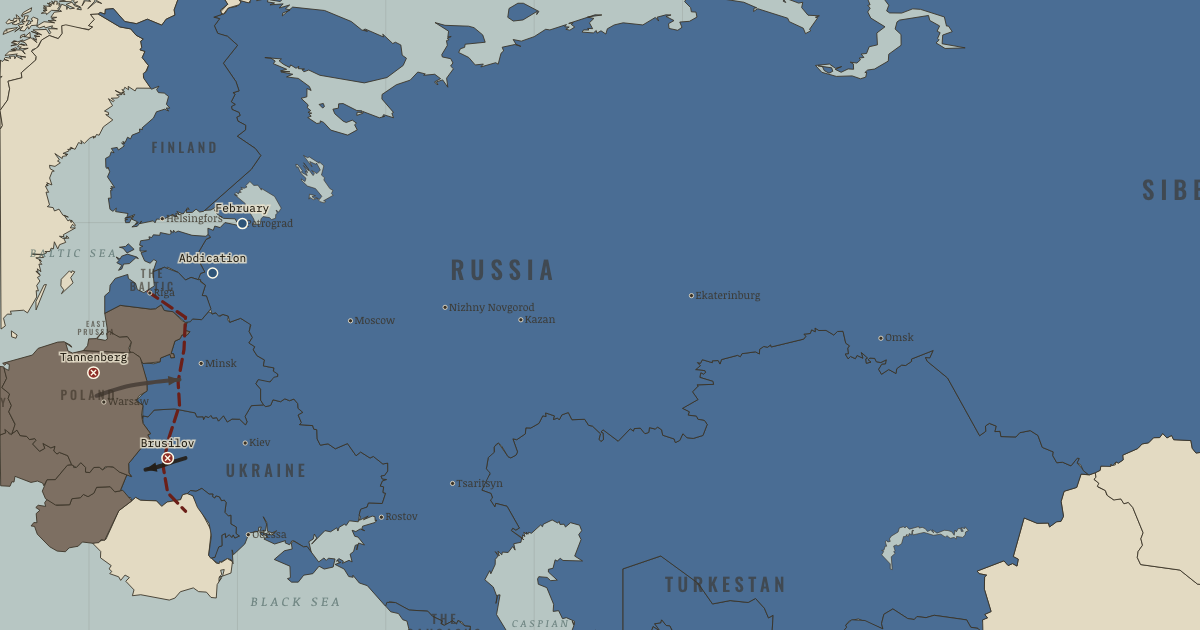
The map above is the world of MAR 1917 — The Tsar abdicates.
BRIEF EXPLANATION — THE ESSENTIAL ARGUMENT
The February Revolution is best understood as a state losing the loyalty of the men with the guns, and the cause was a war the empire could not sustain. When Russia entered the First World War in 1914 it mobilized more men than it could arm, and defeats followed almost at once: an entire army was encircled at Tannenberg, and the Great Retreat of 1915 surrendered Poland and Lithuania. The railways could move soldiers or food but not enough of both, so grain could sit in the countryside while the capital queued for bread, and the printing of money to pay for the war drove prices sharply upward.
Nicholas II deepened the crisis in 1915 by taking personal command at the front, which tied the throne directly to every defeat and left the government in the hands of a discredited court. In February 1917 bread queues in Petrograd swelled into strikes, and the garrison, reservists who dreaded being sent to die, was ordered to fire on the crowds and refused. Once the soldiers changed sides the autocracy had no instrument of force left, and when his own generals told him at Pskov that the army would not fight for him, Nicholas abdicated. Three centuries of Romanov rule ended less through a rising than through the withdrawal of everyone who was supposed to defend it.
GUIDED EXPLANATION
A state does not collapse simply because it loses battles; it collapses when it can no longer replace what it loses, feed its cities, and keep its soldiers believing that the sacrifice has a purpose. Imperial Russia failed on all three counts. It put millions of men into the field but often could not supply them with rifles or shells, so that courage turned into casualty lists of more than 1.8 million dead. Tannenberg destroyed one army in 1914, the Great Retreat lost Poland and Lithuania in 1915, and Brusilov’s costly 1916 offensive hurt Austria-Hungary while consuming the reserves Russia could not spare.
Behind the front the failure was one of coordination rather than sheer scarcity. The rail network could carry troops to the fighting or grain to the cities, but not both at the necessary scale, and inflation destroyed the peasants’ incentive to sell, so grain existed in the empire while Petrograd went hungry. Nicholas made the position worse by leaving for headquarters in 1915 to command in person, which fused the crown to a losing war and handed the capital to a government associated with the court favorite Rasputin, a peasant faith-healer whose sway over the palace became a lightning-rod for contempt. His murder late in 1916 repaired none of this, because he was a symptom rather than the disease.
The end came in a few February days that no party had planned. Bread protests widened into strikes, the strikes filled the streets, and the decisive moment arrived when the Petrograd garrison, made up largely of reservists close to the workers and afraid of the front, refused the order to shoot and instead armed the crowd. That refusal is the deep mechanism of February, because the revolution did not defeat the autocracy’s army, the army declined to defend the autocracy. Halted in his train at Pskov and advised by every front commander to go, Nicholas abdicated on 2 March. Power then passed to a Provisional Government of liberal notables that held the ministries, while the Petrograd Soviet, a council of workers’ and soldiers’ deputies, held the actual loyalty of the streets, a division of authority that would define the year to come.
DEEP EXPLANATION — EVIDENCE & INTERPRETATION
War as a test of state capacity
Russia did not fall simply because it suffered defeats, because states routinely survive terrible losses when they can replace equipment, distribute food, sustain their credit, and preserve the belief that sacrifice serves a purpose. Imperial Russia struggled to coordinate those functions at once. Rail bottlenecks tied the front to the home cities in a single knot: moving troops crowded out food, urban shortages provoked strikes, and inflation removed the peasants’ reason to sell grain for money that was losing its value. Historians still debate whether the wartime economy was near absolute exhaustion or was suffering a crisis of distribution and confidence, and the distinction matters, because grain existed in the country even as the queues in the capital lengthened. What converted logistical failure into the failure of a regime was political, because by taking command himself Nicholas removed the distance between military setbacks and the crown, and the autocracy had no parliament or trusted ministry that could absorb the blame and reorganize policy. War became an audit of institutions, and the autocracy failed it.
Why the garrison’s choice was decisive
Crowds had challenged the Russian state before, most obviously in 1905, without bringing it down, and February became a revolution at the moment when soldiers refused to disperse the crowds and then handed them their weapons. The composition of the Petrograd garrison mattered, because many were reservists awaiting deployment, socially close to the workers and frightened of the front, so their sympathies lay outside the barracks. Their mutiny did not mean that every unit in the army supported revolution, but it destroyed the government’s reliable force in the capital, and the senior generals then treated Nicholas as an obstacle to continuing the war and advised him to abdicate. This sequence supports what historians call the leaderless revolution, since no party directed the first uprising and the Bolshevik leaders were in exile or Siberia. Yet the spontaneity unfolded inside a society already shaped by earlier strikes, socialist organization, and the soviet of 1905. A collapse needs both the defection of the state’s armed core and institutions capable of giving the crowd political form, and in February the first arrived before anyone had agreed on the second.
New here? Chapters 1–2 of every atlas are free to sample, and the WW2 atlas is free in full. One membership opens all thirteen — the Cartographer’s Circle.
THE SITES
WHY IT HAPPENED
A war the state could not supply. Russia had the men and the courage and neither the industry nor the transport to sustain a modern war. Shell famine, rifle shortages, and a rail network that could carry troops or food but not both turned bravery into casualty lists. Over 1.8 million military dead. And casualty lists into a garrison that would not march.
The Tsar takes command. By personally assuming supreme command in 1915, Nicholas fused the fate of the monarchy with the fate of a losing war and removed himself from a capital sliding into chaos. Every retreat was now his. The government left behind, discredited by the Rasputin scandal, commanded neither respect nor obedience.
Cities starved while grain rotted. This was not a famine of absolute shortage but of breakdown: inflation destroyed the peasants’ reason to sell, and the railways could not move what there was. When the bread failed in Petrograd in February, the regime discovered that a hungry capital full of armed, mutinous reservists is a detonator, not a grievance.
A monarchy that had run out of defenders. By 1917 Nicholas had alienated everyone: liberals wanted a real parliament, generals wanted competent government, workers wanted bread, peasants wanted land and peace. When the test came, not one significant group. Not even his own high command. Was willing to fight to keep him. Revolutions succeed when the regime’s own servants stop defending it.
THE TURN
Abdication at Pskov, 2/15 March 1917. The generals’ telegrams, not the Petrograd crowd, ended the dynasty: asked whether the army would restore order in the capital, every front commander advised the Tsar to go. This is the deep mechanism of February. The revolution did not defeat the autocracy’s army. The autocracy’s army declined to defend it. A regime is only as strong as the willingness of its men to kill for it, and in March 1917 that willingness was gone.
WHAT IT CHANGED
Dual power is born the same week. Two bodies emerged from the ruins: a Provisional Government of liberal notables claiming legal authority, and the Petrograd Soviet of workers’ and soldiers’ deputies commanding the actual loyalty of the streets and the garrison. Neither could govern without the other, and they wanted opposite things. That contradiction is the whole plot of 1917.
Order No. 1 dissolves the old army. The Soviet’s first decree told soldiers to obey their officers only when the Soviet agreed, and to elect committees. It was meant to protect the revolution from a counter-coup. It also meant the army as a disciplined instrument was finished. From here the millions of armed peasants in uniform would vote with their feet. Toward home and land.
A dynasty gone, with no plan for what replaces it. Nobody had prepared to govern. The men who inherited power were as surprised as the crowd, committed to a war the crowd would not fight, and legitimated by nothing but the emergency. The vacuum they could not fill is what Lenin would step into.
FIELD QUESTION — Was February 1917 a revolution the people made, or a collapse the regime brought on itself — the “leaderless revolution” thesis?
Both, and the tension is the point. No party organized the February rising. The Bolshevik leaders were in exile or Siberia and as astonished as anyone. In that sense it was a spontaneous, leaderless collapse. The state simply lost the loyalty of its soldiers, and fell. But “leaderless” can be overstated: years of underground organizing, the 1905 template, war-weariness deliberately fanned, and a working class schooled in strikes all shaped how the collapse turned into a transfer of power. The transferable lesson: mass anger topples nothing by itself. It topples a regime when the regime’s own coercive core defects. And whoever is organized enough to fill the resulting vacuum, however small, inherits the state. In February no one was ready. By October someone was.
AN INTERESTING FACT
Russia arguably had one more tsar after Nicholas — for about a day. He first abdicated in favor of his son, then, once his physician confirmed that the hemophiliac Alexei could not live apart from his parents, rewrote the manifesto that same evening for his brother, Grand Duke Michael. Sounded out in a Petrograd apartment the next morning and told his safety could not be guaranteed, Michael declined the crown unless a constituent assembly offered it — so the dynasty ended in two abdications, the second by a “Michael II” whom no one had crowned and whom jurists doubted was ever legally tsar at all.
THE DISPATCH
One short letter when a new atlas opens — and the printable study guide for The Russian Revolution is yours now, free.
NO TRACKING · YOUR ADDRESS IS USED FOR THE DISPATCH AND NOTHING ELSE · UNSUBSCRIBE ANYTIME