MAPS OF HISTORY · The Russian Revolution · ALL CHAPTERS · CHAPTER 5
CHAPTER 5 · DECEMBER 1917–MARCH 1918 · MAR 1918
Brest-Litovsk
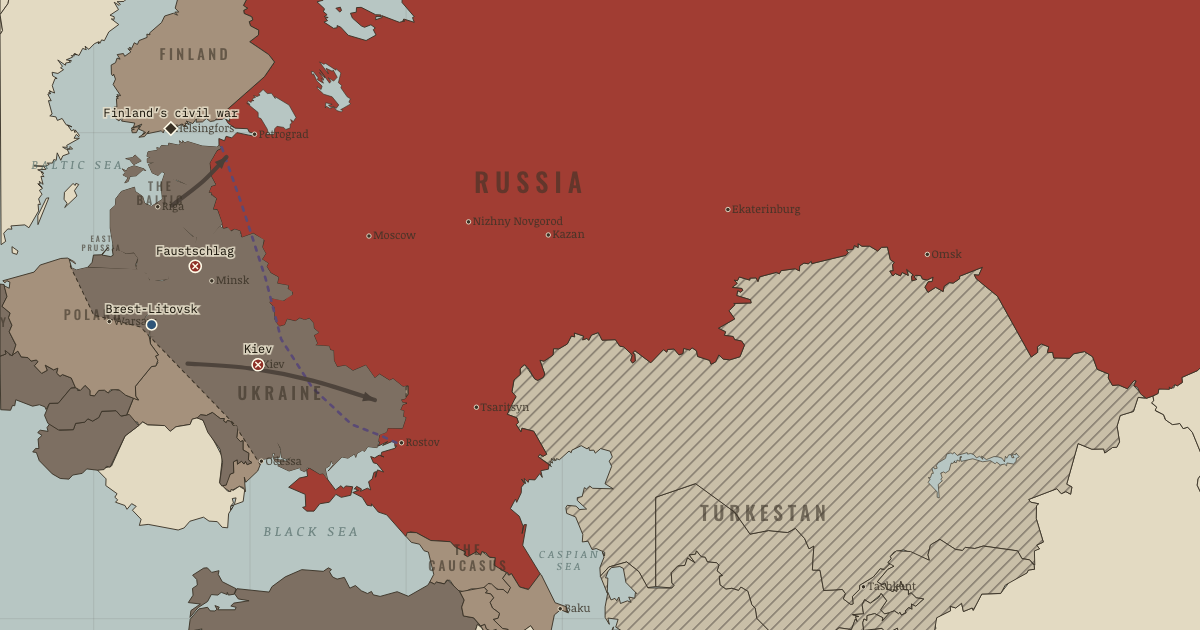
The map above is the world of MAR 1918 — Brest-Litovsk.
BRIEF EXPLANATION — THE ESSENTIAL ARGUMENT
Having won power partly by promising peace, the Bolsheviks discovered that they had almost no army with which to obtain it, and the gap between the promise and the means shaped everything that followed. At the peace talks at Brest-Litovsk, Trotsky tried a formula of neither war nor peace, declaring Russia out of the fighting while refusing to sign a punishing treaty, in the hope that German workers would rise before German armies moved. The armies moved instead, and Operation Faustschlag was among the easiest advances of the whole war, as German troops walked into Ukraine, the Baltic lands and Belorussia against an army that had ceased to exist.
Lenin then forced his party to accept the treaty of 3 March 1918, which surrendered roughly a third of the empire’s population and much of its industry, coal, iron and grain. He treated territory as expendable so long as the Soviet government survived, a priority that split the revolutionary coalition when the Left Socialist-Revolutionaries quit in protest. The treaty was annulled within months when Germany itself collapsed, so his gamble on a breathing space paid off narrowly. Yet the loss of Ukraine’s grain pushed the regime toward seizing food by force at home, and the settlement handed the Allies a pretext to intervene, costs that outlived the document itself.
GUIDED EXPLANATION
The Bolshevik position at Brest-Litovsk rested on a single hard fact, that the old imperial army had voted for peace with its feet while the new Red Army did not yet exist, so Russia could not fight and therefore could not bargain. Trotsky’s formula of neither war nor peace was an attempt to escape that trap by refusing both a treaty and a war, gambling that revolution inside Germany would make the question moot. The gamble failed. German units advanced almost without resistance in Operation Faustschlag, which proved that a government without an army cannot turn a moral gesture into leverage, and Lenin, appalled, insisted the party sign before the terms grew worse.
The treaty of 3 March 1918 stripped away Finland, Poland, the Baltic lands, Belorussia, Ukraine and the Caucasus, removing about a third of the former empire’s population along with much of its industry, coal, iron and best grain; the exact shares vary with which territories and dates are counted, but the scale is not in doubt. German occupation reached almost to the Don, and Ukraine was turned into a grain-colony under a puppet ruler, so that Kiev, which would change hands more than a dozen times, was only beginning its ordeal. In the north-west, newly independent Finland tore itself apart in a civil war between Reds and Whites, an early sign of how the empire’s collapse would set each borderland at its own throat.
The treaty’s costs at home ran deeper than the lost provinces. Lenin’s willingness to trade half the map to preserve the party divided his own coalition, because the Left Communists and the Left Socialist-Revolutionaries wanted a revolutionary war to the death, and when he insisted on the peace he called obscene, the Left SRs left the government and, in July, tried to reignite the war by assassinating the German ambassador. The loss of Ukraine’s grainlands mattered most of all, because it arrived just as the cities began to starve and the regime turned to seizing peasants’ grain by force. Peasants had been promised land, and now the state came for their harvest, so the machinery of coercion that would define the civil war grew directly out of that reversal.
DEEP EXPLANATION — EVIDENCE & INTERPRETATION
The “breathing space” calculation
Lenin’s argument began with capacity rather than honor. Russia could not defend the front, so refusing a treaty would not preserve territory; it would simply invite a German occupation on terms imposed by movement rather than negotiation. He expected that conflict among Germany’s enemies, or revolution within Germany itself, would eventually cancel the settlement, and that prediction proved correct sooner than he hoped when the armistice of November 1918 nullified Brest-Litovsk. The cost during the intervening months was nonetheless real, because millions lived under new occupying authorities, Ukraine was stripped for grain, and violence deepened across the borderlands. Judging the treaty either as simple betrayal or as brilliant realism misses the trade-off it embodied. Lenin saved a government by transferring immediate costs onto populations and territories it could not protect, and the episode reveals his hierarchy of aims with unusual clarity, since the preservation of party power came before imperial borders, before obligations to allies, and before the consent of the regions being handed away.
How territorial loss changed food policy
Brest-Litovsk did not by itself create the system later called War Communism, but it sharpened the food crisis by cutting the Soviet cities off from the empire’s main grain-producing regions, above all Ukraine. Urban authorities already faced inflation, transport breakdown, and a collapse in the exchange of goods between town and country that left peasants with little reason to sell. With far less grain reaching the cities through markets, the regime increasingly turned to armed detachments and fixed-price requisition, and the mechanism became a destructive loop: seizures reduced the incentive to grow a surplus, the shrinking marketed supply invited still more coercion, and the coercion generated peasant resistance. Historians debate whether War Communism was mainly an emergency improvisation or a deliberate push toward socialist distribution, and both motives can be found in the policy. Brest matters because it narrowed the practical options at the precise moment that ideology made centralized seizure attractive, so a concession at the map’s western edge transformed the relationship between the state and the villages at its core.
New here? Chapters 1–2 of every atlas are free to sample, and the WW2 atlas is free in full. One membership opens all thirteen — the Cartographer’s Circle.
THE SITES
WHY IT HAPPENED
An army that no longer existed. Lenin’s brutal realism rested on a fact: the old army had voted for peace with its feet, and the new one did not yet exist. Russia could not fight, so it could not bargain. “A peace to gain time” was not a preference but the only option that did not end in German troops in Petrograd. Recognizing when you have no cards is a rarer skill than playing good ones.
Trotsky’s gamble on world revolution. “Neither war nor peace” only made sense if the German proletariat was about to rise. It was the first, costly lesson that the Bolsheviks’ deepest assumption. That their revolution would be rescued by revolutions abroad. Could not be relied on. The German workers did not come. The German army did.
German war aims in the east. Berlin did not want a fair peace. It wanted a breadbasket and a buffer. The terms were designed to detach Ukraine and the borderlands as German dependencies and free troops for the last great offensive in the west. Brest-Litovsk shows what a victorious Germany intended for eastern Europe. A preview worth remembering when you reach 1941.
The regime’s need to survive at any price. For Lenin the revolution came before the empire: better to lose half the map and keep the Bolshevik state than to lose the state defending the map. This ruthless prioritizing. The party first, always. Is the thread that runs from Brest to the Constituent Assembly to the Terror.
THE TURN
The signing at Brest-Litovsk, 3 March 1918. The revolution chose survival over territory, party over empire. And in doing so lit the civil war. Ceding Ukraine’s grain forced requisitioning at home. The “obscene peace” gave the Allies their pretext to intervene and the Left SRs their cause to revolt. And the amputated borderlands became a ring of hostile or occupied states. Lenin called it a breathing space, and he was right. The treaty was annulled eight months later when Germany itself collapsed. But the breathing space was bought with the conditions for three years of war.
WHAT IT CHANGED
A third of the country goes foreign. The map tells it: the entire west. Baltics, Belorussia, Ukraine. Falls under the grey of German occupation, and Finland, the Baltics and Poland begin their separate national lives. When Germany collapses in November, this band does not simply return. It becomes the contested borderland of the next three years.
The one-party state hardens. The Left SRs’ departure over Brest ended the only coalition the Bolsheviks ever had. Their July 1918 revolt gave the pretext to suppress them for good. From mid-1918 Russia is, in fact, a single-party dictatorship. A direct consequence of the split this treaty caused.
Grain by force — the road to War Communism. Having ceded the Ukrainian breadbasket and facing famine in the cities, the regime turned to armed requisitioning of the peasants’ grain. The beating heart of “War Communism,” and the grievance that would fuel the peasant risings of 1920–21. The treaty that fed Germany starved the Soviet cities into coercion.
The intervention gets its excuse. A Russia out of the war, its stores of Allied munitions now potentially German, gave Britain, France, America and Japan their first reasons to land troops. Nominally to guard supplies and reopen an eastern front, soon to prop up the Whites.
FIELD QUESTION — Was Brest-Litovsk a betrayal of Russia and the Allies, or the realistic move that saved the revolution?
Judge it by outcomes and alternatives. The betrayal case is real: Russia abandoned its allies mid-war, handed Germany a breadbasket that prolonged the fighting in the west, and surrendered millions of people to occupation. The realist case is stronger: with no army, the only alternatives were a worse dictated peace or German occupation of the heartland, and the treaty was in fact torn up within months when Germany lost. So Lenin gave away, temporarily, land he could not have held anyway, and kept the one thing that mattered to him, the Soviet state. The deepest point is what the choice reveals: for the Bolsheviks the revolution was not Russia, and its survival justified any territorial or moral price. That calculus. Party over nation, ends over means. Is the through-line of everything that follows, for good and for horror.
AN INTERESTING FACT
To prove the new diplomacy belonged to the people, the first Soviet delegation to Brest-Litovsk included a worker, a soldier, a sailor — and a peasant, Roman Stashkov, recruited off the street on the way to the station when someone noticed the tableau was incomplete. Seated at dinner among German and Austrian aristocrats, the old man was asked whether he preferred red or white wine and answered, according to the diplomats’ memoirs, “whichever is stronger.” The anecdote is a miniature of the whole conference: a revolution improvising a state at a table across from generals who could not decide whether to laugh.
THE DISPATCH
One short letter when a new atlas opens — and the printable study guide for The Russian Revolution is yours now, free.
NO TRACKING · YOUR ADDRESS IS USED FOR THE DISPATCH AND NOTHING ELSE · UNSUBSCRIBE ANYTIME