MAPS OF HISTORY · The Russian Revolution · ALL CHAPTERS · CHAPTER 7
CHAPTER 7 · 1918–1920 · FEB 1919
Why the Reds Won
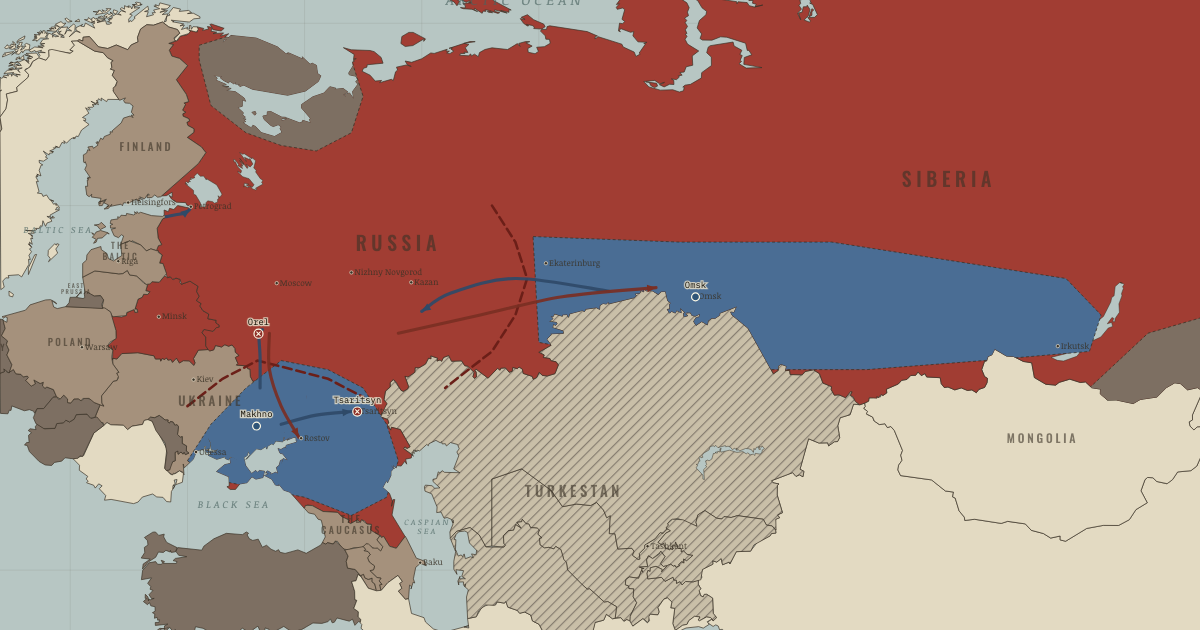
The map above is the world of JUN 1919 — Kolchak checked, Denikin rising.
BRIEF EXPLANATION — THE ESSENTIAL ARGUMENT
On paper the Reds should have lost, and explaining why they did not is the central puzzle of the civil war. They were blockaded, cut off from the grain, coal and oil of the borderlands, and faced by professional officers backed by foreign powers, and at the crisis of October 1919 their territory had shrunk to little more than the old Muscovite core. Yet that core held Moscow, Petrograd, the arms factories, the densest hub of railways and two-thirds of the population, which let the Reds fight on interior lines and shift reserves from one threatened front to another in days, while the White armies were scattered thousands of kilometers apart around the rim and never once attacked together.
Politics decided the war as much as geography. Most Russians were peasants who hated the Reds’ grain requisitions, but they feared the Whites more, because behind every White general stood the landlord returning to reclaim the fields the peasants had seized in 1917. The Reds also fought under one government, one party and one army, while the Whites were a coalition of monarchists, liberals, Cossacks and nationalists who agreed on little beyond opposition to Bolshevism. Given the choice between the party that took their grain and the party that would undo the revolution on the land, the villages let the Reds win, and that, more than any battle, is the reason they did.
GUIDED EXPLANATION
The Red position looked desperate but rested on a decisive advantage of geography. The compact central region the Reds held was small on the map yet contained the capital, the main arms factories, the government offices and the densest railway network, along with most of the population. Because they held the center, the Reds fought on interior lines, meaning the shorter routes inside an encircling ring, and could move a division from the Siberian front to the southern front within a week. Kolchak in Siberia, Denikin in the south and Yudenich before Petrograd stood thousands of kilometers apart and never coordinated their offensives, so the Reds were able to mass against one enemy at a time and defeat them in turn.
Unity of command reinforced that advantage where White disunity squandered it. The Bolsheviks had one party and one army under Trotsky with a single ruthless purpose, and they fought with their enemies’ own weapons, using some fifty thousand former tsarist officers under commissar guard to run the Red Army, so that the workers’ state was saved by the Tsar’s professionals. War Communism, the seizure of grain at gunpoint, the militarizing of labor and the nationalizing of everything, was economically ruinous, cutting production to a fraction of its pre-war level, but it threw a poor country’s entire surplus at the front. The Whites, by contrast, were a coalition that agreed on nothing except opposition to the Reds and were led by generals who despised politics and one another.
The deepest reason lay in the arithmetic of the countryside. Four in five Russians were peasants who resented the requisitions, yet they understood that a White victory meant the landlord returning to take back the land they had won in 1917, and fear of that outcome outweighed their hatred of the commissar. The picture was complicated by the Greens, peasant armies such as Makhno’s anarchists in Ukraine, who fought Reds and Whites alike for a revolution of the villages. But when the final choice came, the countryside would not restore the landlords, and the Whites could never escape this trap, because their commitment to a single indivisible Russia and their base among the old propertied classes alienated the two largest groups in the country, the peasants over land and the nationalities over independence. Military skill could not rescue a cause the population had decided against.
DEEP EXPLANATION — EVIDENCE & INTERPRETATION
Why interior lines helped but did not decide alone
Holding the center shortened the Reds’ routes between fronts and gave them access to the densest railway junctions, which allowed them to concentrate first against Kolchak and then against Denikin and Yudenich, while the White forces on the circumference could not easily reinforce one another. Geography created an opportunity rather than an automatic victory. Railways still required fuel, repair, scheduling, rolling stock, and political control over the workers and stations that ran them, and the Reds also had to choose their priorities and accept risk on the fronts they temporarily starved. Trotsky’s centralized command could make those choices, whereas the competing White governments lacked a common political authority to make them at all. To say that geometry was destiny is therefore too strong if taken literally: geometry lowered the cost of Red coordination, organization converted that lower cost into actual movement, and politics supplied enough conscripts and compliance to keep the trains running and the armies in the field.
The peasant’s negative choice
Most peasants did not endorse Bolshevik requisitioning, and the scale of the rural uprisings proves the depth of their hostility, yet civil wars often turn on comparative fear rather than on positive loyalty. The land seizures of 1917 had already transferred the great estates in practice, and the social ties of White officers, their vague promises, and scattered incidents of landlord restoration made villagers suspect that a White victory would reverse that gain. The Reds, whatever else they took, formally accepted the destruction of landed estates. This bargain was not stable, and once the main White threat disappeared the peasants rebelled against Soviet demands, which is exactly what one expects of conditional tolerance rather than allegiance. White politics narrowed its options further by insisting on a Russia one and indivisible, which foreclosed alliances with the non-Russian national movements. Military professionalism could not compensate for a program that frightened the rural majority and alienated potential borderland partners, so the Reds won in large part because their opponents offered too little that the decisive populations wanted to keep.
New here? Chapters 1–2 of every atlas are free to sample, and the WW2 atlas is free in full. One membership opens all thirteen — the Cartographer’s Circle.
THE SITES
WHY IT HAPPENED
Interior lines and the railway hub. Holding the center meant the Reds could move a division from the Siberian front to the southern front in a week. The Whites, on the circumference, could not move troops between fronts at all. In a war fought on railways across a continent, geometry was destiny. The compact red core on the map is not a weakness. It is the reason for victory.
One command against three. The Reds had unity of purpose, party and army. The Whites had a quarrel of generals. Kolchak, Denikin and Yudenich never mounted a coordinated offensive, so the Reds never had to fight more than one seriously at a time. A divided enemy attacking in sequence can be beaten by a smaller force attacking in turn.
The peasant fears the landlord more than the commissar. The Whites could never escape their social base. Committed to “Russia one and indivisible” and shadowed by returning landlords, they alienated both the peasants (over land) and the nationalities (over independence). The two largest constituencies in the country. The Reds’ requisitions were hated. The Whites’ program was feared. Hatred loses to fear.
War Communism and mass mobilization. By nationalizing the economy and requisitioning ruthlessly, the Reds concentrated a poor country’s whole surplus on the war, and conscripted an army of five million. It wrecked the economy. Production fell to a fifth of 1913. But it won the war. The bill came due in 1921.
THE TURN
Orel, October 1919 — the high-water that broke. Denikin’s advance on Moscow reached Orel, 400 km from the Kremlin. The closest the Whites ever came. And there it broke, for the reasons this chapter argues: the drive was a thin spearhead with no reserves, its rear was on fire with peasant and Makhnovist revolt, and the Reds. Fighting on interior lines. Massed everything they had for the counterstroke. The furthest White advance and the start of the Red flood outward happen at the same place and the same moment. After Orel, the map only reddens.
WHAT IT CHANGED
The Whites doomed by their politics, not their soldiers. White armies fought superbly and still lost, because they could not answer the two questions that decided the war. Who gets the land, and what happens to the nations of the empire. A movement that offers the majority nothing they want cannot win a civil war, however good its cavalry.
A victorious but deformed state. The Reds won with the tools of War Communism, one-party rule, terror and a hostage officer corps. And those tools did not vanish with victory. The party that emerged in 1920 was more militarized, more centralized and more ruthless than the party that had seized power in 1917. You do not win a civil war by these means and stay unchanged.
The countryside pays and then revolts. The peasants let the Reds win, and were rewarded with more requisitioning. Once the White threat was gone, the arithmetic reversed. And in 1920–21 the villages that had tolerated the Reds rose against them. Victory over the Whites removed the only reason peasants had to endure War Communism.
FIELD QUESTION — Blockaded, outnumbered in territory and faced by professional armies with foreign backing, the Reds won. Which mattered most — geography, organization, or politics?
All three braided together, but politics is the deepest. Geography (interior lines, the railway hub, the industrial and demographic core) gave the Reds a decisive operational advantage. They could always concentrate against one enemy at a time. Organization (one party, one army, unity of command, War Communism’s total mobilization) let them exploit that geography where the fractious Whites could not. But both served a political fact: the Reds had made a revolution the majority would not see reversed. The Whites lost because they could not offer the peasants land or the nationalities freedom without ceasing to be what they were. Defenders of “one and indivisible” Russia and, in the villages’ eyes, of the landlord. The transferable lesson of every civil war: military skill cannot rescue a cause the population has decided against, and the side that answers “who gets the land?” in the majority’s favor starts with the war half-won.
AN INTERESTING FACT
Nestor Makhno’s afterlife is one of the war’s stranger codas. The peasant anarchist who had commanded tens of thousands across the steppe escaped over the Dniester into Romania in 1921, passed through internment camps and a Polish prison, and washed up in Paris — where the terror of Ukraine’s landlords worked shifts at the Renault plant and died of tuberculosis in 1934. His ashes were placed in Père Lachaise, the same cemetery where the Paris Communards had been shot in 1871.
THE DISPATCH
One short letter when a new atlas opens — and the printable study guide for The Russian Revolution is yours now, free.
NO TRACKING · YOUR ADDRESS IS USED FOR THE DISPATCH AND NOTHING ELSE · UNSUBSCRIBE ANYTIME