MAPS OF HISTORY · WW2 · ALL CHAPTERS · CHAPTER 10
CHAPTER 10 · JUL–DEC 1943 · JUL 1943
Kursk, and the Fall of Fascist Italy
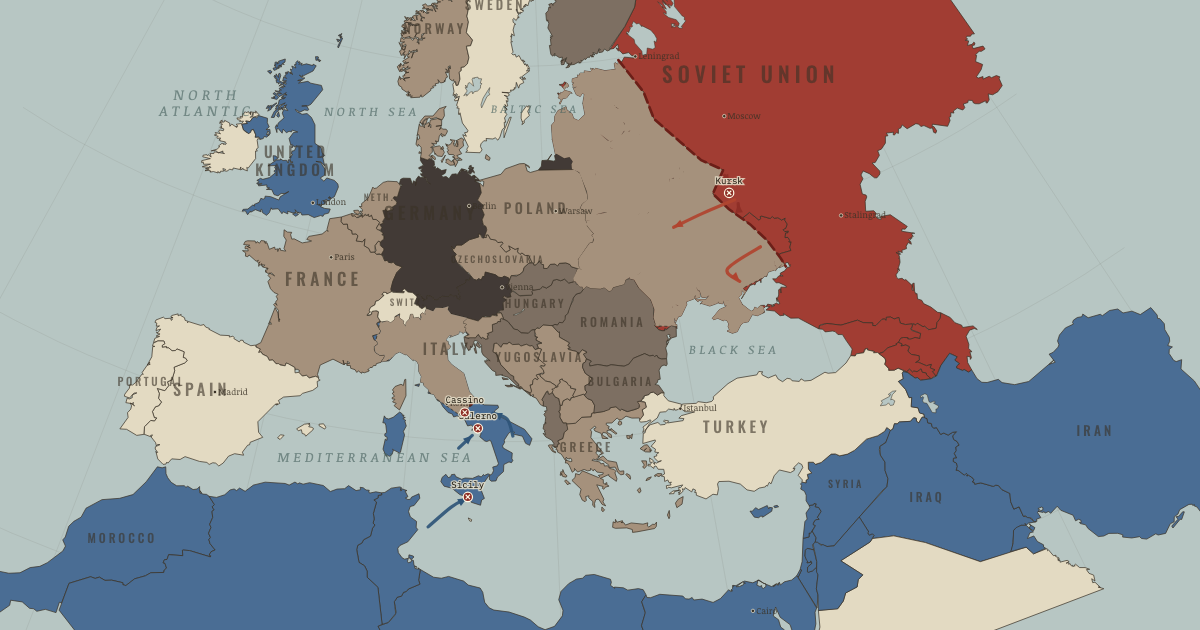
The map above is the world of OCT 1943 — Italy changes sides.
BRIEF EXPLANATION — THE ESSENTIAL ARGUMENT
After Stalingrad, Germany needed a victory to prove it still held the initiative in the east, and its attempt to win one at Kursk instead confirmed that the initiative had passed for good. In July 1943 the German army attacked the Kursk salient, a large bulge in the front, hoping to pinch it off in a single decisive stroke. The plan was undone before it began, because Soviet intelligence had identified the target and four months of warning were spent building defensive belts of extraordinary depth. The German attacks ground to a halt in the minefields and gun lines, and Soviet counteroffensives then rolled westward.
While the eastern front turned, the Western Allies opened a new one in the Mediterranean. Their landing in Sicily in July 1943 exposed the weakness of Mussolini’s regime, which his own Fascist colleagues then removed from power, and Italy signed an armistice in September. Germany had foreseen this and moved quickly to occupy the north, disarm the Italian army, and reinstall Mussolini as the puppet ruler of a rump state. Italy therefore became two things at once, a slow and painful campaign of liberation from the south and a civil war fought among Italians themselves.
GUIDED EXPLANATION
The front around Kursk bulged deep into German-held territory, forming a salient that Germany planned to pinch off from both sides in Operation Citadel, restoring confidence after the disaster at Stalingrad. The trouble was that the target was obvious, the German delays waiting for new tanks were visible, and Soviet intelligence supplied detailed warning of the plan. The Soviets used the time to build layered minefields, anti-tank positions, and deep reserves, so that their defence could absorb the German armoured punch before their own counteroffensives began. By autumn the Red Army had reached the River Dnieper, and Germany would never again launch a strategic offensive in the east.
In July the Western Allies landed in Sicily, and the invasion laid bare the weakness of Mussolini’s regime. The Fascist Grand Council voted him out, the king ordered his arrest, and Italy signed an armistice in September. Germany had prepared for exactly this and rapidly occupied northern and central Italy, rescuing Mussolini and installing him over the puppet Salò Republic. The map therefore does not show a simple change of sides, because Allied forces and co-belligerent Italian troops advanced from the south while German forces, Italian fascists, and Italian partisans fought one another the length of the peninsula.
Kursk mattered because the two sides needed different things from it, and only one of them could have its way. Germany required a swift, decisive encirclement, while the Soviet Union needed only to absorb the blow and keep its reserves intact, and deep minefields and gun lines duly converted German speed into slow attrition. Soviet losses, especially in the tank fighting near Prokhorovka, were far heavier than older heroic accounts admitted, yet the Soviet Union could replace them where Germany could not. The Sicily landing added a second theatre for Hitler to worry about, though Citadel was already failing on its own. In Italy, narrow terrain and prepared German lines prevented any quick Allied advance, so the campaign removed an Axis partner and tied down German divisions without opening a fast road into Germany, and strategic success sat awkwardly beside operational frustration.
DEEP EXPLANATION — EVIDENCE & INTERPRETATION
Defense in depth as a choice
Soviet commanders deliberately chose to receive the German attack before launching their own, and the choice repays attention. They traded ground and the appearance of initiative for the chance to inflict attrition under prepared conditions. Several defensive belts combined mines, anti-tank guns, infantry strongpoints, and reserves to slow and channel the German armour, so that the attackers could pierce parts of the system but spent fuel, vehicles, and time doing it. Fresh Soviet reserves then struck an enemy already exhausted. The popular image of Prokhorovka as an even tank duel has been revised by archival research, which shows Soviet armoured losses on 12 July running far higher than German losses. The strategic result was still Soviet, because replacement capacity and reserve depth were not equal, which shows that tactical exchange ratios and strategic outcomes can point in opposite directions. Germany needed a decisive encirclement; the Soviet Union needed only to prevent one and keep enough strength for its own counteroffensive.
Regime collapse did not end the war
Mussolini’s removal showed how quickly a dictatorship built on prestige can lose the support of its own elite once military failure reaches home soil. Yet the attempt to leave the war opened a security vacuum rather than a clean exit. German plans disarmed many Italian units, seized the key routes, and held a naturally defensible mountain peninsula, so the Allies gained an Italian partner and useful naval advantages but not immediate control of Italy. Geography strongly favoured the defence, because narrow fronts, rivers, mountains, and poor weather blunted Allied superiority. The campaign tied down German divisions, but it also consumed Allied shipping and troops that might have served elsewhere, which is why historians assess Italy as a strategic compromise, one that removed an Axis power and opened the Mediterranean while failing to provide a rapid route into Germany. For Italians themselves, occupation and partisan conflict made the years 1943 to 1945 at once an international war and a civil war.
The WW2 atlas is free in full — no sign-up.
THE SITES
ON THIS DAY
WHY IT HAPPENED
Germany needed a shop-window victory. After Stalingrad and Tunis, Berlin needed proof — for allies, neutrals and its own public — that it still held the initiative. Kursk was chosen less because it could win the war than because standing still felt like admitting the war was lost.
The best-advertised attack of the war. The Lucy spy ring and British Ultra decrypts told Moscow the plan; months of German delays waiting for new tanks told everyone the place. For once the Red Army knew exactly where, and spent the time turning steppe into fortress — defense as a chosen weapon, not a last resort.
The Mediterranean compromise. At Casablanca the Americans wanted France in 1943; the British argued shipping and experience made Sicily the realistic next step. Italy became the compromise: keep pressure on, knock Italy out, draw German divisions south — while the real invasion waited for 1944.
THE TURN
Prokhorovka and the halt order, 12–13 July. As the southern pincer grinds into the Soviet reserve tank army at Prokhorovka, news arrives of the Sicily landings. Hitler halts Citadel to send forces west — the first time the two-front war visibly forces him to choose. The strategic initiative in the East passes to the Red Army and never returns.
WHAT IT CHANGED
The long retreat begins. From Kursk the Eastern Front becomes a conveyor moving west: the Dnieper falls in autumn, Kiev in November. German strategy shrinks to “hold everything, everywhere,” which means losing everything, slowly.
Italy: liberation and civil war. South of the Gustav Line, an Allied co-belligerent Italy; north of it, Mussolini’s Salò republic under German guns, fighting Italian partisans — a civil war inside the world war, whose scars last decades.
Proof the alliance can land. Sicily and Salerno are dress rehearsals — amphibious command, naval gunfire, mistakes included — for the graduation exercise scheduled for a Norman beach next spring.
FIELD QUESTION — The Soviets knew exactly where Germany would attack at Kursk — and chose to defend rather than attack first. Why was that the harder, smarter choice?
Prepared belts reduced German advantages in speed and coordination. They imposed losses before Soviet reserves counterattacked. Waiting surrendered the appearance of initiative and required confidence that defenses would hold. It worked because Soviet depth and replacement capacity could support an attritional plan that Germany could not afford.
AN INTERESTING FACT
Prokhorovka — celebrated for decades as a titanic melee that bled both sides equally — reads differently since the Soviet archives opened: on 12 July the attacking 5th Guards Tank Army lost somewhere between 200 and 300 armored vehicles, dozens of them in an anti-tank ditch its own engineers had dug, against German losses a small fraction of that. Stalin convened a commission and considered court-martialing the tank army’s commander; the heroic version was allowed to stand instead. The revision changes the arithmetic, not the outcome — the Red Army could absorb such a day and keep attacking; the panzer force could not afford even its far smaller share.
THE DISPATCH
One short letter when a new atlas opens — and the printable study guide for WW2 is yours now, free.
NO TRACKING · YOUR ADDRESS IS USED FOR THE DISPATCH AND NOTHING ELSE · UNSUBSCRIBE ANYTIME