MAPS OF HISTORY · The Decolonization of Africa · ALL CHAPTERS · CHAPTER 9
CHAPTER 9 · 1965–1990 · APR 1980
The Settler Redoubt
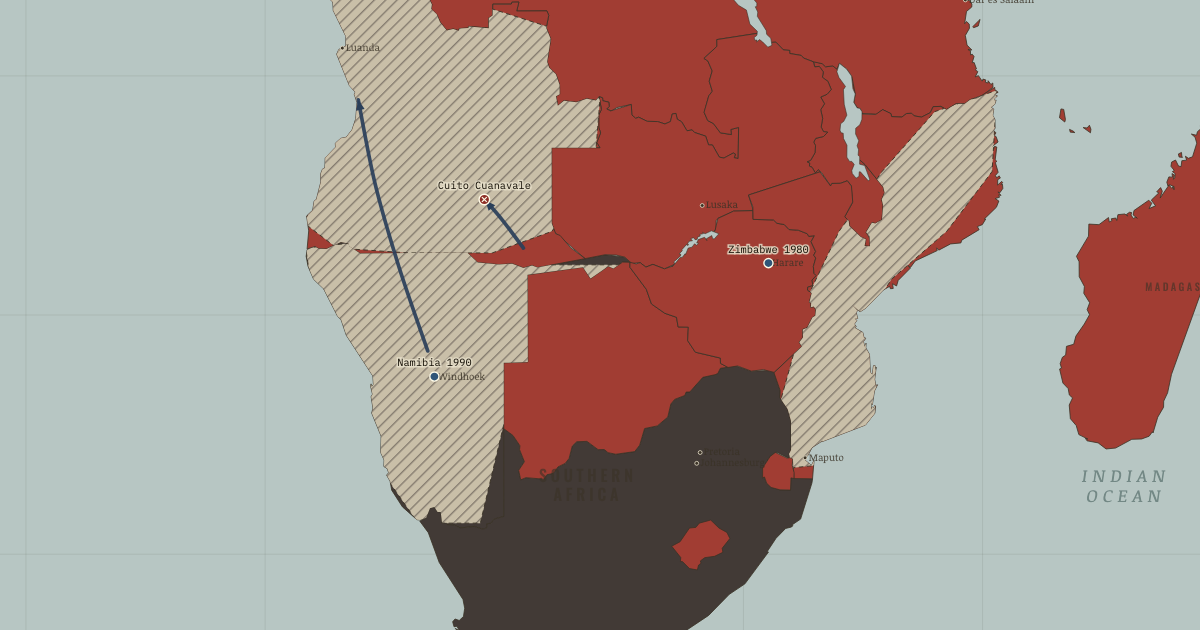
The map above is the world of APR 1980 — Zimbabwe — a settler state ends.
BRIEF EXPLANATION — THE ESSENTIAL ARGUMENT
Settler rule lasted longest in southern Africa, and it did so for the Algerian reason multiplied several times over. White minorities there controlled the land, the wealth and the machinery of armed states, and they regarded the region as their only home, so majority rule threatened them with the loss of everything rather than the mere lowering of a distant flag. Rhodesia went first and hardest. Rather than accept Britain’s condition of eventual majority rule, its white settlers declared independence unilaterally in 1965 and held out for fifteen years, sustained by sanctions-busting and by South African support, until guerrilla war and the loss of Portuguese Mozambique as a buffer finally forced them to negotiate.
The 1979 Lancaster House settlement secured majority rule for the new Zimbabwe in 1980, but it protected white-owned land for a decade, buying peace at the price of deferring the central grievance. That left Namibia and South Africa. Namibia had been ruled by South Africa since 1915 in defiance of the United Nations, and its freedom came not on its own soil but through the war in Angola, where the disputed battle of Cuito Cuanavale in 1987–88 produced a linked bargain: Cuban withdrawal from Angola in exchange for South African withdrawal from Namibia, which became free in 1990.
GUIDED EXPLANATION
Rhodesia’s settlers could evade sanctions as long as they had friendly neighbours, routing trade through South Africa and through Portuguese Mozambique, which is why economic pressure alone did so little for so long. When Mozambique became independent and hostile in 1975, both the guerrilla war and the isolation grew much harder to contain. The Lancaster House agreement then delivered a ceasefire and one-person-one-vote elections, yet its willing-buyer, willing-seller land clause froze the colonial distribution of land for ten years. It ended the immediate war while postponing the injustice that would detonate in Zimbabwe two decades later.
South Africa had occupied Namibia in open defiance of the United Nations, and SWAPO’s guerrillas had fought there since 1966. At Cuito Cuanavale in 1987–88, South African and UNITA forces met Angolan and Cuban forces in the largest battle in Africa since the Second World War. Historians still dispute whether it was a defeat, a victory or a stalemate, but its political effect is clearer, since neither side could impose a cheap military solution, and the negotiations that followed linked Cuban withdrawal to Namibian independence. The accumulation of military, economic and diplomatic pressure then closed in on Pretoria at home, leaving the last redoubt facing the reckoning the next chapters describe.
Rhodesia’s quarter-million whites and South Africa’s far larger settler population regarded southern Africa as their only home and controlled its land, mines and government. As in Algeria, this made a negotiated handover almost impossible for decades: majority rule meant, to them, the loss of everything, so they chose defiance, sanctions and war over the compromise that had freed the colonies to the north. The structural logic of settler colonialism. The one this atlas keeps returning to. Reached its extreme here.
The former Rhodesia became independent under Mugabe after the Lancaster House settlement. A genuine triumph of the negotiated model, and the birthplace of a land grievance deferred rather than resolved. When the ten-year land clause and the patience behind it expired, the violent seizures of 2000 and the country’s economic collapse followed. The settlement bought a peaceful birth at the cost of an unaddressed injustice. The pattern of negotiated transitions.
DEEP EXPLANATION — EVIDENCE & INTERPRETATION
Why Minority Regimes Could Absorb So Much Pressure
Settler states behaved differently from colonies administered mainly from Europe, and the difference explains their staying power. White communities controlled the local institutions, considered the territory their permanent home, and feared that majority rule would strip away their security, status and property, so they were willing to bear costs that a distant metropolitan public would never have accepted. Rhodesia further relied on South African backing and on supply routes through Portuguese Mozambique, which blunted the early effect of sanctions. No single instrument brought such a regime down. Guerrilla war raised the cost of security, Mozambique’s independence removed a crucial buffer, sanctions accumulated over years, and diplomatic isolation narrowed the alternatives, so the right model is one of compounding pressure. That model explains both why confident predictions of quick collapse kept failing and why negotiation eventually became possible. It should not, however, make the outcome seem impersonal, because African resistance is what sustained the pressure while settler leaders chose repression and delay. Structure explains the durability, and human action explains how that durability was finally overcome.
A Disputed Battle and Its Clear Consequence
Cuito Cuanavale carries competing national memories that are worth stating plainly. Cuban and African nationalist accounts often describe a decisive defeat of the apartheid army, while South African accounts stress that their immediate operations achieved limited aims and that they never intended to occupy the town permanently. Many historians settle on the word stalemate, or separate the fighting around Cuito itself from the later Cuban advance toward the Namibian border. That uncertainty should be preserved rather than resolved for the sake of a tidy story. What matters for this atlas is the changed bargaining context, because continued escalation now promised heavy costs to everyone, Cuba had increased its forces, and the regional war became tied to the implementation of Namibian independence. The 1988 agreements exchanged Cuban withdrawal for South African withdrawal and a UN-supervised transition. The battle did not by itself end apartheid, but it weakened confidence in an unlimited military solution and added to the wider pressure under which Pretoria began to reassess both its regional and its domestic strategy.
New here? Chapters 1–2 of every atlas are free to sample, and the WW2 atlas is free in full. One membership opens all thirteen — the Cartographer’s Circle.
THE SITES
ON THIS DAY
WHY IT HAPPENED
Settlers with nowhere to go, again. Rhodesia’s quarter-million whites and South Africa’s far larger settler population regarded southern Africa as their only home and controlled its land, mines and government. As in Algeria, this made a negotiated handover almost impossible for decades: majority rule meant, to them, the loss of everything, so they chose defiance, sanctions and war over the compromise that had freed the colonies to the north. The structural logic of settler colonialism. The one this atlas keeps returning to. Reached its extreme here.
“Kith and kin” and the failure of sanctions. Rhodesia’s 1965 UDI gambled that Britain would not use force against fellow whites (it did not) and that sanctions could be evaded. For fifteen years they were. Through South Africa, through busted embargoes, through Portuguese Mozambique until 1975. Sanctions alone never toppled the regime. What broke it was the guerrilla war plus the loss of its Portuguese buffer, which together made the country ungovernable and its economy unsustainable. A lesson about the limits and the slow cumulative bite of economic pressure.
Lancaster House: how a settler state is negotiated away. The 1979 settlement is a template worth studying: sustained guerrilla pressure and sanctions brought the white regime to accept majority rule, but the price was constitutional guarantees. Reserved white parliamentary seats for a period, and above all a willing-buyer-willing-seller land clause that froze the colonial land distribution for ten years. It ended the war and enabled a peaceful transfer. It also deferred the explosive land question, which detonated in Zimbabwe two decades later. Negotiated endings trade present peace for deferred problems.
Cuito Cuanavale: the myth broken. The 1987–88 battle in south-east Angola was the largest in Africa since El Alamein. Its outcome. A bloody stalemate rather than the South African victory Pretoria expected. Is argued by historians as the military hinge of the whole southern endgame: it demonstrated that apartheid’s army was not invincible, strengthened the Cubans’ and Angolans’ negotiating hand, and produced the linkage deal (Cuban withdrawal for Namibian independence) that finally freed Namibia. Whether it was a clear defeat or merely a check, it changed the political arithmetic decisively.
THE TURN
Cuito Cuanavale, 1987–88 — the hinge. South Africa commits its heaviest armour to crush the Angolan-Cuban forces and is fought to a standstill at a ruined town in the Angolan bush. The myth of white military supremacy. The psychological foundation of the settler redoubt. Does not survive it. Within months the linkage negotiations produce the deal that ends South Africa’s occupation of Namibia. Within two years Namibia is free and Pretoria, its army checked abroad and its economy strangled by sanctions at home, opens the talks that will end apartheid itself. A stalemate in the Angolan mud is the moment the last redoubt begins to fall.
WHAT IT CHANGED
Zimbabwe, 1980 — and the deferred reckoning. The former Rhodesia became independent under Mugabe after the Lancaster House settlement. A genuine triumph of the negotiated model, and the birthplace of a land grievance deferred rather than resolved. When the ten-year land clause and the patience behind it expired, the violent seizures of 2000 and the country’s economic collapse followed. The settlement bought a peaceful birth at the cost of an unaddressed injustice. The pattern of negotiated transitions.
Namibia, 1990 — Africa’s last colony. The linkage deal freed Namibia after 75 years of South African rule and 23 years of war. SWAPO’s Sam Nujoma took office in a UN-supervised transition that became a model. On the map, the second-to-last charcoal territory turns red. Only South Africa now remains. And the same forces that freed Namibia, above all the proof that the apartheid state could be checked, are now turned inward.
The noose on Pretoria. By 1990 South Africa stood alone: its buffer states gone, its army bloodied abroad, its economy reeling under sanctions and capital flight, its townships ungovernable at home. The fall of the settler redoubt to its north. Mozambique, Zimbabwe, Namibia. Stripped away every layer of the apartheid state’s defensive glacis and left it facing the reckoning the next two chapters describe.
FIELD QUESTION — Why did settler rule in southern Africa survive decades longer than colonialism elsewhere — and what combination of pressures finally ended it?
It survived because the settler equation was at its strongest here: large, entrenched white populations who saw the region as their only homeland, controlled its wealth and arms, and would fight rather than concede majority rule. The Algerian dynamic without a metropole to withdraw to. No single pressure was sufficient: sanctions alone were evaded for fifteen years. Guerrilla wars alone could not militarily defeat well-armed states. International isolation alone was tolerable. What ended it was the accumulation and interaction of all of them. Sustained armed struggle that made the countries ungovernable, the collapse of the Portuguese buffer that exposed the redoubt, economic strangulation by sanctions and capital flight, and finally the military check at Cuito Cuanavale that destroyed the myth of white invincibility and shifted the political arithmetic. The transferable lesson is that deeply entrenched minority regimes rarely fall to one clean blow. They fall when military, economic, diplomatic and internal pressures compound over time until the cost of holding on exceeds the cost of letting go. And when the belief in their own invincibility, which is half their strength, is finally broken.
AN INTERESTING FACT
Bob Marley had released a song called “Zimbabwe” on the 1979 album Survival, and when the real thing arrived he came in person — flying the Wailers and their equipment to Harare at his own expense to play the independence ceremony at Rufaro Stadium on 18 April 1980, the night the new flag first rose. Tear gas, fired at the crowds pressing the stadium gates, drifted over the field and briefly stopped the show; the next day Marley played a second, free concert so the tens of thousands who had been shut out could hear him.
THE DISPATCH
One short letter when a new atlas opens — and the printable study guide for The Decolonization of Africa is yours now, free.
NO TRACKING · YOUR ADDRESS IS USED FOR THE DISPATCH AND NOTHING ELSE · UNSUBSCRIBE ANYTIME