MAPS OF HISTORY · The Decolonization of Africa · ALL CHAPTERS · CHAPTER 10
CHAPTER 10 · 1948–1990 · MAR 1990
Apartheid’s Long Fall
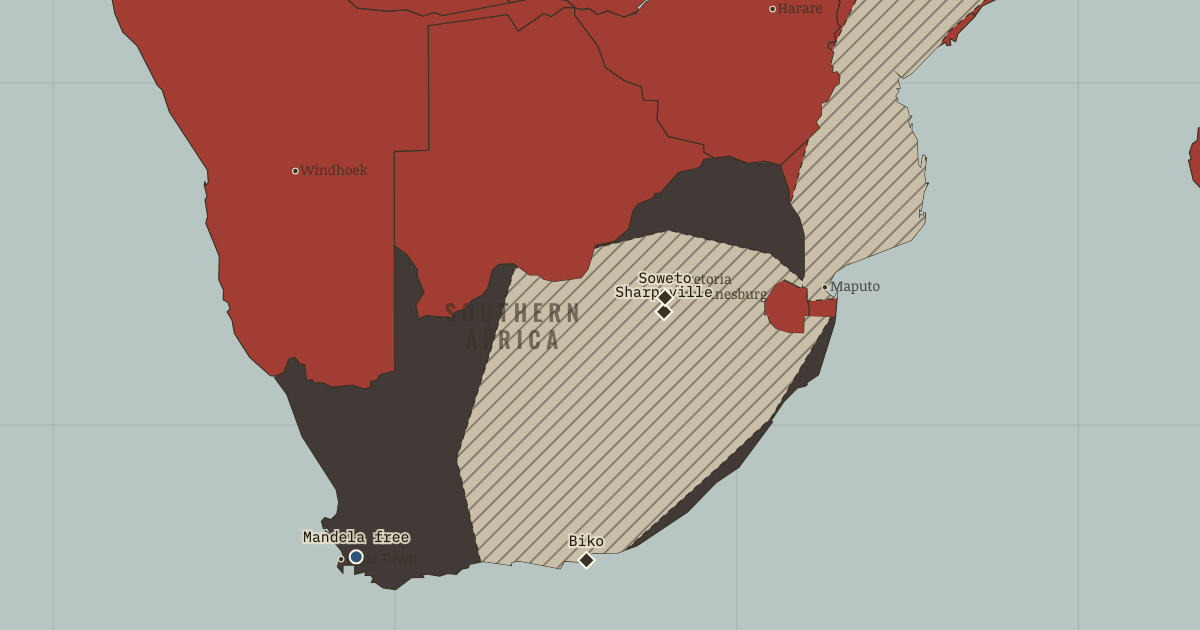
The map above is the world of MAR 1990 — Namibia — and Mandela walks.
BRIEF EXPLANATION — THE ESSENTIAL ARGUMENT
South Africa was the last and hardest case, the country the whole liberation struggle was finally reaching. It had been under white-minority rule since 1910, but from 1948 the National Party built something far more total, a legal machine of racial classification, territorial dispossession and political exclusion that stripped the Black majority of citizenship, land, movement and the vote. Resistance ran through every available channel, from protest and labour action to armed struggle, international campaigning and the daily organizing of the townships. Sharpeville, Soweto and Steve Biko stand on this map as memorials to people the state harmed and killed, never as milestones to be scored.
What finally moved the immovable was the compounding pressure of the 1980s. The townships became difficult to govern, and financial sanctions bit in a precise way when international banks refused in 1985 to roll over South Africa’s short-term loans, triggering a debt crisis and capital flight that convinced the white business class that apartheid had become unsustainable. Regional military dominance had been checked abroad, and the end of the Cold War was removing the anti-communist justification the regime had leaned on. F. W. de Klerk concluded that negotiating from relative strength beat waiting for collapse, unbanned the ANC in February 1990, and released Nelson Mandela nine days later, opening the phase in which the system would have to be dismantled without bringing the country down.
GUIDED EXPLANATION
From 1948 the National Party expanded white-minority rule into apartheid, a system that reached into almost every part of life. Pass laws controlled where people could move, land policy reserved most of the country for the white minority, and the homeland policy assigned Black South Africans a nominal citizenship in fragmented territories so the state could deny them national political rights while still using their labour. After police killed sixty-nine people at Sharpeville in 1960, the banned ANC and PAC turned toward armed resistance, Mandela was imprisoned for twenty-seven years, and the 1976 Soweto uprising and Biko’s death in custody became further evidence of the system’s violence.
The state could contain resistance for decades, but it could never manufacture consent. Through the 1980s strikes, boycotts and township revolt raised the internal cost of rule, and then the financial mechanism proved decisive: when international banks refused in 1985 to renew short-term loans, South Africa faced a debt crisis, the rand collapsed, and capital fled the country. Sanctions worked here through money rather than through moral appeal alone. Regional setbacks and the end of the Cold War stripped away the regime’s remaining supports, and de Klerk unbanned the ANC in February 1990. Mandela’s release signalled a shift from attempted suppression to bargaining, rather than the completion of liberation itself.
From 1948 the National Party legislated total racial separation: the population classified by race, mixed marriage banned, land reserved (87% for whites), Black South Africans stripped of citizenship and assigned to nominal “homelands,” movement controlled by pass laws. It was designed to be permanent and self-reinforcing. Understanding that totality explains why its fall required not reform but the negotiated dismantling of an entire legal order. The subject of the next chapter. (The system’s full anatomy belongs to the planned apartheid atlas.)
Unbanning the ANC and freeing Mandela converted a liberation struggle into a negotiation between a state and a movement, each able to destroy the settlement but neither able to impose its own. The armed struggle wound down. The harder work of bargaining a new constitution began. The shift from fighting the wall to dismantling it brick by brick is the subject of the four years that follow.
DEEP EXPLANATION — EVIDENCE & INTERPRETATION
How Law Made Racial Domination Endure
Apartheid was far more than social prejudice or physical separation, and understanding its machinery explains why minor reform could never settle the conflict. Population classification determined where a person could live, work, study and marry, and what political status they held. Land acts and forced removals concentrated ownership in white hands, while pass laws regulated the movement of labour. The homeland policy then attempted to assign Black South Africans citizenship in fragmented territories so that the white state could deny them national political rights while continuing to rely on their work. This administrative architecture made domination routine and distributed it across courts, employers, police and local offices, so that it did not depend on any single institution. It also generated resistance at many points at once, against passes, school language, removals, low wages and township government. Because the parts reinforced one another, meaningful change required dismantling the whole constitutional order rather than adjusting a few discriminatory rules. The people killed at Sharpeville, at Soweto and in custody are remembered here as victims of that order, and never as markers of progress.
When the Cost of Holding on Finally Reversed
No single boycott, battle or leader ended apartheid, and the honest account is one of several pressures compounding until the regime’s own calculation flipped. The state retained formidable coercive power, but repression could no longer produce a stable political future. Township resistance and organized labour raised the domestic cost of rule, while the 1985 debt crisis showed white business leaders that international isolation now threatened growth and finance. The regional wars consumed resources without securing lasting dominance, and the settlement over Namibia reduced the value of continued confrontation. The end of the Cold War then weakened Pretoria’s claim that minority rule was a necessary defence against communism and eased its fear of a Soviet-backed takeover. De Klerk’s decision remained genuinely contingent, since he judged that negotiating from relative strength offered better protection than bargaining later from a position of decline. This reading does not make him the author of liberation. Decades of resistance changed the options among which he chose, and it shows how accumulated pressure becomes political change only when decision-makers revise their estimate of the cost of holding on.
New here? Chapters 1–2 of every atlas are free to sample, and the WW2 atlas is free in full. One membership opens all thirteen — the Cartographer’s Circle.
THE SITES
ON THIS DAY
WHY IT HAPPENED
The architecture of apartheid — and why recap it here. From 1948 the National Party legislated total racial separation: the population classified by race, mixed marriage banned, land reserved (87% for whites), Black South Africans stripped of citizenship and assigned to nominal “homelands,” movement controlled by pass laws. It was designed to be permanent and self-reinforcing. Understanding that totality explains why its fall required not reform but the negotiated dismantling of an entire legal order. The subject of the next chapter. (The system’s full anatomy belongs to the planned apartheid atlas.)
The turn to armed struggle. Sharpeville in 1960 was the hinge of method: the massacre and the subsequent banning of the ANC and PAC closed the door on peaceful protest and pushed the movement to sabotage and guerrilla struggle (Umkhonto we Sizwe), and its leaders. Mandela, Sisulu. To prison or exile. For thirty years the struggle was fought from cells, townships and neighbouring states. The regime’s violence radicalized the resistance exactly as in Algeria. Peaceful avenues closed produce armed ones.
Sanctions and capital flight — the argument that actually bit. For decades sanctions were partial and evaded, and their effect is often overstated. But the financial pressure of the mid-1980s was decisive in a specific, mechanical way: when international banks refused in 1985 to roll over short-term loans, South Africa faced a debt crisis, the rand collapsed, and capital fled. This convinced the white business class and then the state that apartheid had become a losing economic proposition. That the system was now costing the very people it was designed to enrich. Economic self-interest, more than moral suasion, moved the establishment.
De Klerk’s calculus. By 1989 the pressures had converged: ungovernable townships, a bloodied army, a strangled economy, a lost buffer, and. With the Cold War ending. The collapse of the “anti-communist bastion” justification and of Soviet backing for the ANC that Pretoria had feared. De Klerk concluded that negotiating from relative strength now was better than negotiating from collapse later, or fighting a war that could not be won. Releasing Mandela was not conversion but calculation. Which is often how the immovable finally moves.
THE TURN
Mandela walks free, 11 February 1990. After twenty-seven years, Nelson Mandela leaves prison on foot, and a struggle that had run through massacre, exile and armed resistance enters its final, negotiated phase. The moment matters because of what it signals: the apartheid state has concluded it can neither win nor endure, and has chosen to bargain with the man it jailed rather than fight to the end. It is the answer to Algeria and Rhodesia. A settler regime that, faced with the same unwinnable equation, chooses (barely, and under enormous pressure) negotiation over Götterdämmerung. What that negotiation cost and how narrowly it held is the last chapter.
WHAT IT CHANGED
From resistance to transition. Unbanning the ANC and freeing Mandela converted a liberation struggle into a negotiation between a state and a movement, each able to destroy the settlement but neither able to impose its own. The armed struggle wound down. The harder work of bargaining a new constitution began. The shift from fighting the wall to dismantling it brick by brick is the subject of the four years that follow.
The memorials remain. Sharpeville, Soweto, Biko and thousands of unnamed dead were the price of reaching 1990. The transition did not erase them. The Truth and Reconciliation Commission that followed was built precisely to keep them in national memory rather than avenge them. On this map they are memory sites, never scores. The human cost of the last redoubt’s fall. Remember them.
The Cold War’s end clears the board. The collapse of Soviet communism in 1989–91 removed both the regime’s excuse (apartheid as anti-communist bulwark) and one of the ANC’s patrons, lowering the stakes and the fear on both sides and making a settlement thinkable. Southern Africa’s endgame and the Cold War’s end are entangled. The freeing of Namibia and the unbanning of the ANC come in the same eighteen months as the fall of the Berlin Wall.
FIELD QUESTION — After decades of surviving protest, sanctions and armed struggle, why did the apartheid state finally choose to negotiate itself out of power around 1990?
Because the cost-benefit calculation that had long favoured holding on finally reversed, under several pressures compounding at once. Internally, the townships had become ungovernable and the security state could contain but not end the insurrection. Economically, the 1985 debt crisis and capital flight convinced the white business class and government that apartheid was now impoverishing rather than enriching them. The decisive, mechanical bite of financial pressure. Militarily, Cuito Cuanavale and the loss of the buffer states ended the option of dominating the region by force. Diplomatically, isolation was total. And the end of the Cold War in 1989–91 simultaneously destroyed the regime’s anti-communist justification and reduced its fear of a Soviet-backed ANC. De Klerk’s decision was thus not moral conversion but strategic calculation: negotiating from relative strength beat fighting an unwinnable war or bargaining later from collapse. The lesson, echoing Rhodesia and inverting Algeria, is that entrenched regimes concede when. And only when. The accumulated costs of holding power exceed the risks of giving it up, and when at least some of their leaders are clear-eyed enough to see it in time.
AN INTERESTING FACT
Long Walk to Freedom began as contraband. Mandela drafted it at night on Robben Island in the mid-1970s, Walter Sisulu and Ahmed Kathrada passed comments in the margins, and Mac Maharaj copied the manuscript into minute script and carried it out on his release in 1976; the original, buried in containers under the prison courtyard, was unearthed by warders digging foundations for a new wall — a discovery that cost Mandela his study rights for four years. The book the prison confiscated became the memoir of a president.
THE DISPATCH
One short letter when a new atlas opens — and the printable study guide for The Decolonization of Africa is yours now, free.
NO TRACKING · YOUR ADDRESS IS USED FOR THE DISPATCH AND NOTHING ELSE · UNSUBSCRIBE ANYTIME