MAPS OF HISTORY · The American Civil War · ALL CHAPTERS · CHAPTER 7
CHAPTER 7 · MAY–JUL 1863 · JUL 1863
The Twin Turning
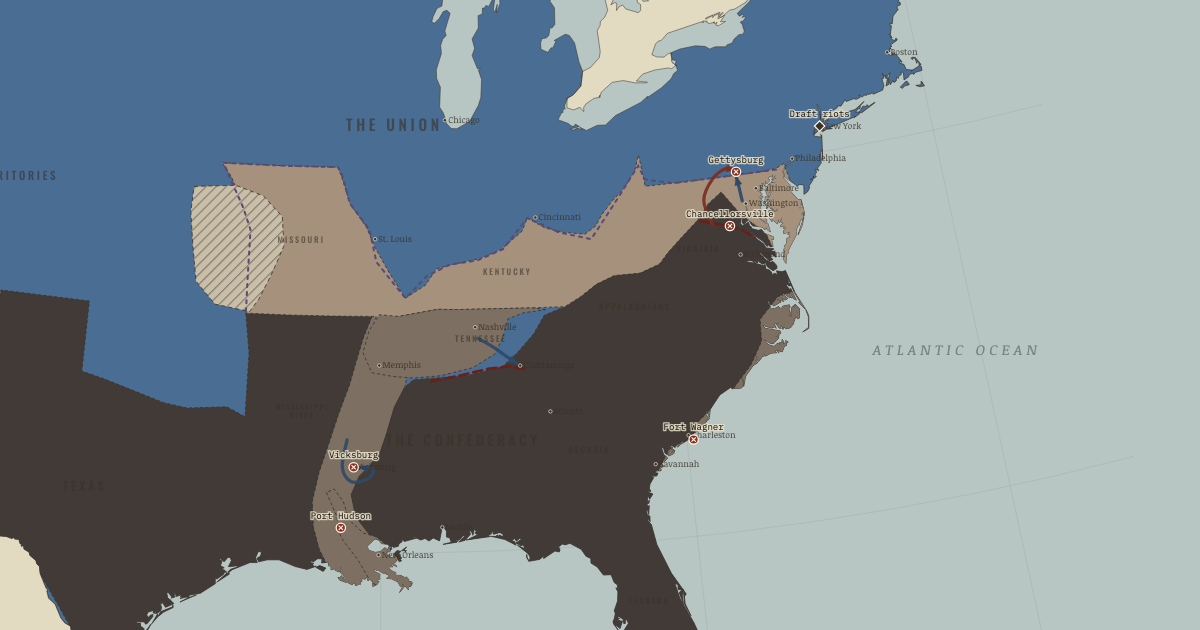
The map above is the world of JUL 1863 — The twin blow — Gettysburg and Vicksburg.
BRIEF EXPLANATION — THE ESSENTIAL ARGUMENT
The war’s decisive turn came in July 1863, when two victories a day apart broke the Confederacy’s strategy in different ways. Lee’s second invasion of the North ended at Gettysburg, where Union forces held their ground for three days and Pickett’s Charge failed, and although the Army of Northern Virginia escaped, it would never again mount a comparable strategic offensive.
The victory in the West was the more permanent one. One day after Gettysburg, Vicksburg surrendered to Grant, who had crossed the Mississippi, kept two Confederate forces apart, and locked the city into a siege. Port Hudson soon fell as well, so the Union controlled the whole river and split the Confederacy in two. The same month, the service of Black soldiers and a violent revolt against conscription showed how deeply the war was transforming both societies.
GUIDED EXPLANATION
Lee invaded Pennsylvania to feed an exhausted army, shake Northern confidence, and force a decision away from ravaged Virginia. The two armies met at Gettysburg largely by accident, and the Union troops formed a strong defensive line and held both flanks. On 3 July the Confederate assault remembered as Pickett’s Charge crossed nearly a mile of open ground under artillery and rifle fire, and about half the attackers fell. Lee withdrew with his army damaged but still intact, its offensive power spent for good.
Grant’s Vicksburg campaign produced a result that could not be undone. He moved below the fortress, crossed the river, drew supplies partly from the countryside, and defeated separated Confederate forces before opening a 47-day siege. Vicksburg surrendered on 4 July, and Port Hudson followed, so the grey-tan corridor on the map now ran the length of the Mississippi. The trans-Mississippi region remained Confederate in name, but it could no longer reliably supply the armies fighting east of the river.
The two victories changed different things, and holding them apart clarifies why the war turned. Gettysburg denied Lee the political and military result he sought on Northern soil, cost the two armies about 51,000 casualties, and ended his invasions, yet he escaped across the Potomac to fight for two more years. Vicksburg subtracted an army, a fortress, and a transport route at once, and it did so through Grant’s willingness to refuse the strongest approach, for after failed canals and bayou operations he passed the batteries, crossed on open ground, and kept Johnston and Pemberton from combining. The July map also carries the strain the war placed on society, since draft resistance in New York turned into murderous racial violence while Black troops at Fort Wagner and elsewhere pressed their claim to citizenship through service and sacrifice. The turning point was therefore military, geographic, and political together, narrowing Confederate choices while widening the meaning of the Union war.
DEEP EXPLANATION — EVIDENCE & INTERPRETATION
Auditing the risk at Gettysburg
Lee’s decision to attack the Union center on 3 July was not senseless, because it had a clear purpose. His flank attacks had nearly succeeded, he believed the center had been thinned, and a retreat without a decision would have defeated the whole campaign. Its operational assumptions were nonetheless poor. The preliminary artillery bombardment did far less damage than he expected, coordination among the attacking units was limited, the approach exposed the infantry for nearly a mile, and no fresh force stood ready to exploit even a narrow breakthrough. Longstreet’s objections show that these problems were visible at the time and not only in hindsight. Historians still debate Lee’s information and his alternatives, but the charge illustrates escalation of commitment, in which the demand for a decisive victory makes evidence for withdrawal ever harder to accept. Valor cannot correct a plan whose firepower and follow-through are inadequate.
Why Vicksburg was harder to reverse
Gettysburg stopped an invasion, while Vicksburg removed a transport system and captured roughly 30,000 defenders, and that difference supports the case that Vicksburg was the more decisive of the paired victories. Grant’s achievement lay in changing the problem itself. Direct approaches through swamps and canals had failed, so he ran the river batteries, crossed south of the city, and operated for a time away from a conventional supply line, all while moving between Johnston and Pemberton to keep the two Confederate forces from uniting. The campaign still depended on naval transport, local food, intelligence, and Confederate command failures, so living off the land never meant operating without logistics. Once the fortress and Port Hudson fell, reopening Confederate traffic would have required retaking a long, defended river rather than winning a single battle. Irreversibility is a useful test for turning points, because it asks what capacity disappeared rather than only whose morale rose.
New here? Chapters 1–2 of every atlas are free to sample, and the WW2 atlas is free in full. One membership opens all thirteen — the Cartographer’s Circle.
THE SITES
ON THIS DAY
WHY IT HAPPENED
Why Lee rolled the dice again. He told Davis the choice was stark: stand still and starve slowly behind the Rappahannock, or invade and force a decision while the army still had its edge. He also believed. After Fredericksburg and Chancellorsville. That his men could break any Union line, and discounted what two years of rifled muskets and earthworks had done to frontal attacks. Confidence is a weapon that dulls with use. Gettysburg’s third day is its edge failing.
Vicksburg as a problem of approach. The fortress was unassaultable from the river and swamp-guarded from the north. Grant spent a winter failing at canals and bayous. The solution inverted the problem: get south of it on the wrong bank, cross into open country, and make the fortress come out or starve. Compare the pattern at Donelson and later at Chattanooga: Grant’s signature is refusing the strong front and attacking the system that feeds it.
Two societies under strain. Conscription arrived in both nations (the Confederacy first, 1862), and both laws let the rich buy out. $300 in the North, a “twenty-negro” overseer exemption in the South. “Rich man’s war, poor man’s fight” was a grievance with teeth: draft riots in New York, bread riots in Richmond that spring. Total war taxes social contracts as heavily as treasuries.
THE TURN
Vicksburg, 4 July 1863. Gettysburg is the war’s most famous battle. Vicksburg is its more decisive one. Gettysburg repelled. The Army of Northern Virginia escaped to fight for two more years. Vicksburg subtracted: a river, a region, 30,000 soldiers, and the Confederacy’s territorial integrity, permanently. It also settled the Union’s command question. The general who took Vicksburg would soon command everything. When ranking turning points, prefer the irreversible to the dramatic.
WHAT IT CHANGED
The Confederacy is halved. Scrub the map forward and watch the trans-Mississippi (Texas, Arkansas, west Louisiana) fade from the war: still charcoal, but strategically an island. Richmond’s writ now runs on one side of the river. The anaconda has finished its central coil.
Black soldiers change the war’s meaning. Fort Wagner’s casualty list. And Port Hudson’s and Milliken’s Bend’s the same summer. Ended serious Northern debate about whether Black men would fight. Frederick Douglass drew the syllogism: “He who fights the battles of America may claim America as his country. And have that claim respected.” The road from these parapets to the 14th and 15th Amendments is direct. So is Confederate fury at the sight, which Chapter 8 must name at Fort Pillow.
The last hope becomes political. After July 1863 the Confederacy’s military theory of victory is gone. What remains is Lee’s original insight inverted. Make the war cost so much that the North votes it down in November 1864. Every 1864 campaign, and the entire next chapter, is fought against that clock.
FIELD QUESTION — Pickett’s Charge has become the war’s emblem of doomed valor. Was it a blunder, or a calculated risk that failed?
Reconstruct Lee’s ledger fairly: two days of flank attacks had nearly broken both Union wings. He judged the center thinned, massed 150 guns to suppress it, and sent his freshest division a mile behind that bombardment. Now audit it: the artillery mostly overshot (worn fuses, smoke), the stone wall and the copse were pre-registered by Union guns, and even success would have punched a salient his exhausted army could not have exploited. Longstreet told him no 15,000 men ever arrayed could take that ground. And was right within the hour. The honest verdict: a calculated risk whose calculations were checkable and wrong, taken because the alternative (retreat without decision) refuted the campaign’s whole premise. Note the pattern for your own decisions: when a plan’s premise fails, escalation of commitment masquerades as boldness.
AN INTERESTING FACT
Of Gettysburg’s roughly 2,400 civilians, exactly one was killed in the battle: Mary Virginia “Jennie” Wade, twenty years old, struck by a stray bullet that passed through two wooden doors while she kneaded dough in her sister’s kitchen on the morning of 3 July. When the armies marched away they left the town transformed into a hospital — some 21,000 wounded of both sides in and around a community of that size, with thousands of dead men and horses to bury in the July heat. That burial emergency is why a soldiers’ cemetery was chartered on the field — the same cemetery Lincoln would be invited, almost as an afterthought, to offer “a few appropriate remarks” at in November.
THE DISPATCH
One short letter when a new atlas opens — and the printable study guide for The American Civil War is yours now, free.
NO TRACKING · YOUR ADDRESS IS USED FOR THE DISPATCH AND NOTHING ELSE · UNSUBSCRIBE ANYTIME