MAPS OF HISTORY · The American Civil War · ALL CHAPTERS · CHAPTER 6
CHAPTER 6 · SEP 1862–JAN 1863 · SEP 1862
Antietam and Emancipation
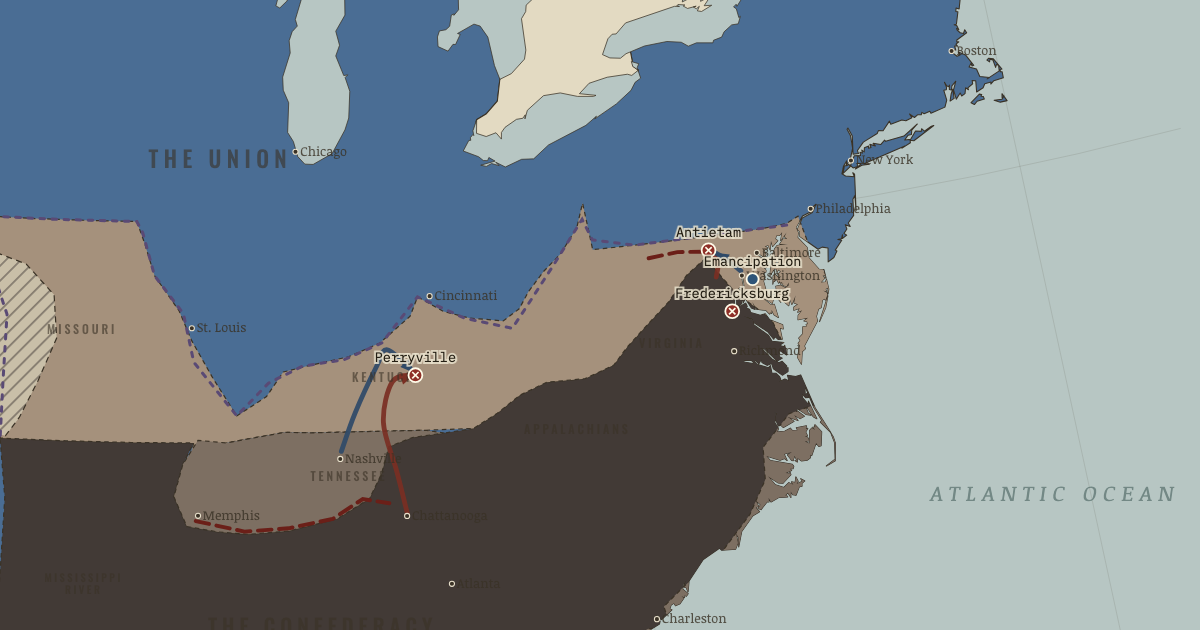
The map above is the world of SEP 1862 — Antietam — the high-water mark.
BRIEF EXPLANATION — THE ESSENTIAL ARGUMENT
In September 1862 the Confederacy made its most ambitious bid of the war, sending armies into Maryland and Kentucky at once in search of supplies, recruits, political effect at the Northern midterm elections, and possible European mediation. Both invasions failed. At Antietam, McClellan halted Lee’s army but did not destroy it, and the single day cost about 23,000 casualties, the bloodiest in American history.
Lincoln used that inconclusive result to remake the war’s purpose. Five days after the battle he announced emancipation in the territory still in rebellion, a measure that tied every Union advance to freedom, authorized Black men to enlist, and made European support for a slaveholding Confederacy politically impossible. A battle that fell short of a clear tactical victory nonetheless changed what the war was about and the diplomatic ground on which it was fought.
GUIDED EXPLANATION
Lee’s Maryland campaign and Bragg’s advance into Kentucky aimed at far more than territory, since a success on Northern or border soil might sway the autumn elections, gather border-state recruits, and encourage Britain to offer mediation. Chance then intervened when a Union soldier found a lost copy of Lee’s orders, which revealed that his army was dangerously divided. McClellan still attacked in stages at Antietam and kept large reserves idle, so Lee’s battered army was able to hold its ground and then withdraw safely, while Bragg likewise fell back after Perryville.
Five days after Antietam, Lincoln issued the preliminary Emancipation Proclamation, and its precision is the key to its power. His authority reached only the areas in rebellion, since the war power let him seize an enemy’s resources but not free a loyal citizen’s property, so the measure exempted the loyal slave states and looked narrow on its face. Its mechanism, however, was broad, because from 1 January 1863 every mile that Union armies advanced turned the declaration into fact, allowing enslaved people to claim freedom and Black men to enlist. Emancipation also made the war openly about slavery, which raised the political cost of any British or French intervention. Because a measure resting on war powers might lapse with peace, permanent abolition would still require the Thirteenth Amendment.
The map explains how these effects fit together. The Confederate arrows reached their northern limit in September 1862 and then withdrew, which weakened the diplomatic case for recognizing a victorious new nation and gave Lincoln his first clear military result after months of defeat. That timing let emancipation appear as policy backed by force rather than as a desperate cry from a losing power. The final proclamation took effect on 1 January 1863, and while it did not instantly free anyone beyond Union reach and the loyal border states remained exempt, every later grey-tan advance could now destroy slavery in practice. Enslaved people were agents in that process, escaping to the lines, supplying information, supporting the armies, reuniting families, and enlisting, until some 180,000 Black soldiers had served the Union. Their service added military strength and made any restoration of the old Union increasingly impossible.
DEEP EXPLANATION — EVIDENCE & INTERPRETATION
Decisive by consequence, not by score
Antietam is often called a Union victory because Lee left Maryland, though the fighting itself ended closer to a tactical draw. That classification does not settle the battle’s importance, which lay in its consequences. The campaign produced no Confederate recruits, no diplomatic movement, and no political shock in the North; instead it gave Lincoln enough military credibility to announce a policy he had already drafted. This is why historians separate tactical outcome from strategic consequence. McClellan’s failure to concentrate his attacks or to pursue Lee remains controversial, yet his army had also suffered heavily, its units were disordered, and its information was uncertain. The sound judgment is that McClellan repeatedly treated incomplete knowledge as a reason to preserve his options, while Lincoln needed battlefield results that created political options. At Antietam a limited military success opened a transformative political path.
The Proclamation’s narrow legal mechanism
The Proclamation did not abolish slavery everywhere on 1 January 1863, because it declared freedom only in designated areas still in rebellion, using the president’s authority to weaken an enemy in wartime. Loyal slave states and certain occupied areas were exempt, and critics then and later used those exclusions to call the measure merely symbolic. The objection misreads how enforcement worked. Enslaved people moved toward Union forces, commanders could no longer return them as property, and advancing armies turned the declaration into facts on the ground, while Black enlistment added military weight and made any retreat from emancipation harder. Its legal narrowness was also a genuine limit, since a court or a restored peace might undo a measure grounded in war powers, which is exactly why Lincoln pressed for the Thirteenth Amendment. The Proclamation was at once limited and revolutionary, because it linked military movement, self-emancipation, recruitment, diplomacy, and eventual constitutional change into a single process.
New here? Chapters 1–2 of every atlas are free to sample, and the WW2 atlas is free in full. One membership opens all thirteen — the Cartographer’s Circle.
THE SITES
ON THIS DAY
WHY IT HAPPENED
Why Lee invaded. Necessity and opportunity: Virginia’s farms were stripped and feeding his army required Northern fields. A victory on Union soil before the midterms might elect peace Democrats. And Palmerston’s cabinet had agreed to consider mediation. Recognition in all but name. If Lee won again. The Maryland campaign was the Confederacy’s one genuinely coordinated bid to end the war by breaking Northern will from outside and inside at once.
Why the Proclamation waited. Seward’s advice in July was brutal and correct: issued after the summer’s defeats, emancipation would read as “the last shriek on the retreat”. A plea for slave revolt from a losing power. Announced after a victory, it was policy from strength. Lincoln also spent the wait preparing the politics: publicly answering Greeley (“If I could save the Union without freeing any slave I would do it…”) so that when the blow came it stood on the unassailable ground of military necessity.
The border-state calculus. Exempting Kentucky, Missouri and Maryland was not timidity but arithmetic. Those states in the Union were worth armies, and Lincoln had spent 1861–62 refusing generals (Frémont, Hunter) who freed slaves prematurely precisely to keep them. Emancipation succeeded as policy because it was sequenced: first secure the border, then strike at slavery where the strike was also a weapon.
McClellan’s last battle. Handed the enemy’s plan, he moved with what one historian calls deliberate haste, attacked in series rather than in mass, and let Lee’s shattered army stand unmolested for a day and then escape. Whether caution, politics or temperament, November settled it: Lincoln removed him for good. “He has got the slows.”
THE TURN
Antietam, 17 September 1862. Measure the hinge by what did NOT happen: Britain did not mediate, Maryland did not rise, the midterms did not break Lincoln, and Lee’s aura of invincibility cracked. And by what became possible: emancipation proclaimed from strength. A drawn battle that changes what both sides are fighting about is more decisive than most victories. Decisiveness is measured in consequences, not casualties inflicted.
WHAT IT CHANGED
The war acquires a second war aim. From January 1863 Union armies liberate by advancing. Hover the map’s grey-tan zones and read their notes. Garrisons, contraband camps, and the first Black regiments recruiting in the occupied coasts and river towns. There is now no negotiated peace that restores 1860. The war can only end in the Confederacy’s destruction or the Union’s exhaustion.
Europe steps back for good. Mediation died in cabinet in October–November 1862. The Proclamation then made intervention politically impossible for the world’s leading anti-slavery public. The Confederacy’s foreign policy. Cotton coercion plus battlefield prestige. Is bankrupt fourteen months into the war. It will fight on alone.
Fredericksburg: the year ends in blood. Burnside, McClellan’s replacement, throws the army at Marye’s Heights in December. 12,600 casualties for nothing. Northern morale hits the war’s floor. “peace” Democrats surge. Remember this darkness when judging how remarkable November 1864’s election result is.
FIELD QUESTION — The Proclamation freed no one in the loyal states and couldn’t be enforced where it applied. Defend the claim that it was still the war’s most important single document.
Judge instruments by their mechanism, not their reach on day one. Legally it converted four million people from “property” into a war resource the Union was licensed to take. And then into 180,000 soldiers, whom Lincoln later called indispensable to victory. Strategically it fused Union victory to abolition, so every subsequent battlefield outcome carried constitutional consequences (the Thirteenth Amendment is its ratification in permanent form). Diplomatically it closed Europe. And note its limits honestly: it rested on war powers that peace would end, which is exactly why the Amendment had to follow. A document that redefines what a war is FOR. While its author holds the border states and the law together. Is statecraft of the highest order. The Proclamation’s narrowness is not its weakness but the signature of how it worked.
AN INTERESTING FACT
A month after the battle, Mathew Brady’s New York gallery hung a small show titled “The Dead of Antietam” — photographs made by his operators Alexander Gardner and James Gibson before the burial parties had finished, the first time the American public saw its own battlefield dead. Crowds filed past the prints on Broadway, and the New York Times wrote that Brady had done something “to bring home to us the terrible reality and earnestness of war,” as if he had laid the bodies “in our dooryards and along the streets.” Every argument since about what a public at war should be shown starts in that room.
THE DISPATCH
One short letter when a new atlas opens — and the printable study guide for The American Civil War is yours now, free.
NO TRACKING · YOUR ADDRESS IS USED FOR THE DISPATCH AND NOTHING ELSE · UNSUBSCRIBE ANYTIME