MAPS OF HISTORY · The Cold War · ALL CHAPTERS · CHAPTER 2
CHAPTER 2 · 1947–1949 · MAY 1949
Containment
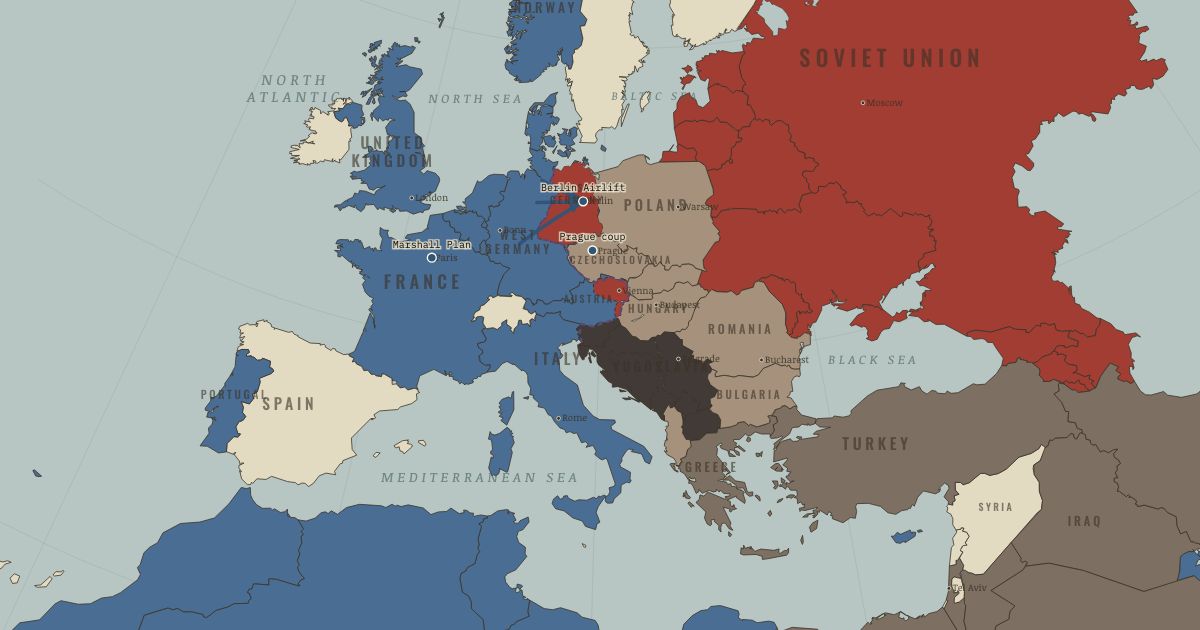
The map above is the world of MAY 1949 — Two Germanies, two Europes.
BRIEF EXPLANATION — THE ESSENTIAL ARGUMENT
The argument at the centre of this chapter is that the United States first fought the Cold War with money rather than with soldiers. By 1947 a bankrupt Britain could no longer sustain the Greek government against communist insurgents, and Washington responded with the Truman Doctrine, a pledge to support “free peoples” resisting subjugation. Its larger instrument was the Marshall Plan, an offer of roughly $13 billion to rebuild Europe, former enemies included, on the reasoning that poverty rather than invasion was the immediate danger containment had to meet.
The offer carried conditions, chiefly open economic accounts and cross-border cooperation, that a Soviet command economy could not accept without loosening its own grip, so Moscow refused the aid and required the states in its sphere to refuse it as well. Berlin then converted this economic division into a test of nerve. When Stalin cut land access to the Western sectors in 1948, the Allies chose to supply the city by air for 323 days rather than force a convoy through. The blockade failed, and its failure brought into being both NATO and two rival German states.
GUIDED EXPLANATION
The winter of 1946–47 brought hunger, fuel shortages and political instability across Europe, and Washington concluded that such conditions could carry communist parties to power through the ballot box even where the Red Army never advanced. Marshall aid therefore tied recovery directly to containment, on the theory that prosperous societies would find communism far less appealing. Western output climbed back above its pre-war level within a few years, while Moscow’s refusal of the aid pushed Eastern Europe into a separate, Soviet-run economic system. A single American programme had begun to divide the continent into two.
Berlin then showed how geography could apply pressure below the level of open war. Stalin closed the road and rail routes into the Western sectors but left the agreed air corridors untouched, calculating that the Allies would rather surrender the city than risk a fight over supply lines. Instead they flew in some 2.3 million tons of coal and food until Moscow lifted the blockade in May 1949. The crisis mattered because it hardened temporary arrangements into permanent ones. A standing Western alliance now bound American security to Europe, and within months the Federal Republic and the German Democratic Republic faced each other across the old occupation line, so that a siege meant to loosen Western resolve had instead welded it together.
The brutal winter of 1946–47 froze canals, halved German rations and pushed French and Italian communist parties. Already a quarter of the vote. Toward power through the ballot box. Marshall’s planners argued that empty stomachs, not Soviet tanks, were the immediate threat. The Plan was containment aimed at despair. It worked: Western European output passed prewar levels by 1951, and the communist vote crested and receded.
On 4 April 1949 twelve nations sign the North Atlantic Treaty. The United States’ first peacetime European alliance since 1778. Article 5’s “an attack on one…” converts the security dilemma into a standing commitment. Watch Greece and Turkey join the blue column in 1952 on the timeline, West Germany in 1955.
DEEP EXPLANATION — EVIDENCE & INTERPRETATION
Recovery, influence and division
The Marshall Plan was at once genuine reconstruction and deliberate statecraft, and both descriptions are true at the same time. It transferred about $13.3 billion, encouraged trade and helped restore production across Western Europe, yet it also required recipients to open their accounts to scrutiny and coordinate their recoveries, drawing them toward an American-led market order. Historians still dispute whether the parallel offer to Moscow was sincere or framed so that it would be refused, but the underlying constraint was real either way, because accepting outside supervision would have threatened Stalin’s control over both a command economy and an entire sphere of client states. Czechoslovakia’s experience exposes the mechanism cleanly: its government first agreed to attend the Paris talks, then reversed itself after direct Soviet pressure. The Plan therefore succeeded on two levels while failing on a third. It underwrote prosperity and democratic stability wherever governments were free to join, but it also made the economic division of Europe far harder to reverse, and the peoples east of the line paid for a settlement they were never allowed to choose.
Coercion without crossing the trigger
The blockade and airlift together established a pattern that would recur throughout the era, which is best understood as calibrated coercion, the application of pressure kept deliberately below the point that would justify war. Stalin exploited the fact that the Western powers held no written guarantee of ground access to Berlin, so he could close the routes without launching an attack that might start a wider conflict. Truman in turn rejected both withdrawal and an armed convoy, choosing instead an airlift that sustained the Western position while leaving Moscow a way to end the crisis without suffering a visible military defeat. Logistics became strategy, because aircraft schedules, coal tonnage and runway capacity now carried political meaning: they proved that West Berlin could be kept alive indefinitely. The episode also demonstrates how pressure that fails can strengthen the very coalition it was meant to divide, since the blockade helped convince sceptical American legislators and European publics that a permanent alliance was necessary. NATO and a West German state were precisely the outcomes Stalin had hoped to prevent.
New here? Chapters 1–2 of every atlas are free to sample, and the WW2 atlas is free in full. One membership opens all thirteen — the Cartographer’s Circle.
THE SITES
ON THIS DAY
WHY IT HAPPENED
Europe was starving, and hunger votes. The brutal winter of 1946–47 froze canals, halved German rations and pushed French and Italian communist parties. Already a quarter of the vote. Toward power through the ballot box. Marshall’s planners argued that empty stomachs, not Soviet tanks, were the immediate threat. The Plan was containment aimed at despair. It worked: Western European output passed prewar levels by 1951, and the communist vote crested and receded.
Why Moscow refused the money. Marshall aid was offered to the USSR and its sphere. Sincerely or as a wedge, historians still argue. Stalin sent Molotov to Paris with ninety economists, then pulled him out: the Plan required open accounts and integration into a Western-run system, which for a command economy meant surrendering control of its buffer. Refusing was rational for the regime and ruinous for its subjects. Czechoslovakia had voted to attend, and was overruled by phone. The two Europes on this map begin as two answers to one memo.
Berlin: geography as leverage. The 1945 occupation plan left the Western sectors of Berlin deep inside the Soviet zone with no written guarantee of ground access. Only three agreed air corridors, each twenty miles wide (your three arrows). Stalin’s blockade was calibrated below the threshold of war: no shots, just closed gates. The airlift answered in kind. No convoy forced through, just physics and logistics. Both sides discovered the Cold War’s grammar: pressure everywhere short of the trigger.
The bomb behind the politeness. America’s atomic monopoly (until August 1949) shaped both sides’ caution. Stalin would not shoot down transports. Truman parked B-29s in England as a signal. The bombers were not actually atomic-configured, an early bluff in a long tradition. Neither side wanted the war both were preparing for. The entire crisis ran on nerve.
THE TURN
Berlin, 24 June 1948 — the gates close. Stalin’s best chance to stop a West German state without war becomes the event that guarantees one. The airlift turns Berliners from defeated enemies into the West’s first Cold War heroes, gives containment its founding legend, and convinces skeptical senators that Europe will fight for itself. NATO passes the Senate 82–13 while the planes are still flying. A siege meant to divide the West welds it.
WHAT IT CHANGED
NATO: the entangling alliance at last. On 4 April 1949 twelve nations sign the North Atlantic Treaty. The United States’ first peacetime European alliance since 1778. Article 5’s “an attack on one…” converts the security dilemma into a standing commitment. Watch Greece and Turkey join the blue column in 1952 on the timeline, West Germany in 1955.
Two Germanies, one open wound. The Federal Republic (May 1949) and the GDR (October) face each other along the zone line. See the hatched split on the map. Neither recognizes the other. Berlin stays divided and porous, the one hole in the curtain. Three million East Germans will walk through it by 1961, until the regime does the only thing left.
The Cominform and the first heretic. Stalin’s answer to Marshall is discipline: the Cominform (1947) to command the bloc’s parties, purges to enforce it. But Yugoslavia’s Tito. Who liberated his own country without the Red Army. Refuses orders and survives excommunication in 1948. Watch Yugoslavia turn charcoal: the first proof that “the communist world” is a phrase, not a fact.
FIELD QUESTION — The Marshall Plan is often called the most successful foreign policy in American history. What exactly did it buy — and what did it cost?
Bought: Western European recovery (and with it the electoral defeat of communism in France and Italy), the habit of European cooperation that became the EEC, and forty years of the deutschmark anchoring the Western order. All for about $13 billion. Cost: the definitive division of Europe. The Plan’s conditions made joining impossible for command economies, so it drew the economic curtain that Fulton had only described. Czechoslovakia’s overruled acceptance is the hinge case. Most historians judge the trade knowingly made and worth it. The Czechs, Poles and Hungarians paid the price of a stability they never chose. Ask of every grand strategy: who bears its costs, and did they get a vote?
AN INTERESTING FACT
The airlift’s best-loved cargo weighed almost nothing. Pilot Gail Halvorsen, who had split two sticks of gum among children at the Tempelhof fence, began wiggling his wings on approach and dropping sweets on handkerchief parachutes; “Operation Little Vittles” grew — American schoolchildren tying the parachutes — to roughly 23 tons of candy by the end. The ledger has a darker column the legend tends to omit: some seventy British and American airmen, and German ground workers besides, died in crashes and accidents along the corridors, in a battle in which no shot was ever fired.
THE DISPATCH
One short letter when a new atlas opens — and the printable study guide for The Cold War is yours now, free.
NO TRACKING · YOUR ADDRESS IS USED FOR THE DISPATCH AND NOTHING ELSE · UNSUBSCRIBE ANYTIME