MAPS OF HISTORY · The Cold War · ALL CHAPTERS · CHAPTER 1
CHAPTER 1 · 1945–1946 · MAR 1946
The World the War Left
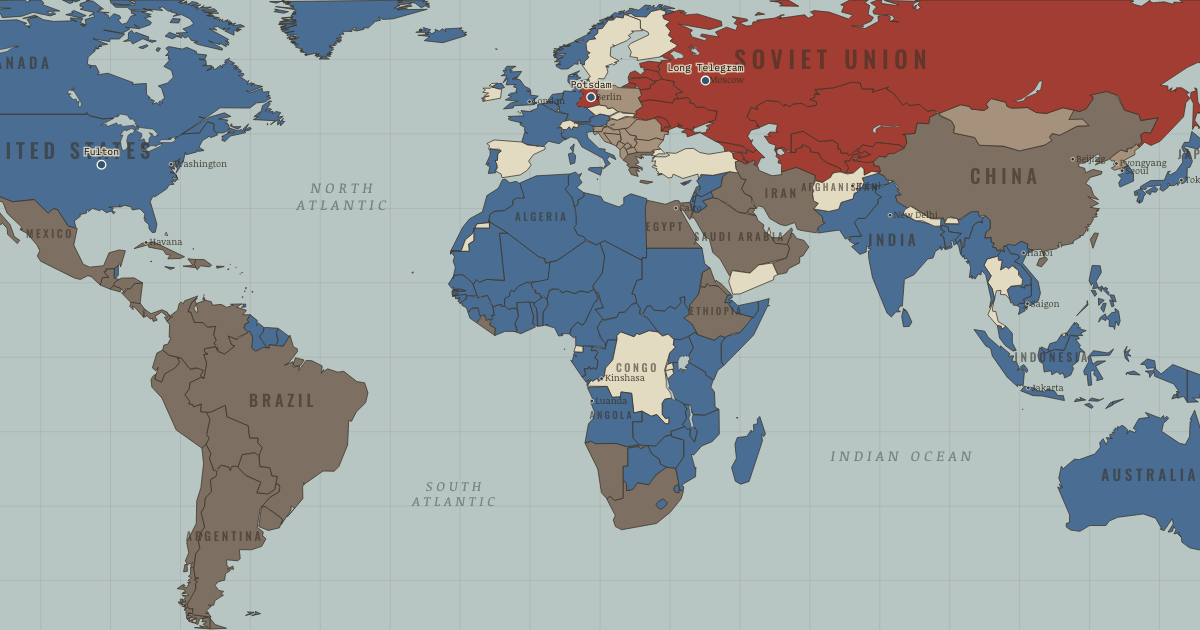
The map above is the world of AUG 1945 — The world the armies made.
BRIEF EXPLANATION — THE ESSENTIAL ARGUMENT
The question that runs through this whole atlas is why the two states that had just defeated Nazi Germany together spent the next forty-six years preparing to fight each other. The answer begins with where their armies stopped in 1945. The Soviet Union, invaded through Poland twice within thirty years at a cost of some 27 million dead, concluded that safety meant physically controlling the ground between Moscow and Berlin. The United States, twice drawn into world wars by the collapse of Europe, concluded that safety meant a world of open trade and governments free to choose their own alignment. Each definition was purely defensive in the eyes of the power that held it, and deeply threatening in the eyes of the other.
This is the mechanism historians call the security dilemma, in which a step one power takes only to protect itself looks like aggression to its rival, which then arms in response, until both are locked into a confrontation neither intended. Quarrels over Poland, Iran and the future of Germany turned that mechanism into a lasting political division. In 1946 the American diplomat George Kennan supplied Washington with its guiding idea, containment, meaning the patient resistance of Soviet pressure without war, and Churchill supplied the public with its image, an “iron curtain” drawn across the middle of Europe.
GUIDED EXPLANATION
The colours on the 1945 map were drawn by armies rather than by any peace conference, and that fact shaped everything that followed. Soviet forces held the ground they had reached in central Europe, Western forces held what they had taken from the opposite direction, and the empires of Britain, France and the rest still coloured much of Asia and Africa. The most dangerous feature of the settlement was Berlin, the German capital, which lay deep inside the Soviet occupation zone yet was itself divided among the victors. Because the Western sectors could be supplied only across Soviet-held territory, the city became a place where either side could apply pressure without having to fire a shot.
The division then hardened through a sequence of disputes in which each side read the other’s conduct as proof of hostile intent. Stalin had promised free elections in Poland at the Yalta conference and instead installed a communist-led government, and Soviet troops lingered in northern Iran past their agreed withdrawal date, leaving only under Anglo-American pressure. These episodes mattered less for the territory involved than for the habit of interpretation they created. Once officials in both capitals treated every local quarrel as a test of the adversary’s deeper aims, compromise began to look like surrender, and the framework of mutual suspicion that would govern the next four decades settled into place.
The USSR, invaded twice through Poland in thirty years at a cost of 27 million dead, defined security as controlling everything between Berlin and Moscow. The United States, twice dragged into world wars by European collapse, defined security as ensuring no single power dominated Eurasia. Each definition made the other side’s nightmare true: Soviet buffer-building looked like expansion. American engagement looked like encirclement. No villain is required for this mechanism to run. Which is precisely what makes it worth studying.
Kennan’s idea gets money and muscle within eighteen months: aid to Greece and Turkey, the Marshall Plan, then NATO. The doctrine’s author will spend decades protesting that he meant political containment, not military. A reminder that ideas are hostages to their implementers.
DEEP EXPLANATION — EVIDENCE & INTERPRETATION
Structure, ideology and responsibility
Historians have long divided over why the Cold War began, and the competing schools assign responsibility differently. Orthodox accounts stress Stalin’s coercion in Poland and the outward pressure of Soviet power. Revisionist accounts emphasise American economic strength, the atomic monopoly and the drive for an open world economy that closed societies could not join. Post-revisionists combine the two by holding structure and choice together. Two exceptionally powerful states had been left facing each other in the vacuum where Germany and Japan once stood, which made some rivalry likely, yet their leaders still decided how severe that rivalry became. The value of the security dilemma is that it explains the underlying mechanism without excusing anyone: Soviet control of Eastern Europe answered a real memory of invasion while denying neighbouring peoples any say in their own government, and American containment answered real coercion while increasingly treating every local change as a piece of one global threat. Poland is the sharpest test precisely because security and sovereignty were both genuine interests there. The useful conclusion is not that conflict was automatic, but that structural tension made restraint hard while ideology and particular decisions made the resulting Cold War far deeper than it had to be.
How a diagnosis became doctrine
Kennan’s Long Telegram was an interpretation of Soviet behaviour rather than a finished military plan. It described that behaviour as cautious, driven by internal ideology, and responsive to firm but limited resistance at a few decisive points. Kennan expected economic and political strength concentrated at key industrial centres to hold Soviet power in check. Washington soon stretched the idea well beyond his intention, in a process worth naming as doctrinal expansion, whereby a narrow diagnosis becomes a broad rule because officials need a single guide they can apply to many different cases. The Truman Doctrine recast aid to Greece and Turkey as support for free peoples everywhere, and the secret NSC-68 review of 1950 translated containment into open-ended global military readiness. The gain from such a rule is consistency, and the cost is that genuinely unlike situations start to look identical. Nationalism, civil war and decolonisation could then be misread as moves directed from Moscow. That distinction runs through the whole era, and it helps explain why containment worked as recovery in Western Europe yet produced far more contested and violent results across Asia and the decolonising world.
New here? Chapters 1–2 of every atlas are free to sample, and the WW2 atlas is free in full. One membership opens all thirteen — the Cartographer’s Circle.
THE SITES
ON THIS DAY
WHY IT HAPPENED
The security dilemma — two rational fears. The USSR, invaded twice through Poland in thirty years at a cost of 27 million dead, defined security as controlling everything between Berlin and Moscow. The United States, twice dragged into world wars by European collapse, defined security as ensuring no single power dominated Eurasia. Each definition made the other side’s nightmare true: Soviet buffer-building looked like expansion. American engagement looked like encirclement. No villain is required for this mechanism to run. Which is precisely what makes it worth studying.
Ideology made compromise read as defeat. This was not only a great-power rivalry. Leninism taught that capitalist encirclement guaranteed eventual war. American liberalism taught that closed societies breed aggression (the lesson of the 1930s). Both creeds were universal. Each side believed history itself was on its side. So every local dispute, from Polish ministries to Iranian oil, carried the weight of a verdict on the future of mankind.
Poland: the test case that failed. Watch Poland on this map. The country Britain went to war for in 1939. At Yalta, Stalin conceded “free and unfettered elections”. What followed were arrests of Home Army leaders, a rigged referendum (1946) and a falsified election (1947). For Washington, Poland proved Soviet promises were worthless. For Moscow, Western protest over Poland proved the West meant to re-encircle Russia with hostile states. One country, two proofs.
A power vacuum with two occupants. Germany and Japan. The powers that had organized Eurasia’s two ends. Were rubble. Britain was bankrupt (it would devalue and retreat from Greece, India and Palestine within three years). France was humiliated. Only two states retained the means to shape the world, and nothing but each other stood between them. Bipolarity wasn’t chosen. It was the arithmetic of 1945.
THE TURN
Moscow, 22 February 1946. Asked routinely why Moscow opposed the World Bank, George Kennan answers with 5,000 words: Soviet hostility flows from internal needs, not Western actions. It cannot be charmed away, but it can be contained, patiently, without war, until the system mellows or breaks. The cable is copied to every embassy and becomes the nearest thing the era has to a master plan. And, forty-five years later, its prophecy of mellowing-or-breakup comes true almost on schedule.
WHAT IT CHANGED
Containment becomes policy. Kennan’s idea gets money and muscle within eighteen months: aid to Greece and Turkey, the Marshall Plan, then NATO. The doctrine’s author will spend decades protesting that he meant political containment, not military. A reminder that ideas are hostages to their implementers.
The wartime alliance is unrecoverable. By late 1946 Moscow has its own mirror-image telegram (Ambassador Novikov: America seeks “world domination”), and Stalin tells voters that war is inherent to capitalism. Both bureaucracies now process every event through an adversarial frame. The interpretive lock-in that makes later off-ramps so hard to take.
Europe divides before the world does. The iron curtain Churchill named runs on this map as a dashed line from the Baltic to the Adriatic. Switch to the EUROPE theater and find it. For four decades the Cold War’s center holds absolutely still there, while its violence migrates to Asia, Africa and Latin America.
FIELD QUESTION — Was the Cold War inevitable in 1945 — or the product of avoidable choices?
The orthodox school blamed Stalin’s expansionism. Revisionists blamed American economic ambition. Post-revisionists (Gaddis and after) tend to answer: some confrontation was structurally likely. Two universalist superpowers in a vacuum. But its depth was chosen. Test the counterfactuals: a Poland with Finnish-style limited autonomy, or an early atomic-sharing deal, might have produced a colder peace rather than a forty-year siege. But note what the structure explains that personalities don’t: the same standoff logic emerged in Korea, Germany and Iran simultaneously, wherever the armies touched. The transferable lesson is the security dilemma itself. Watch for it whenever two powers each arm against the other’s defenses.
AN INTERESTING FACT
The war had a name before most of its combatants knew they were fighting it. George Orwell coined “cold war” in the London magazine Tribune in October 1945 — ten weeks after Hiroshima — predicting that the bomb would produce “a peace that is no peace” between unconquerable super-states. The financier Bernard Baruch carried the phrase into official speech in April 1947 (“let us not be deceived: we are today in the midst of a cold war”), and Walter Lippmann’s book that autumn fixed it for good. Even “iron curtain” was secondhand — Goebbels had used it in print in February 1945, thirteen months before Fulton.
THE DISPATCH
One short letter when a new atlas opens — and the printable study guide for The Cold War is yours now, free.
NO TRACKING · YOUR ADDRESS IS USED FOR THE DISPATCH AND NOTHING ELSE · UNSUBSCRIBE ANYTIME