MAPS OF HISTORY · The Cold War · ALL CHAPTERS · CHAPTER 5
CHAPTER 5 · 1953–1961 · AUG 1961
Coexistence and Its Crises
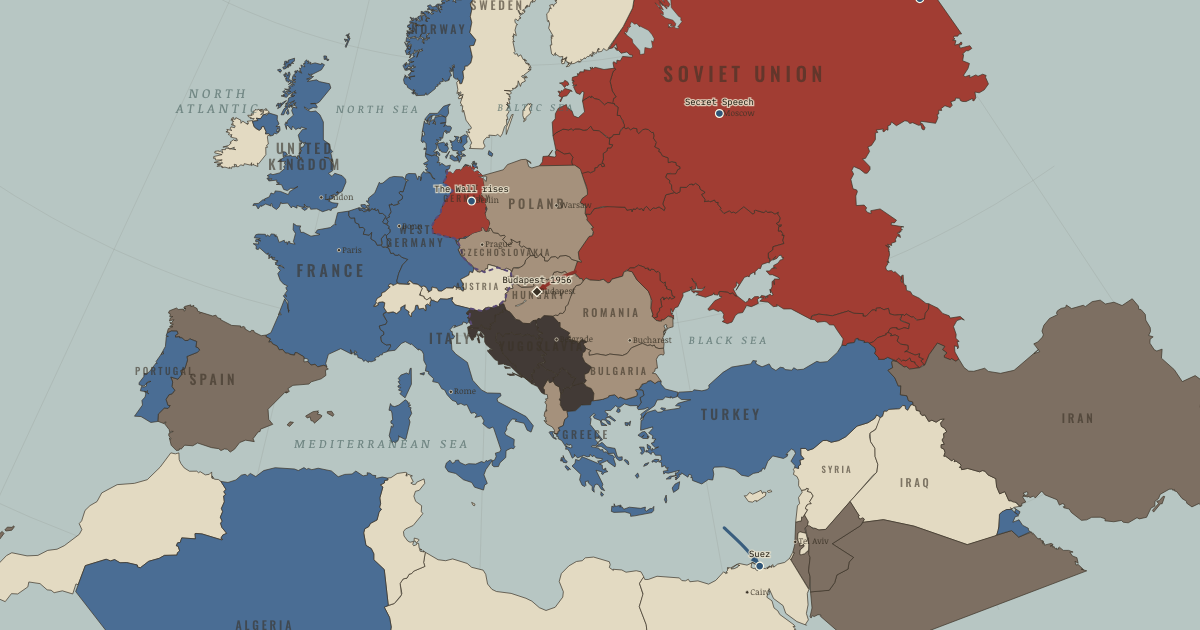
The map above is the world of AUG 1961 — The wall goes up.
BRIEF EXPLANATION — THE ESSENTIAL ARGUMENT
The death of Stalin in 1953 opened a decade in which the Soviet system tried to loosen its grip without losing control of it. Khrushchev promised “peaceful coexistence” with the West and, in a closed speech in 1956, exposed part of Stalin’s terror to the party itself. The effect across the bloc was to weaken the fear that held it together, so that Poland won limited reform while Hungary went further, demanding multiparty politics, neutrality and an exit from the Warsaw Pact.
The limit of that freedom was then made brutally plain. Soviet tanks crushed the Hungarian rising in November 1956, killing some 2,700 people, and in the very same week Washington forced Britain and France to abandon their invasion of Egypt at Suez. The two crises together exposed how unequal the freedoms were inside both alliances. Berlin remained the unsolved pressure point until East Germany, steadily losing its skilled citizens to the West, sealed the city with a wall in August 1961, easing an international crisis by intensifying repression at home.
GUIDED EXPLANATION
Khrushchev’s Secret Speech of 1956 was meant to renew the Soviet system by condemning Stalin’s crimes, yet it dissolved fear faster than Moscow had intended. Once the centre itself declared the terror criminal, reformers throughout the bloc could demand change while still claiming to be loyal socialists. Poland secured a softer, still-communist government that autumn. Hungary pushed past the boundary Moscow would tolerate by seeking neutrality and departure from the alliance, and Soviet armour returned to Budapest, killing roughly 2,700 people and driving 200,000 into exile.
The Suez crisis, unfolding in the same weeks, revealed a parallel hierarchy in the West. Eisenhower used financial pressure to force Britain, France and Israel to abandon their invasion of Egypt, demonstrating that even great allies now moved only with American consent. The rivalry then reached beyond the planet, as Sputnik in 1957 produced a “missile gap” panic that was largely imaginary, and a U-2 spy plane shot down over the USSR in 1960 exposed the mistrust beneath the thaw. The problem underneath it all remained Berlin, through which skilled East Germans were leaving at thousands a day, until the regime closed the gap with concrete. The Wall stopped the exodus while quietly conceding that the system could hold its own people only by force.
Khrushchev attacked Stalin to secure his own position and revive a terrorized system. But the speech dissolved the fear that held the empire together. Mechanism: once Moscow itself said the line had been criminal, every satellite reformer could claim orthodoxy while demanding change. Poland’s Gomułka rode the wave. Hungary’s revolution outran it. Autocracies that admit past crimes without offering future rights create exactly the gap revolutions grow in. A lesson that returns, fatally for the USSR, under glasnost.
Suez finishes Britain and France as independent world powers. Eden resigns within months, and decolonization accelerates from retreat to rout. France draws a different conclusion than Britain: never depend on Washington again. Hence its own bomb (1960) and de Gaulle’s exit from NATO’s command (1966). The Western column on this map is an alliance, not a monolith, from 1956 on.
DEEP EXPLANATION — EVIDENCE & INTERPRETATION
Reform from above and pressure from below
Khrushchev intended de-Stalinisation as a controlled renewal of the system, but by condemning Stalin’s crimes he weakened the fear and unquestioned authority that had disciplined the whole bloc. Reformers could now argue that change was compatible with socialism rather than an act of treason. Moscow could live with the limited Polish settlement because Poland stayed inside the Warsaw Pact, whereas Hungary crossed the strategic line by seeking neutrality and withdrawal from the alliance. The contrast exposes the underlying Soviet tradeoff: variation in a satellite’s domestic life could be tolerated, but the loss of the military buffer could not. Contingency also shaped the outcome, since the Politburo genuinely debated letting Hungary go before deciding to intervene, and the simultaneous Suez invasion made it far harder for the West to claim any moral high ground. Crushing Budapest preserved the bloc in the short term, yet it drove a third of the members from communist parties in France and Italy and taught every satellite that Soviet power, rather than consent, set the system’s limits. The apparent victory carried a heavy long-term cost in legitimacy that the events of 1989 would finally collect.
A brutal solution that reduced strategic risk
The Berlin Wall exposes a hard distinction between human outcomes and strategic ones. It violated freedom of movement and created a fortified border where roughly 140 people are thought to have died trying to cross, and at the same time it ended the recurring crisis over how to halt East Germany’s loss of population. Kennedy privately preferred a wall to a war because it stabilised the territorial situation, but preferring it does not make it good; it means only that a single policy can lower the risk of war between states while deepening repression inside one of them. The driving mechanism was demographic pressure, because East Germans could slip westward through the open sectors of Berlin without crossing the fortified inner-German border, and a disproportionate share of those leaving were young and highly skilled. Sealing that route protected the workforce the GDR needed to survive, yet it also advertised the regime’s lack of consent to the whole world. The Wall was therefore both a practical barrier and an ideological confession, which is why its fall in 1989 mattered so much: it reversed both functions in a single night.
New here? Chapters 1–2 of every atlas are free to sample, and the WW2 atlas is free in full. One membership opens all thirteen — the Cartographer’s Circle.
THE SITES
ON THIS DAY
WHY IT HAPPENED
De-Stalinization was a controlled burn that escaped. Khrushchev attacked Stalin to secure his own position and revive a terrorized system. But the speech dissolved the fear that held the empire together. Mechanism: once Moscow itself said the line had been criminal, every satellite reformer could claim orthodoxy while demanding change. Poland’s Gomułka rode the wave. Hungary’s revolution outran it. Autocracies that admit past crimes without offering future rights create exactly the gap revolutions grow in. A lesson that returns, fatally for the USSR, under glasnost.
Hungary and Suez: the linkage that saved Moscow. The Kremlin hesitated for days over Hungary. Politburo minutes show real debate about letting it go. Suez helped decide: with the West’s own powers bombing an Arab capital, the propaganda cost of crushing Budapest halved, and Khrushchev could pose as anti-imperialist while doing empire’s work. Western radio had encouraged Hungarians to expect help that was never coming. None came. The lesson every satellite drew. The West will mourn you, not save you. Kept the bloc quiet for twelve years.
Sputnik and the politics of panic. The satellite itself was a modified missile test. Its strategic meaning. Soviet rockets can reach Kansas. Was real but not yet operational (the USSR had a handful of unwieldy ICBMs. The “missile gap” actually favored America enormously). But panic is a political fact regardless of its accuracy: Sputnik produced NASA, the National Defense Education Act, and a Democratic campaign theme Kennedy rode to office. Note the pattern. Each side’s alarmists were the other side’s best allies. And watch it recur with the “bomber gap” before and the “window of vulnerability” after.
Berlin: the pressure differential. East Germany was the one satellite whose citizens could simply walk west, sector to sector, and by 1961 they were leaving at 2,000 a day. Disproportionately young, skilled, educated. The GDR was bleeding to death demographically. Khrushchev’s ultimatums (1958, 1961) to end Berlin’s special status were attempts to close the wound by threat. The wall was the fallback: if you cannot win the comparison, forbid it.
THE TURN
Berlin, 13 August 1961 — the admission. Overnight, a state seals its own people in. First wire, then concrete, then a death strip where perhaps 140 will die trying to cross. Strategically the wall stabilizes the Cold War: Kennedy privately calls it “a hell of a lot better than a war,” and the Berlin crises stop. But as argument, it is the war’s quiet verdict: sixteen years into the competition of systems, one side has to wall its citizens in to keep them. Reagan’s 1987 speech, and the crowds of 1989, only collect a debt signed here.
WHAT IT CHANGED
The empires exit the stage. Suez finishes Britain and France as independent world powers. Eden resigns within months, and decolonization accelerates from retreat to rout. France draws a different conclusion than Britain: never depend on Washington again. Hence its own bomb (1960) and de Gaulle’s exit from NATO’s command (1966). The Western column on this map is an alliance, not a monolith, from 1956 on.
Nasser’s template: play both sides. Nasser survives Suez a hero, armed by Czech-brokered Soviet weapons and dammed by Soviet engineers at Aswan. While jailing Egyptian communists. Watch Egypt on the map: parchment, then tan, then back. The non-aligned discover the auction: the superpowers’ rivalry is the Third World’s leverage, and Moscow’s “anti-imperialist” brand, burnished at Suez, opens doors across three continents.
The space race as war by other means. Gagarin (1961) and Apollo (1969) bracket a decade in which orbit substitutes for battle: same rockets, same prestige stakes. It is the era’s best invention. A contest the whole species could watch whose dead were counted in crews, not armies (Apollo 1’s three, Soyuz 1 and 11’s four, and the launch-pad workers of the 1960 Nedelin disaster the USSR denied for thirty years). And it drove the satellite and computing revolutions the post-Cold-War world runs on.
FIELD QUESTION — Was crushing Hungary a Soviet victory or a Soviet defeat?
By every immediate measure, victory: the bloc held, the West stayed out, and deterrence-by-example bought twelve quiet years. But run the longer ledger. Budapest cost Moscow the world’s communist parties (a third of French and Italian members quit within a year. The birth of Eurocommunism), armed the charge that Soviet anti-imperialism was fraud, and taught the satellites that the system rested on tanks alone. Knowledge that resurfaced intact in 1989, when the tanks stayed home and everything fell in months. Empires that can only compel have already lost the argument. The interesting question is how long compulsion can outlive consent. Here: thirty-three years, almost to the week.
AN INTERESTING FACT
How did the CIA get the Secret Speech? Through a romance. Viktor Grayevsky, a Polish journalist, noticed a red-bound copy — one of the numbered printings circulated to bloc parties — on the desk of his girlfriend, a secretary at the Polish party’s headquarters; he borrowed it for an afternoon and walked it to the Israeli embassy, where every page was photographed before he returned it. Israel passed the text to the CIA, and by 4 June 1956 the speech Khrushchev had delivered behind locked doors was published for the whole world to read.
THE DISPATCH
One short letter when a new atlas opens — and the printable study guide for The Cold War is yours now, free.
NO TRACKING · YOUR ADDRESS IS USED FOR THE DISPATCH AND NOTHING ELSE · UNSUBSCRIBE ANYTIME