MAPS OF HISTORY · The Cold War · ALL CHAPTERS · CHAPTER 6
CHAPTER 6 · 1962 · OCT 1962
Cuba: To the Brink
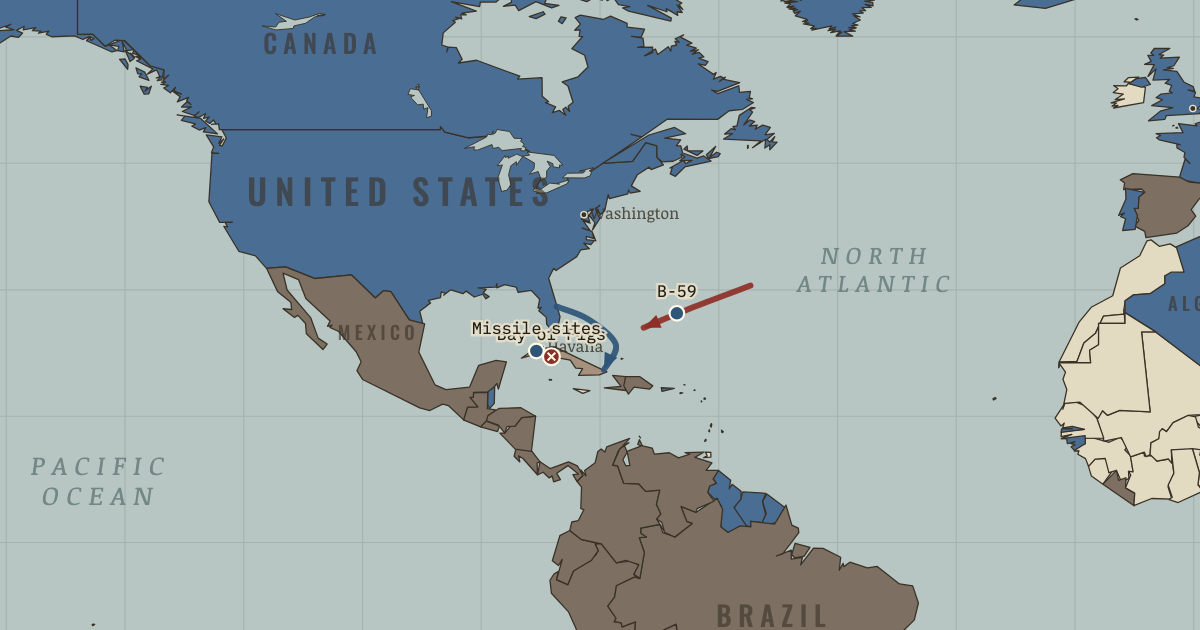
The map above is the world of OCT 1962 — Cuba flips; Africa walks free.
BRIEF EXPLANATION — THE ESSENTIAL ARGUMENT
The Cuban Missile Crisis grew out of an unequal nuclear balance and a chain of provocations. The United States held a wide lead in strategic missiles and had recently placed its own weapons in Turkey, on the Soviet border, while Cuba, driven toward Moscow by American hostility and the failed Bay of Pigs invasion, offered Khrushchev a way to narrow that gap by secretly stationing Soviet missiles ninety miles from Florida. A U-2 reconnaissance flight photographed the launch sites in October 1962.
For thirteen days the world watched the only direct nuclear confrontation of the era. Kennedy rejected his commanders’ push for immediate airstrikes and chose a naval “quarantine” instead, buying time for negotiation. The crisis ended with a public American pledge not to invade Cuba and a secret agreement to withdraw the American missiles from Turkey. Careful judgement created the space for that diplomacy, yet several accidents that week reveal how much survival also depended on plain luck.
GUIDED EXPLANATION
Cuba’s revolution drifted toward Moscow after Washington’s hostility and the botched Bay of Pigs landing of 1961 pushed it there, and Khrushchev saw in the island both a vulnerable ally worth protecting and a way to offset a heavy strategic disadvantage. Medium-range missiles, which the USSR possessed in quantity, would count as strategic weapons the moment they stood off the American coast. The plan’s fatal weakness was that it depended on a secrecy that tens of thousands of troops and hundred-foot missile trailers, spread across a photographed island, could never actually keep.
For thirteen days in October the Executive Committee argued over its options while Soviet ships steamed toward the quarantine line. Kennedy rejected airstrikes because they would kill Soviet personnel and might trigger a response no one could control, choosing instead a blockade that placed the next decision back on Khrushchev. The most dangerous moments came from below the leaders’ view: on 27 October a U-2 was shot down over Cuba, another strayed into Soviet airspace, and the submarine B-59, out of radio contact and shaken by depth charges, came within one officer’s refusal of firing a nuclear torpedo. The settlement withdrew the missiles and preserved Cuba, and both capitals emerged sobered enough to begin building the first machinery of arms control.
The missile gap ran against Moscow. 26 reliable Soviet ICBMs against hundreds of American bombers and missiles ringing the USSR from Turkey to Britain. Cuba offered instant equalization: medium-range missiles (which the USSR had in plenty) become strategic weapons when parked off Florida. Khrushchev also genuinely feared a second, serious invasion of Cuba and saw the deployment as deterrence. The plan’s fatal flaw was operational: it required secrecy that 40,000 troops and 100-foot missile trailers on a photographed island could never keep.
Both capitals emerge shaken into sobriety: a direct teletype link (June 1963) so the next crisis can be argued in hours not days, and the Limited Test Ban Treaty (August 1963) ending atmospheric testing. The first arms-control agreement of the era, seed of the entire SALT/ABM/INF architecture. The crisis didn’t end the arms race. It civilized its paperwork.
DEEP EXPLANATION — EVIDENCE & INTERPRETATION
Why the quarantine created decision space
An immediate airstrike would have handed control of events to military reactions in the first hour, whereas the quarantine applied pressure more slowly and forced Khrushchev to decide whether to challenge it. Calling the blockade a “quarantine” did not remove the legal awkwardness, since a formal blockade has traditionally been treated as an act of war, but it helped distinguish the action and lower the temperature. The essential mechanism was tempo control, because Kennedy’s advisers could raise or ease the pressure while private messages quietly explored a way out. The secret removal of the obsolete Jupiter missiles from Turkey gave Moscow a genuine concession without letting the public exchange look like a direct swap, which protected allied confidence but also hid how the compromise really worked and fed a durable myth that firmness alone had forced the Soviets to retreat. Effective crisis management here combined force, open lines of communication and an exit that both leaders could accept. It did not abolish danger; it multiplied the number of separate moments in which restraint had a chance to operate.
What B-59 does to deterrence theory
Nuclear deterrence assumes that leaders grasp the threats they face and make their choices under firm, centralised command, and the experience of submarine B-59 exposes the operational gap beneath that comfortable assumption. Its crew had lost communication with Moscow, were suffering in extreme heat, and could not know that the American practice depth charges falling around them were meant as signals rather than as an attack. Launching the submarine’s nuclear torpedo required the agreement of three officers, and Vasili Arkhipov withheld his consent. Other incidents the same day included the loss of a U-2 over Cuba and an accidental flight toward Soviet airspace, none of them ordered by Kennedy or Khrushchev. Historians therefore argue over whether the outcome shows successful deterrence or extraordinary luck, and the strongest reading holds both at once: Kennedy’s deliberate process slowed the escalation and Khrushchev accepted a compromise, yet survival still turned on individuals coping with events their governments had never anticipated. Institutions can make luck less dangerous, but they cannot remove chance from complex weapons systems.
New here? Chapters 1–2 of every atlas are free to sample, and the WW2 atlas is free in full. One membership opens all thirteen — the Cartographer’s Circle.
THE SITES
ON THIS DAY
WHY IT HAPPENED
Khrushchev’s gamble: parity on the cheap. The missile gap ran against Moscow. 26 reliable Soviet ICBMs against hundreds of American bombers and missiles ringing the USSR from Turkey to Britain. Cuba offered instant equalization: medium-range missiles (which the USSR had in plenty) become strategic weapons when parked off Florida. Khrushchev also genuinely feared a second, serious invasion of Cuba and saw the deployment as deterrence. The plan’s fatal flaw was operational: it required secrecy that 40,000 troops and 100-foot missile trailers on a photographed island could never keep.
The Bay of Pigs, author of the crisis. April 1961 taught every party the wrong-but-fateful lesson: Castro learned invasion was coming and demanded protection. Khrushchev learned Kennedy could be pressured (their Vienna summit confirmed it. “he savaged me,” Kennedy admitted). Kennedy learned never again to swallow unanimous expert confidence. The single lesson that saved October 1962, when the experts were unanimous again and again wrong about Soviet tactical nukes already on the island (the invasion the chiefs urged would have met them).
The quarantine: force with a built-in pause. An airstrike kills Soviet soldiers in hour one and forces Moscow’s hand. A blockade. Illegal under international law, hence the softer word “quarantine”. Puts the next move back on Khrushchev and buys days of decision time. ExComm’s real product was tempo control: every step chosen to leave the adversary an exit with face. Compare the Yalu (Ch. 4), where victory’s momentum was allowed to set policy. Crisis design is a learnable craft. This is its textbook.
THE TURN
27 October, aboard B-59 — one man’s no. Out of radio contact for days, batteries failing, crew fainting in 45°C heat, bracketed by practice depth charges it cannot know are signals. B-59’s captain orders the nuclear torpedo readied: “We’re going to blast them now! We will die, but we will sink them all.” Authorization required three officers. Flotilla commander Vasili Arkhipov, aboard by administrative chance, said no. No committee, no hotline, no doctrine. The era’s machinery of deterrence, at its one moment of direct contact, came down to one exhausted man’s judgment. Treat every theory of “stable deterrence” to this fact.
WHAT IT CHANGED
The hotline and the test ban: procedure against apocalypse. Both capitals emerge shaken into sobriety: a direct teletype link (June 1963) so the next crisis can be argued in hours not days, and the Limited Test Ban Treaty (August 1963) ending atmospheric testing. The first arms-control agreement of the era, seed of the entire SALT/ABM/INF architecture. The crisis didn’t end the arms race. It civilized its paperwork.
Two lessons, drawn in opposite directions. Washington concluded that resolve plus flexible options wins crises. Moscow concluded it must never again negotiate from weakness. “you Americans will never be able to do this to us again,” a Soviet diplomat told his counterpart. And launched the naval and missile buildup that reached true parity by 1970. The stability of the 1970s and the expense of the 1980s are both children of October 1962.
Cuba, the client who wasn’t consulted. Castro. Who had urged Khrushchev to accept nuclear war rather than back down, and learned of the withdrawal from the radio. Never forgave the humiliation, and spent the next decades exporting revolution on his own initiative, from Bolivia to Angola, often ahead of Moscow’s wishes. File under the era’s recurring surprise: clients have agendas. The tail wags every dog on this map.
FIELD QUESTION — Kennedy’s advisers split between airstrike and blockade. The airstrike faction lost — and later evidence suggests the airstrike would likely have triggered nuclear use. Was the outcome good judgment or good luck?
Both, inseparably. And the proportions matter. Judgment: Kennedy had read The Guns of August, distrusted expert unanimity after the Bay of Pigs, deliberately slowed the clock, and privately traded the Jupiters. Accepting political cost to give his adversary an exit. Luck: Arkhipov’s presence on B-59 specifically. The strayed U-2 not being shot down. Khrushchev deciding Saturday night that the deal outran the humiliation. McNamara’s later verdict. “we lucked out”. Coexists with the fact that the process was designed to give luck more chances to save them. That is the transferable principle: you cannot remove chance from crises, but you can choose procedures that let chance land softly. Then ask the darker question: how many Arkhipov-shaped holes exist in today’s arsenals?
AN INTERESTING FACT
The famous “red telephone” never existed. The hotline the crisis produced was a teleprinter — both sides distrusted spur-of-the-moment speech and wanted the pause of typing and translation — running over cable through London, Copenhagen, Stockholm and Helsinki. Washington’s first test message, on 30 August 1963, was the typist’s pangram “THE QUICK BROWN FOX JUMPED OVER THE LAZY DOG’S BACK 1234567890”; Moscow replied with a lyrical description of the evening sun over its capital. The link was first used in a real crisis during the Six-Day War of 1967 — by which time both ends knew it worked.
THE DISPATCH
One short letter when a new atlas opens — and the printable study guide for The Cold War is yours now, free.
NO TRACKING · YOUR ADDRESS IS USED FOR THE DISPATCH AND NOTHING ELSE · UNSUBSCRIBE ANYTIME