MAPS OF HISTORY · The Crusades · ALL CHAPTERS · CHAPTER 6
CHAPTER 6 · 1171–1187 · 1187
Saladin
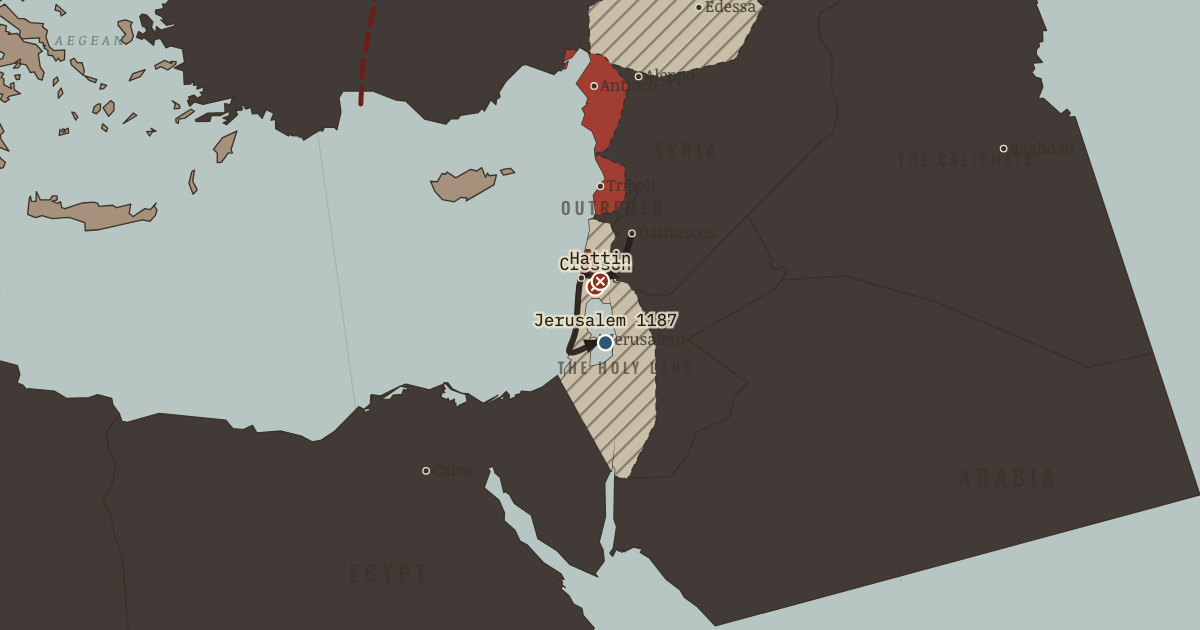
The map above is the world of 1187 — Hattin — the kingdom collapses.
BRIEF EXPLANATION — THE ESSENTIAL ARGUMENT
Outremer had always depended on its enemies remaining divided, and Saladin’s career removed that protection for good. Sent to Egypt as an officer of Nur al-Din, he abolished the Shia Fatimid caliphate in 1171 and returned the country to Sunni allegiance, making himself its master. After Nur al-Din’s death he spent a decade taking Syria as well, mostly from fellow Muslims, and legitimized the conquest through marriage into the Zengid house, recognition from the caliph in Baghdad and the language of jihad. For the first time since the crusaders arrived, Egypt and Syria formed a single power encircling the crusader states.
In 1187 that encirclement closed. The kingdom’s army left its water to relieve Tiberias and was destroyed at the Horns of Hattin, after which the cities surrendered one after another and Jerusalem itself gave up in October. Saladin’s relatively restrained treatment of the conquered city, with ransoms often reduced or waived and no general massacre, stood in deliberate contrast to the slaughter of 1099. It was genuine mercy and effective political communication at the same time, and it did much to build both his authority and his later reputation.
GUIDED EXPLANATION
The single most consequential change on the map in this period was also one of the quietest, when Fatimid Egypt passed into Saladin’s hands in 1171 and its long separation from Sunni Syria came to an end. Saladin had been sent to Egypt as Nur al-Din’s subordinate, but by ending the Shia Fatimid caliphate and restoring Sunni allegiance he made himself the country’s ruler, and when Nur al-Din died in 1174 he spent years taking Syria from other Muslims. He engineered his legitimacy as carefully as any conquest, marrying into the Zengid family, winning the Baghdad caliph’s recognition and presenting the whole project as preparation for recovering Jerusalem. By 1186 one power controlled both Egypt and Syria, and the crusader coast lay inside its grip.
The crusaders’ own divisions completed the disaster. A disputed succession had placed the weak King Guy on the throne against a powerful faction, and the reckless charge of the military orders at the Springs of Cresson threw away much of the kingdom’s best cavalry in a single afternoon. Guy then led his whole army across a waterless plateau to relieve Tiberias, against the advice of his commanders, and at Hattin on 4 July the parched and surrounded force was destroyed and the True Cross captured. With almost no field army left to defend them, the cities fell in rapid sequence, and Jerusalem surrendered in October. Saladin demanded ransoms but often reduced or waived them and allowed no general massacre, and the contrast with 1099 strengthened both his standing and his legend.
Hattin mattered because it exposed the weakness that Outremer’s castles had always concealed. The kingdom had concentrated its scarce mobile forces in one place, and once that army disappeared the fortresses could delay attackers but could no longer relieve one another. Saladin turned the march itself into a weapon, using fire, harassment and control of the wells to exhaust the crusaders before the decisive fighting even began, and the coordinated sweep that followed showed a capacity earlier Muslim rulers had simply lacked the resources to sustain. The collapse was not literally total, since Tyre held out and the northern states survived, but the strategic system had changed permanently. Egypt now financed continued war and Syria supplied depth, while Outremer no longer had enough soldiers to guard both a field army and its walls at once, so that a single defeat could undo nearly ninety years of conquest.
DEEP EXPLANATION — EVIDENCE & INTERPRETATION
Unity Changed the Strategic Equation
Outremer had survived in part because Damascus, Aleppo and Cairo could be played against one another, and Saladin’s achievement was to remove that balance. Egypt supplied revenue, grain and fleets, while Syria supplied routes, cities and armies, and their combination did not make every battle a foregone conclusion but it did let one ruler press on several fronts and replace his losses far more easily than the coastal states could replace theirs. It is worth remembering that Saladin took years to build this position and often fought fellow Muslims to do it, which complicates any simple story of spontaneous religious unity, and the rhetoric of jihad served precisely to explain those wars as necessary preparation. The underlying process was cumulative state formation, running from Nur al-Din’s consolidation of Syria to Saladin’s Egyptian base and his later mastery of Syria. Hattin was the operational result of a strategic imbalance that had been assembled, with great difficulty, over several decades.
The Making of a Shared Hero
Saladin’s clemency at Jerusalem is well attested and genuinely significant when set beside the massacre of 1099, but it was not a blanket softness. After Hattin he ordered the execution of the captured Templars and Hospitallers, and he personally killed Reynald of Châtillon even as he spared King Guy, because medieval rulership could combine selective mercy with exemplary violence without any sense of contradiction. Muslim court writers presented him as the champion of jihad, while later Western literature increasingly recast him as a model of chivalry, and Enlightenment authors then used the figure of the “noble Saladin” to shame the fanaticism of their own crusading ancestors. His reputation is therefore both earned and constructed at once. Political calculation does not make his mercy unreal, since public mercy could save lives and build legitimacy at the same moment. The more useful question is not whether he was sincere or strategic, but how virtue, violence and public representation worked together in the making of a hero honoured on both sides.
New here? Chapters 1–2 of every atlas are free to sample, and the WW2 atlas is free in full. One membership opens all thirteen — the Cartographer’s Circle.
THE SITES
ON THIS DAY
WHY IT HAPPENED
The union of Egypt and Syria. Everything turns on the strategic fact created between 1171 and 1186: the two halves of the Muslim Near East, so long divided, are now a single state ringing the crusader coast. Outremer’s survival had always depended on that division. Once it ended, the kingdom was strategically doomed; Hattin merely delivered the verdict.
Legitimacy, manufactured. Saladin was a Kurdish usurper who took power from fellow Muslims. He made himself legitimate through the Zengid marriage, caliphal investiture, and relentless jihad propaganda that recast the conquest of Muslim Syria as preparation for the war against the Franks. Like Urban and Nur al-Din before him, he understood that holy war is also a language of power.
The crusaders’ self-destruction. A disputed succession had put the weak Guy on the throne against a powerful faction; the orders’ recklessness at Cresson bled the army; and at the fatal council Guy was talked into abandoning his water and marching into a trap. A society with no strategic depth (Ch. 3) chose the one course — battle in the open, away from water — that could destroy it in a day.
THE TURN
The Horns of Hattin, 4 July 1187. This is the catastrophe Chapter 3 predicted. An army that should never have left its wells is destroyed by thirst and encirclement in an afternoon, and with it goes the kingdom’s entire field force and the True Cross. Because Outremer had no depth to absorb a defeat, one lost battle unmade a century of conquest. It is the clearest lesson in the atlas that brittle strength is no strength at all.
WHAT IT CHANGED
Outremer reduced to slivers. Watch the map: the red kingdom becomes a lost-hatch, with only Tyre holding on the coast and Tripoli and Antioch surviving in the north. In a single campaigning season Saladin undoes nearly ninety years.
The Third Crusade summoned. The fall of Jerusalem is a thunderclap in Europe; three of its greatest kings take the cross. The counter-blow is the subject of the next chapter.
A legend in two civilizations. Saladin’s mercy at Jerusalem made him the rare figure honoured by both sides — mujahid and chivalric knight at once. How memory manufactures such heroes is worth interrogating; the man was both merciful and ruthless as war required.
FIELD QUESTION — Saladin is a hero in both Muslim and Western memory. Is that reputation earned, or made?
Both, and the interesting work is separating them. Earned: the clemency at Jerusalem in 1187 was genuine and, set against 1099, morally striking; he was, by the standards of his age, often generous and restrained. Made: he was also a shrewd propagandist who needed legitimacy after seizing power from fellow Muslims, and who could be ruthless — executing prisoners, notably the military orders after Hattin, when it suited the war. The Western romance of “the noble Saladin” grew partly because a chivalrous enemy flattered the chivalry of those he beat, and later because Enlightenment writers used him to shame their own crusading ancestors. A fair judgement holds the real virtue and the real calculation together, and notices that legends are always built for the needs of those who tell them.
AN INTERESTING FACT
The scene in the tent after Hattin was set down by Saladin’s own secretary, Imad al-Din al-Isfahani, who was present. The sultan seated the captured King Guy beside him and handed him water cooled with snow; when Guy passed the cup to Reynald of Châtillon, Saladin had the interpreter make one thing plain — it was the king, not he, who had given that man drink — for by custom a host who offers a captive water has bound himself to spare him. Reynald he then cut down himself, fulfilling an old oath; Guy he spared, saying that kings do not kill kings. One cup of iced water, and the whole Saladin problem — mercy and calculation in a single gesture.
THE DISPATCH
One short letter when a new atlas opens — and the printable study guide for The Crusades is yours now, free.
NO TRACKING · YOUR ADDRESS IS USED FOR THE DISPATCH AND NOTHING ELSE · UNSUBSCRIBE ANYTIME