MAPS OF HISTORY · The Crusades · ALL CHAPTERS · CHAPTER 7
CHAPTER 7 · 1189–1192 · 1191
The Third Crusade
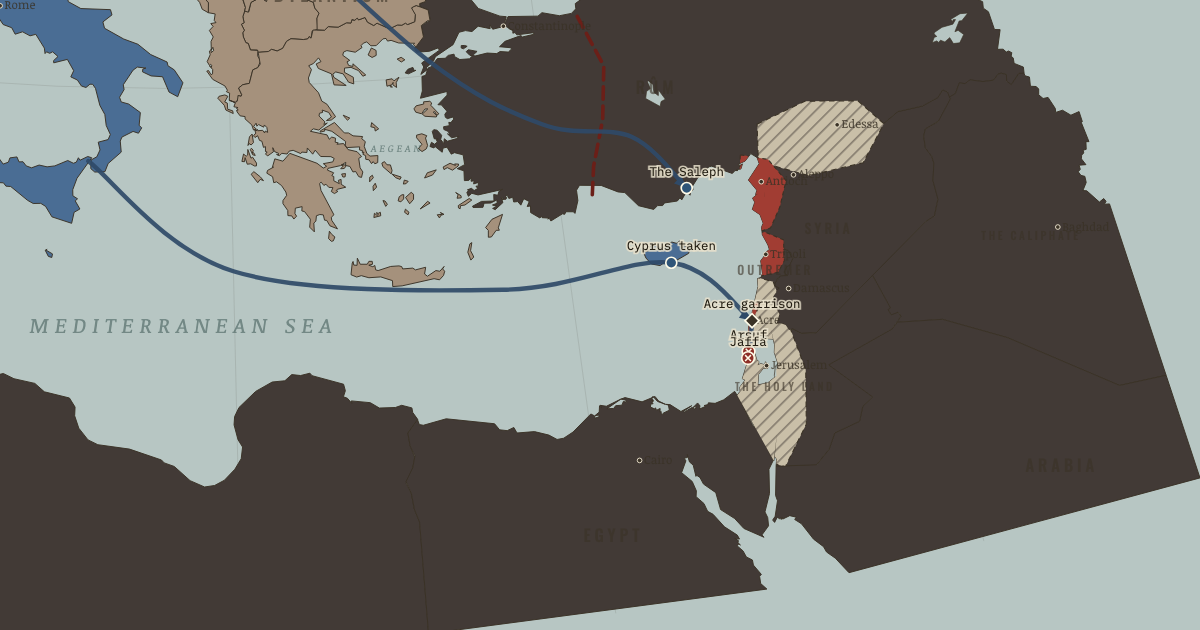
The map above is the world of 1192 — The treaty coast.
BRIEF EXPLANATION — THE ESSENTIAL ARGUMENT
The fall of Jerusalem brought three of Europe’s greatest kings east, and the crusade’s difficulties began at once. Frederick Barbarossa, the mightiest of the three, drowned crossing the Saleph river before he reached the Levant, and Philip II of France left early. That left Richard I of England, who seized Cyprus on his way, helped take the besieged city of Acre and defeated Saladin in open battle at Arsuf. At Acre he also ordered the killing of some 2,700 prisoners of the surrendered garrison, an atrocity against captives that is recorded here soberly.
Despite these victories Richard never attempted to hold Jerusalem, and his reasoning is the strategic heart of the chapter. An inland city could not be supplied or defended while Egypt, the source of Saladin’s resources, remained in Muslim hands. The treaty he made in 1192 preserved a reduced coastal Latin state and secured the right of Christian pilgrimage to Jerusalem without transferring the city itself. Tactical success had bought access rather than possession, which was the most that force could deliver from an insoluble position.
GUIDED EXPLANATION
The Third Crusade lost much of its strength before it could be used. Frederick Barbarossa marched a huge German army overland only to drown in the Saleph in Cilicia in 1190, after which his force dissolved in grief and disease, so that the strongest of the three crusaders never arrived. Richard the Lionheart sailed instead, and on the way seized Cyprus from its Byzantine ruler in an unplanned conquest that turned out to be the crusade’s most durable prize, a Latin kingdom that would outlast every state on the mainland by three centuries. The long siege of Acre finally ended in 1191, and it was there that the campaign’s worst act took place.
With the ransom negotiations for Acre’s surrendered garrison stalled, Richard had some 2,700 prisoners executed in full view of Saladin’s army, and this killing of captives is named here soberly rather than folded into the story of his generalship. He then marched south down the coast in a disciplined defensive formation, refusing to be drawn into a premature fight, and at Arsuf he absorbed Saladin’s harassment and broke his army in the open. The victory proved that a well-handled crusader force could still defeat Saladin in battle. It did not, however, solve the problem that actually governed the war, because winning a field engagement was a different thing from holding territory.
Jerusalem lay inland, and Saladin still controlled the surrounding country and the resources of Egypt, so a Christian garrison there would have been an isolated island in hostile territory, cut off from the sea and impossible to supply. Richard advanced toward the city twice and each time withdrew rather than capture a place he expected to lose, understanding a distinction his contemporaries found hard to accept, between taking an objective and sustaining control of it after the army moves on. He could win battles, including a hard defensive fight at Jaffa in 1192, but he could not manufacture new settlers or remove Saladin’s Egyptian base, and both leaders faced political limits, since Richard needed to return to defend his lands in Europe and Saladin’s emirs were exhausted. The treaty of 1192 was no one’s ideal, yet it converted a military stalemate into a smaller defensible coastal state and protected pilgrimage without surrendering sovereignty, extracting the most that force could win from a position that could not be resolved by force alone.
DEEP EXPLANATION — EVIDENCE & INTERPRETATION
Why Arsuf Did Not Decide the War
At Arsuf Richard kept his infantry and cavalry together in a defensive column close to the coast, where his ships could feed the army, and he held off repeated attacks until a coordinated charge broke Saladin’s forces. The victory restored crusader confidence and secured the march to Jaffa, but it did not destroy Saladin’s state or shrink his much larger base of resources. Jerusalem presented the opposite geography, lying inland, hard to supply and ringed by enemy-held territory, so that taking it and keeping it were entirely different problems. Richard grasped the difference between seizing an objective and sustaining control of it once the army had moved on, whereas medieval observers, fixed on the sacred city, could read his withdrawal only as failure. Preserving the coast in fact kept a viable state alive. Arsuf illustrates a pattern that recurs throughout military history, in which tactical superiority on the battlefield cannot overcome an unfavourable political and logistical map.
Acre and the Limits of Chivalric Memory
After Acre surrendered, the negotiations concerned ransom, the return of the True Cross and the release of Christian captives, and when their implementation stalled Richard ordered roughly 2,700 Muslim prisoners killed, though some accounts give different totals. The explanations offered include the difficulty of guarding so many prisoners during the coming march, distrust of Saladin and a wish to force compliance, but none of them changes the status of the victims as men who had surrendered. Later romantic memory tends to isolate Richard’s courage and diplomacy from this massacre, just as idealized portraits of Saladin can omit his executions after Hattin. A balanced account refuses to keep a moral scoreboard between the two leaders. It preserves the atrocity as part of the campaign and asks instead how practical pressures, retaliation and reputation together made violence against prisoners seem thinkable, and it notes that the language of chivalry regulated some conduct while coexisting with extreme coercion.
New here? Chapters 1–2 of every atlas are free to sample, and the WW2 atlas is free in full. One membership opens all thirteen — the Cartographer’s Circle.
THE SITES
ON THIS DAY
WHY IT HAPPENED
The shock of 1187. The loss of Jerusalem and the True Cross galvanized Europe as nothing had since 1095. Kings who were bitter rivals at home all took the cross — which is also why the crusade was riven by their feuds the moment they arrived.
The logistics of holding Jerusalem. This is the strategic heart of the chapter. Taking the inland city was conceivable; holding it, ringed by Muslim Syria and supplied from an Egypt in enemy hands, was not. Richard grasped that the Holy Land could ultimately be secured only by conquering Egypt — the insight that would drive every crusade after him.
Exhaustion, personal and political. Richard had to go home: his rival Philip of France had already left to intrigue against his lands, and his brother John was scheming. Saladin’s emirs, too, were spent after years of war. The treaty of 1192 was the peace of two exhausted men who each needed it.
THE TURN
Arsuf, 7 September 1191. Arsuf proved that a disciplined crusader army could still beat Saladin in a straight fight — and, in the same stroke, proved that winning battles no longer won the war. Richard could defeat the sultan in the field and still not hold Jerusalem, because the problem was no longer tactical but strategic and logistical. The chapter’s deepest point is in that gap between victory and result.
WHAT IT CHANGED
A rescued but truncated kingdom. Outremer survives — as a coastal strip governed from Acre, with Jerusalem a pilgrimage destination rather than a possession. The states will last another century in this diminished, seaward form.
Cyprus, the lasting prize. Almost incidentally, Richard’s capture of Cyprus gives the Latin world a rich, defensible island base that endures until 1571 — long after the mainland is lost. The crusade’s most durable conquest was the one no one had planned.
The Egypt doctrine. After Richard, every strategist sees that the road to Jerusalem runs through Cairo. The next four major crusades will all aim at Egypt — and mostly die there.
FIELD QUESTION — Richard beat Saladin at Arsuf and Jaffa but never tried to hold Jerusalem. Was that failure or realism?
It was realism, and the mark of a general who understood the difference between a battle and a war. Richard could win field engagements, but a Jerusalem garrison would have been a besieged island in Muslim territory, cut off from the sea and impossible to supply while Egypt fed Saladin’s war. Storming the city for the symbolism and then losing it (as would happen to others) would have been the true failure. The 1192 treaty — pilgrim access without possession — extracted the most that force could deliver from an insoluble position, and Richard’s recognition that Egypt, not Jerusalem, was the strategic key was the crusade’s most clear-eyed conclusion. Judging him by the medieval yardstick (did he retake the Holy City?) misses that he read the map correctly and his contemporaries did not.
AN INTERESTING FACT
For all the legend of their duel, Richard and Saladin never met — not once; every exchange ran through envoys, most often Saladin’s brother al-Adil. Their diplomacy produced the strangest proposal of the age: in October 1191 Richard offered his sister Joan, the widowed Queen of Sicily, in marriage to al-Adil, the couple to rule Jerusalem jointly. Saladin’s judge and biographer Baha al-Din, who recorded the negotiations, says the sultan accepted at once — reckoning Richard could never deliver — and Joan, when she heard of it, was furious at the idea of marrying a Muslim; the scheme dissolved. Every later painting of the two kings face to face depicts a meeting that never happened.
THE DISPATCH
One short letter when a new atlas opens — and the printable study guide for The Crusades is yours now, free.
NO TRACKING · YOUR ADDRESS IS USED FOR THE DISPATCH AND NOTHING ELSE · UNSUBSCRIBE ANYTIME