MAPS OF HISTORY · WWI · ALL CHAPTERS · CHAPTER 9
CHAPTER 9 · WINTER 1917–18 · APR 1918
Brest-Litovsk: The Gamble in the East Pays
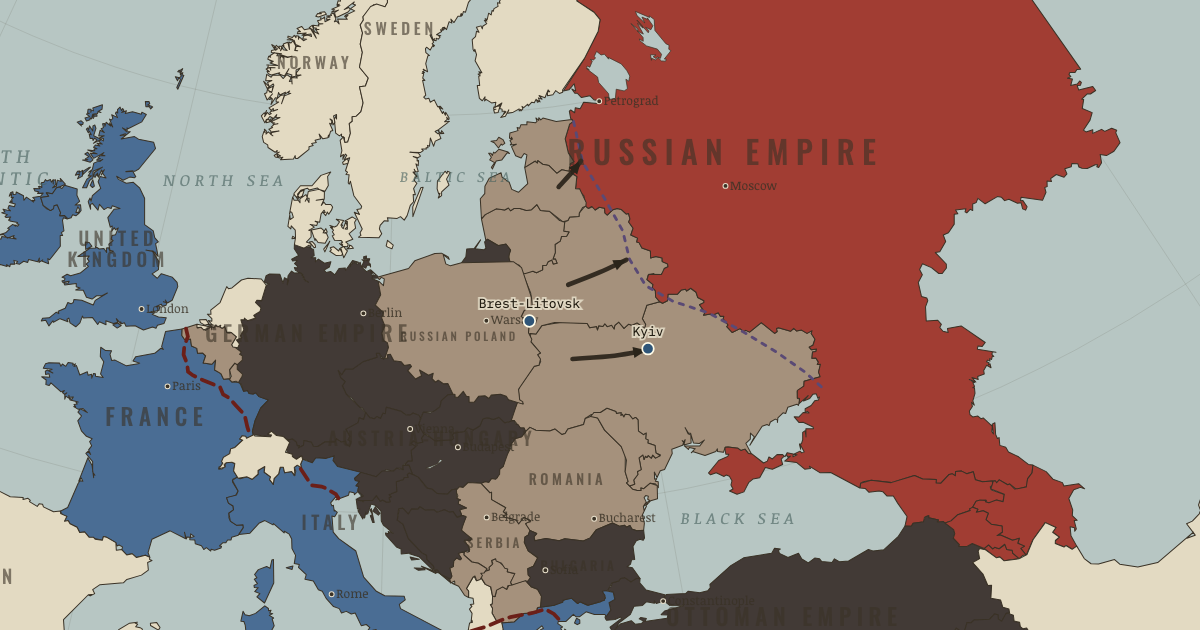
The map above is the world of MAR 1918 — Brest-Litovsk — the occupied east.
BRIEF EXPLANATION — THE ESSENTIAL ARGUMENT
Having seized power on a promise of peace, the Bolshevik government tried to leave the war without paying Germany’s price for it. Its negotiators stalled at the fortress of Brest-Litovsk, hoping to stop the fighting while refusing to sign away Russian territory, but Germany simply resumed its advance against an army that had ceased to resist. Lenin then forced his own party to accept the Treaty of Brest-Litovsk in March 1918. By its terms Russia surrendered vast lands together with a large share of its population, its farmland and its industry.
The treaty gave Germany a great prize on the map and allowed it to move divisions to the Western Front, yet the prize proved far less useful than it looked. Occupying the conquered lands required hundreds of thousands of troops, and the grain Germany expected from them arrived slowly and in small quantities. The treaty also stiffened Allied resolve by showing exactly what a German victory would mean for the defeated. Germany had won territory whose value would only mature over years, while the arrival of American troops left it only months to turn that victory into a decision in the west.
GUIDED EXPLANATION
At Brest-Litovsk, the Bolshevik negotiator Trotsky tried to stop fighting without signing Germany’s terms, gambling that Germany would not attack a country that had already laid down its arms. Germany answered with Operation Faustschlag, and its troops advanced rapidly against almost no organized resistance. Lenin then forced the Bolshevik leadership to accept the treaty on 3 March 1918, over the fierce objections of much of his party.
By the treaty Russia lost Poland, the Baltic lands, Ukraine and other territories that held major shares of its population, farmland and industry. Germany could now move divisions west, but the conquest also demanded garrisons and produced far less grain than expected, because occupying a resource-rich region is not the same as controlling its output. The treaty thus handed Germany assets that would take years to mature. American troops, however, were arriving at once, so Ludendorff had only a single spring in which to turn the eastern victory into a decision in the west.
Lenin accepted what he himself called an obscene peace because the new regime had no reliable army with which to resist. He judged that preserving Bolshevik power mattered more than territory that might later be recovered. Germany, by contrast, treated the treaty as the foundation of a new eastern empire, with client governments and systems of requisition meant to deliver food and raw materials, and these in turn generated resistance and heavy security costs. Roughly a million German and Austro-Hungarian troops remained in the east, even though about forty-eight divisions did transfer to the west. The great territorial gain on the map therefore exaggerates the power Germany could actually use. Brest-Litovsk also hardened Allied resistance by showing what a German victory would impose, and it made a compromise peace less credible at the very moment Germany most needed a quick political result.
DEEP EXPLANATION — EVIDENCE & INTERPRETATION
Lenin’s survival choice
Lenin treated the treaty as a matter of sequence rather than of principle, judging that the revolutionary state could not defend its territorial claims because it had no dependable army. Continuing the war might satisfy the ideological demand for a spreading international revolution, but it could also destroy the very government from which that revolution was supposed to grow. He therefore accepted severe losses in order to preserve political power, expecting that later conflict among the capitalist states would overturn the settlement in time. Trotsky’s formula of neither war nor peace tried to avoid both military resistance and open surrender, yet Germany’s rapid advance exposed how completely it depended on German restraint. Lenin’s judgment proved effective for the survival of the regime, though it was in no way humane in its results, since civil war, occupation and new violence all followed. The episode shows how revolutionary governments often subordinate their doctrine to institutional survival while presenting the retreat as a merely temporary strategy.
Conquest as overhead
Brest-Litovsk promised resources, but a map does not harvest grain or guard railways, and the gap between the two decided the campaign. The client governments Germany installed needed military support, the transport networks needed protecting, and the peasants resisted the seizure of their crops, so large numbers of German and Austro-Hungarian troops had to remain in the east. Some divisions did move west, creating the temporary advantage behind the spring offensives, yet the new eastern empire also swallowed the very manpower meant to exploit it. This is the garrison paradox, in which conquest increases a state’s nominal power while converting its mobile forces into fixed costs of security. Time made the paradox decisive, because Ukrainian grain and long-term economic integration might help over years, whereas American troops changed the balance on the Western Front every single month. Germany had acquired a slow-paying asset in the middle of a fast-moving crisis, and that mismatch helps explain why so enormous a treaty failed to produce victory.
New here? Chapters 1–2 of every atlas are free to sample, and the WW2 atlas is free in full. One membership opens all thirteen — the Cartographer’s Circle.
THE SITES
ON THIS DAY
WHY IT HAPPENED
Lenin’s cold arithmetic. Lenin forced the “obscene peace” through his own Central Committee on one argument: the revolution has no army, and space and time can be repurchased later, but power lost now is lost forever. He was nearly alone — Bukharin wanted revolutionary war, Trotsky his gambit — and he was right on his own terms: the regime survived, and reclaimed most of the losses within five years of Germany’s collapse. Ideology bent to survival is the most underrated pattern in revolutionary history.
Germany’s eastern ideology. Brest-Litovsk was not improvised greed. War-aims programs since 1914 had imagined a German-dominated Mitteleuropa and border strip; the military dictatorship of Ludendorff now had the map to draw it on. Client kingdoms were sketched for the Baltics; Ukraine was detached as an economic colony. Historians point here when they argue continuity between the Kaiser’s empire and later German eastern projects: the appetite predated the ideology that made it genocidal.
The garrison paradox. Conquest that must be held is strength converted into overhead. The million men in the east — securing railways, requisitioning grain, propping clients from Finland to Georgia — were the exact margin missing at the Marne in July. Ludendorff could have traded land for troops; the regime’s appetite made the land untradeable. Every empire meets this arithmetic eventually; Germany met it in its decisive spring.
THE TURN
The treaty signed, 3 March 1918. The moment the gamble locks in. With the stroke that wins Germany the east, the western clock starts: every week spent digesting the conquest is a week of American disembarkations. Brest-Litovsk also destroys any remaining chance of a compromise peace — it shows every Entente government exactly what losing would mean, and hands Allied propaganda its best exhibit. Winning the east made losing the war more likely, and more total. Watch it happen in Chapter 10.
WHAT IT CHANGED
The last race. 48 divisions west, a five-hour hurricane bombardment being rehearsed, Michael scheduled for 21 March: the entire war compresses into a six-month sprint between German transfer and American arrival. Both sides’ staffs literally chart it in divisions per month. No moment of the war is more purely a timetable.
Russia’s agony continues. Brest-Litovsk does not bring Russia peace — it brings civil war: Whites against Reds across the whole red space on this map, with Allied interventions at the ports and the Czechoslovak Legion fighting down the Trans-Siberian. Seven to twelve million will die of war, terror and famine by 1922 — more than Russia lost in the world war it left.
The precedent everyone cites. At Versailles, every German protest of harshness met the same answer: Brest-Litovsk. The treaty became the war’s moral benchmark for what each side would do with total victory — and a warrant, in Allied eyes, for the security clauses of 1919. Punitive peaces breed punitive peaces; the chain runs straight from this fortress to the Hall of Mirrors.
FIELD QUESTION — Brest-Litovsk gave Germany everything it had wanted in the east. Why didn’t it save Germany?
Separate the prize from the price and the clock. The prize was real but slow: grain, oil (Romania), a one-front war — assets that pay out over years. The price was immediate: a million-man garrison, allies and neutrals shown a portrait of German victory, and the abandonment of any negotiated exit (who negotiates with an appetite like that?). And the clock was American: the treaty’s gains could only matter if converted into victory before the summer of 1918 — which meant risking everything on offensives (Ch. 10) that consumed precisely the divisions the east had freed. The general lesson is about time-domain strategy: an asset that pays in years is worthless in a game decided in months — unless it changes the months. Brest-Litovsk didn’t; it just raised the stakes of losing them.
AN INTERESTING FACT
The first Soviet delegation to Brest-Litovsk was cast like a play: beside the diplomats sat, by design, a worker, a soldier, a sailor, a woman — Anastasia Bitsenko, a Socialist-Revolutionary just amnestied from Siberian katorga for assassinating a tsarist general — and a peasant, Roman Stashkov, collared on the street at the last moment so the class would be represented. Wheeler-Bennett’s classic account preserves the dinner scene in which a German prince asks the old man whether he prefers red wine or white, and receives the answer, “Whichever is stronger.” The theater had a purpose: the speeches across that table were aimed over the Germans’ heads, at the workers of Europe.
THE DISPATCH
One short letter when a new atlas opens — and the printable study guide for WWI is yours now, free.
NO TRACKING · YOUR ADDRESS IS USED FOR THE DISPATCH AND NOTHING ELSE · UNSUBSCRIBE ANYTIME