MAPS OF HISTORY · WWI · ALL CHAPTERS · CHAPTER 8
CHAPTER 8 · 1917 · NOV 1917
Breaking Points
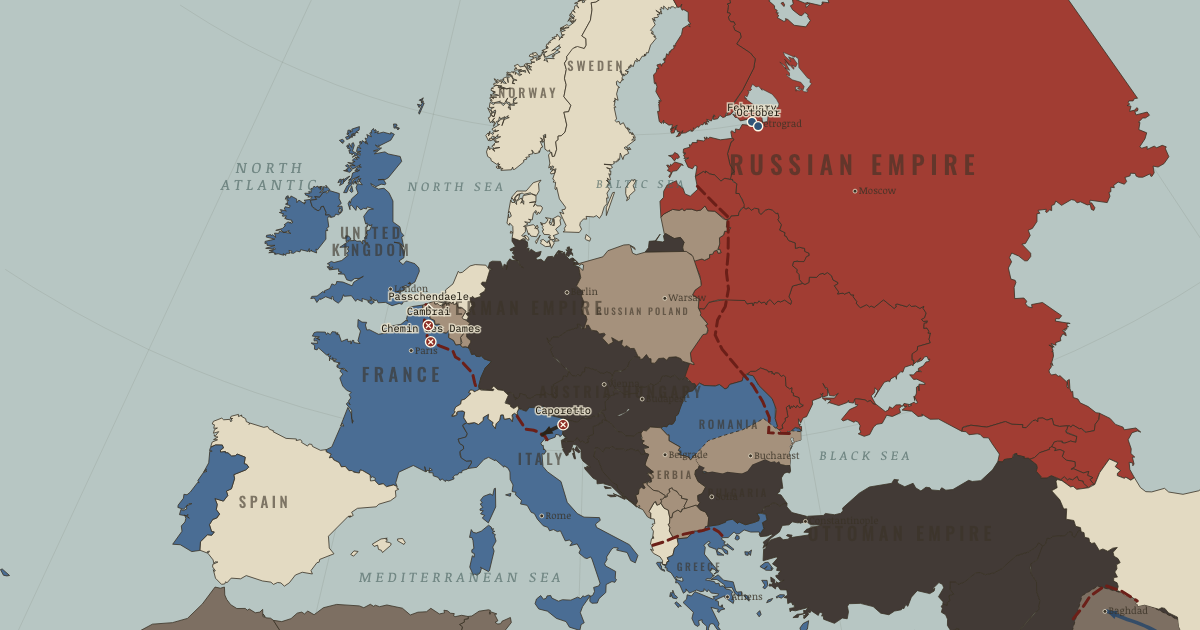
The map above is the world of NOV 1917 — Revolution, and Caporetto.
BRIEF EXPLANATION — THE ESSENTIAL ARGUMENT
By 1917 the strain of three years of war was breaking the societies that fought it, and the striking lesson of the year is that similar hardship broke different states in very different ways. In Russia, food shortages, strikes and the refusal of soldiers to fire on crowds destroyed the monarchy within a week. The Provisional Government that replaced the Tsar chose to keep fighting and steadily lost its authority as the war went badly. The Bolsheviks, a small but disciplined party, gained ground by promising the one thing the country most wanted, which was peace, together with land and bread.
Other states bent under the same pressure without breaking. France suffered widespread mutinies after the failed Nivelle Offensive, yet it recovered once Pétain improved conditions and turned to a patient defensive strategy. Italy came close to collapse when its front was shattered at Caporetto. The battles at Caporetto and Cambrai also revealed new methods for breaking fortified lines, using infiltration troops and massed tanks. Meanwhile the entry of the United States gave the Entente money, shipping and the promise of fresh armies still to come.
GUIDED EXPLANATION
In Petrograd, food shortages and strikes turned into revolution when the soldiers of the garrison refused to fire on the crowds. The Tsar abdicated, and the Provisional Government that took his place chose to continue the war, but another failed offensive deepened desertion and distrust. In November the Bolsheviks seized power on a programme of peace, land and bread, and Russia began to leave the war.
France reached its own breaking point after the failed Nivelle Offensive, when many units refused to attack again while still agreeing to defend the line. Pétain restored discipline through leave, food, rest and a strategy that spared lives. Italy nearly collapsed when its front broke at Caporetto. The battle at Cambrai showed that massed tanks could cross fortified ground, though the attackers could not yet exploit the breach. American entry mattered first through finance and shipping, and the growing arrival of troops then changed the military timetable in the Allies’ favour.
Similar hardship produced different outcomes because the states behind the armies were not alike. France still had a working administration, dependable supplies and a government able to shift from attack to defence. Its mutineers demanded better conditions and refused futile offensives, yet most of them still held the front. Russia’s transport crisis, food shortages and collapsed monarchy left no comparable reserve of trust, and although the Provisional Government kept fighting for the sake of alliance, credit and territory, another offensive destroyed its authority. The Bolsheviks offered the clearest way out. The fighting at Caporetto revealed a separate military mechanism, in which infiltration troops bypassed strongpoints and spread confusion behind the line, while Cambrai used tanks to cross the wire without a long warning bombardment. Both achieved surprise, but neither could yet move supplies and guns far enough forward to turn a breakthrough into a decision.
DEEP EXPLANATION — EVIDENCE & INTERPRETATION
State capacity and the roots of morale
Russia and France both entered 1917 with exhausted soldiers, failed offensives and demands for leave, so their opposite outcomes show that morale is not a purely military quantity that can be measured on its own. France still possessed a working administration, a reliable railway supply and a government able to abandon Nivelle’s promise of a decisive attack in favour of Pétain’s programme of rest, leave, food and limited punishment, and most of the French mutineers still agreed to hold the line even as they refused to attack. Russia’s state had already lost its legitimacy, its transport was failing, its cities lacked food, and its land-hungry peasant soldiers had a powerful reason to go home. The Provisional Government also chose to continue an offensive war without either the monarchy’s old authority or a compelling new purpose. Soldiers could transfer their loyalty to the soviets and to parties offering peace, so the same battlefield grievances, passing through very different political institutions, produced reform in one army and dissolution in the other.
Revolution and the meaning of the war
The February Revolution removed the Tsar but created a situation of dual power, in which the Provisional Government and the workers’ and soldiers’ councils known as soviets each claimed a share of authority. Continuing the war preserved Allied credit and honoured treaty commitments, yet it clashed with what most people plainly wanted and exposed the government to blame for every fresh defeat. The Bolsheviks did not hold majority support through most of 1917, and their real advantage lay in a clear programme during a general collapse of institutions and an organized willingness to seize power outright. The October seizure then changed international politics as much as it changed Russia, because the new regime sought an armistice, published the Allies’ secret treaties and offered revolution as an alternative to the liberal order Wilson was proposing. Historians still debate how inevitable the Bolshevik victory was, but the mechanism is visible, since a prolonged war narrowed the range of policies any government could survive while handing power to the party most willing to abandon them.
New here? Chapters 1–2 of every atlas are free to sample, and the WW2 atlas is free in full. One membership opens all thirteen — the Cartographer’s Circle.
THE SITES
ON THIS DAY
WHY IT HAPPENED
Russia: defeat metabolized as treason. The Tsar had taken personal command in 1915, so every failure was his; the court (Rasputin, a German-born Tsarina) made treason rumors respectable; inflation and the railway crisis emptied the bakeries. Revolution came not from the war’s enemies but from its queue: the regime asked society for total war while giving it neither bread nor voice. February was less a seizure of power than an abdication of one — the state dissolved from the top.
Why the Provisional Government kept fighting. Honor and treaties, dependence on Entente credit, fear of losing the war’s promised prizes (Constantinople!), and a liberal conviction that a free Russia would fight better. Every reason was intelligible; together they were suicide — the one policy the exhausted country could not bear, and the one gift Lenin needed. “Peace, land, bread” won because it was the only platform that named what people actually wanted. Governments that inherit wars should ask which promises are theirs to keep.
The mutiny that wasn’t quite. The French mutinies were a strike, not a revolution: soldiers held trenches, refused offensives, sang the Internationale, and asked for leave, rest and sane tactics. That precision is what made repair possible — Pétain conceded everything compatible with staying in the war and almost nothing else. Compare Russia, where identical grievances met a state that could concede nothing. Armies break where states are already broken; morale is politics wearing a uniform.
Stormtroop and tank: the lock picked twice. Caporetto and Cambrai, three weeks apart, previewed the two halves of 1918: infiltration (bypass strongpoints, follow the barrage, command devolved to sergeants) and armor (crush the wire, cross the trench, no week-long telltale bombardment). Both also previewed the flaw: exploitation — men on foot and unreliable machines outrunning guns and supply. The war’s tactical problem was solved in November 1917; the operational one (turning a hole into a decision) waits for 1918 to be demonstrated — twice, in opposite directions.
THE TURN
The October Revolution, 7 November 1917. A near-bloodless seizure in one city, by one determined minority, of a state nobody else would hold — and the war’s single greatest geopolitical event. It takes Russia out (armistice within five weeks), gives Germany its one-front war at last, publishes every secret treaty in the Entente’s drawer, and plants the regime against which half the next century organizes itself. On this map it is a color: red, spreading. In the world it was a second war beginning inside the first.
WHAT IT CHANGED
Germany’s window opens. Russia’s exit will free some fifty divisions for the west — a one-spring-only superiority before American numbers land. The entire logic of 1918, on both sides, becomes a race against a timetable everyone can read. Chapter 9 maps what Germany took in the east; Chapter 10, what it gambled in the west.
America changes the denominator. US entry converts the Entente’s exhaustion into a waiting game it can win: unlimited credit ends the dollar crisis within weeks, shipyards begin out-building the U-boats, and the promise of millions of fresh troops means Germany cannot win a long 1918. Pétain’s “wait for the Americans and the tanks” is now a strategy, not a hope.
The war’s meaning splits. Wilson’s Fourteen Points (January 1918) and Lenin’s Decree on Peace now compete to define what the slaughter is for — open covenants and self-determination versus immediate peace and world revolution. Every subsequent settlement, from Brest-Litovsk to Versailles, is measured against these rival scripts by the peoples it is imposed on. Ideas entered the order of battle in 1917 and never left.
FIELD QUESTION — Same year, similar exhaustion: why did Russia’s army dissolve while France’s recovered?
Line up the variables. Grievances: nearly identical — senseless offensives, leave, food. The state behind the army: France had a functioning republic, rail-fed cities, and allies delivering; Russia had a collapsed autocracy, a starving capital, and no credible peace-or-victory story. The repair on offer: Pétain could change tactics and conditions because policy allowed defense-until-1918; no Russian government could offer “defense until better times” — the Provisional Government had staked its legitimacy on attack. Political alternatives: French soldiers had no rival state to defect to; Russian soldiers had the Soviets, and a party bidding peace and land. Conclusion worth keeping: armies are load-bearing walls of their states — they crack along the building’s existing faults, not their own. The mutiny tells you about the trench; the revolution tells you about the country.
AN INTERESTING FACT
Among the infiltrators at Caporetto was a 25-year-old Württemberg mountain lieutenant named Erwin Rommel, who in some fifty hours of climbing and bluff took Monte Matajur with a detachment of a few hundred men, claiming — by his own count — 9,000 prisoners for a handful of casualties. Denied the Pour le Mérite when it went first to another officer, he lobbied until he got it. His memoir of these mountain fights, Infantry Attacks (1937), became an interwar classic of tactics: the methods that unlocked the Isonzo in 1917 were studied hardest by the men who would run them again in 1940 — with tanks.
THE DISPATCH
One short letter when a new atlas opens — and the printable study guide for WWI is yours now, free.
NO TRACKING · YOUR ADDRESS IS USED FOR THE DISPATCH AND NOTHING ELSE · UNSUBSCRIBE ANYTIME