Mongol Empire · CHAPTER 5 ·
Jebe and Subutai’s great raid
Chapter 5 of The Mongol Empire, 1206–1294: “The Great Raid”
Pursuing the defeated shah of Khwarazm, Jebe and Subötai led roughly 20,000 riders around the Caspian and through the Caucasus, splitting the Alans and Qipchaqs by diplomacy. At the Kalka River on 31 May 1223 a feigned retreat pulled a Rus and Qipchaq army apart before it was crushed, and the Mongols rode home with intelligence.
Chapter 5 is part of membership. WW2 is free — every chapter. Try chapters 1–2 of any 2 other atlases (3 with a free account). Opening a new atlas uses one of them. Membership opens all 21 — Join.
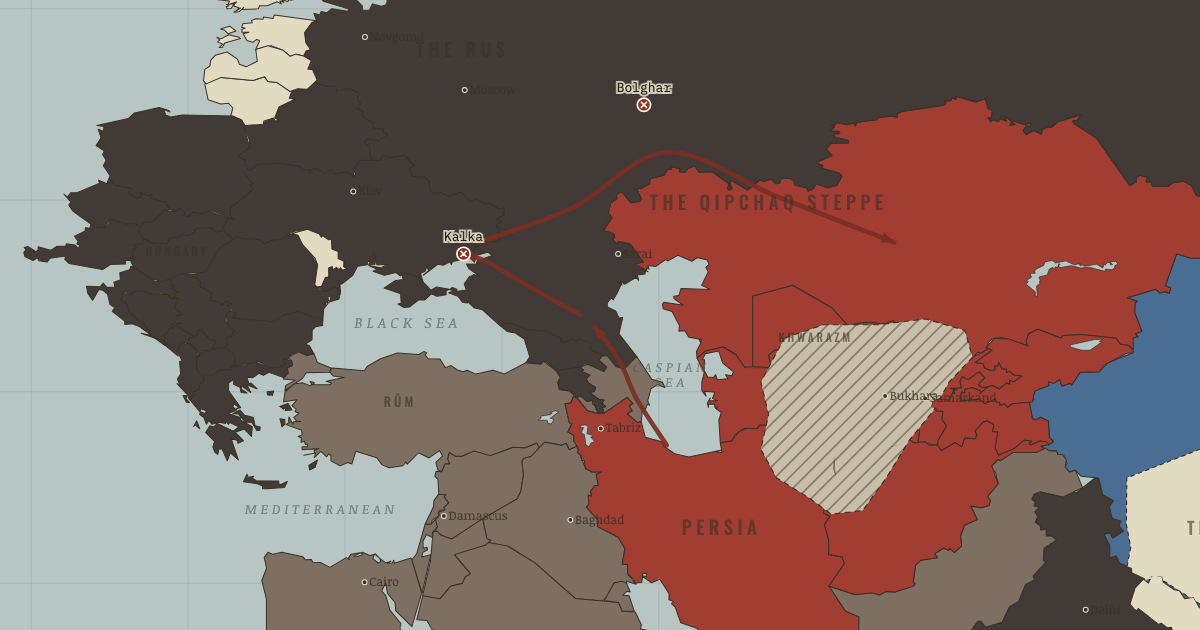
The map above is the world of The Mongol Empire, 1223 — The Great Raid touches the Rus.
Part of IB History: The Mongol Empire →
BRIEF EXPLANATION — THE ESSENTIAL ARGUMENT
The great western raid grew out of the pursuit of the defeated Khwarazm shah, which Jebe and Subötai were allowed to extend around the Caspian with roughly 20,000 riders. The expedition fought its way through the Caucasus, split an Alan–Qipchaq coalition apart by diplomacy, and then destroyed the Qipchaqs once they had been persuaded to stand aside. Its purpose was as much to gather knowledge as to win ground.
Fleeing Qipchaqs drew the Rus princes into the war, and their coalition pursued the Mongols to the Kalka River in 1223, where a long feigned retreat pulled the allied army apart before it was crushed. The Mongols then rode home. For them the journey yielded intelligence for a later invasion, while for the Rus the sudden departure made the disaster look like an isolated calamity rather than the opening move of a far larger campaign.
The full story
The expedition began as a pursuit and became a reconnaissance in force, meaning an operation that gathers intelligence while remaining strong enough to fight. Sent after Shah Muhammad, Jebe and Subötai pressed on past his death, crossing the Caucasus, defeating Georgian forces, and meeting the Alans and Qipchaqs on the open steppe. A Mongol offer persuaded the Qipchaqs to abandon their Alan allies, and the Mongols destroyed the isolated Alans before turning on the Qipchaqs in their turn. Diplomacy separated the opponents before a single major battle was fought.
The surviving Qipchaqs then appealed to the Rus princes, whose combined army crossed onto the steppe without a unified command. The Mongols retreated for days, tempting their pursuers to string themselves out, and at the Kalka River on 31 May 1223 the separated contingents were defeated and the captured princes killed. The victors did not occupy the Rus lands; they turned east and even took losses against the Volga Bulgars on the way. That withdrawal explains the unequal learning the map records, because Subötai carried home routes, rivalries and defences while the Rus rulers returned to their local quarrels and built no common frontier system before the Mongols came back in 1236.
No territory changes colour after the Kalka, which is the point, because the expedition tested routes and opponents without creating a single new province. Its true value was information about which passes could be forced, where pasture lay, and which princes distrusted one another. The setback against the Volga Bulgars also cut against any simple story of invincibility, since the reconnaissance revealed danger running in both directions. When Batu’s far larger force returned thirteen years later, it brought the resources of the whole state to a landscape that its senior commanders had already crossed once.
DEEP EXPLANATION — EVIDENCE & INTERPRETATION
Reconnaissance with strategic memory
The expedition was not a modern survey mission working from a written plan, and historians should resist folding every improvised move into a single flawless design. Jebe and Subötai adapted after the shah’s death, fought for passage and sought permission to continue their loop. Even so, Mongol command culture could preserve practical knowledge through experienced officers, dispatch riders and assemblies, and Subötai’s later career links the expedition of the 1220s directly to the western conquest of the 1230s. The advantage was institutional memory, because observations about river crossings, pasture, political rivalries and enemy tactics stayed attached to commanders who would use them again. Many of the victims recorded the event as a providential disaster, a frame that preserved its meaning while producing no military response. The map records the result. Historical explanation must also keep institutions, environmental limits and decisions visible, because none of those forces worked alone.
Defeat in detail at the Kalka
To defeat an enemy in detail means to destroy the separated parts of a larger force before they can combine. The Rus–Qipchaq army was not necessarily smaller than the Mongol force, but its princes shared no single command and marched at different speeds, and the feigned retreat widened those gaps still further. Some contingents entered the battle while others watched from behind defensive works. This does not prove that medieval Europeans were incapable of coordination; it shows that this particular coalition had weak incentives to accept another prince’s authority. The Mongols repeatedly converted political mistrust into battlefield sequence, so their tactical movement worked because diplomacy and rival command structures had already divided the target. That distinction prevents a visible event from becoming a single-cause story. Outcomes emerged through interacting political, material and human constraints over time.
Key places on the map
On this day
Why it happened
Reconnaissance in force, as institution. Calling the raid a raid undersells the doctrine: the Mongols institutionalized deep reconnaissance in a way no contemporary did — years-long expeditions producing route surveys, political intelligence and client contacts, stored in a command culture (and in Subötai personally) that could act on them a decade later. The 1236 invasion (Ch. 6) follows this expedition’s map almost turn by turn. No European or Islamic power possessed anything comparable; most could not have named the Mongols’ ruler.
The steppe road runs both ways. Geography that had always funneled nomads west — Huns, Avars, Magyars, Qipchaqs — was now organized under one command for the first time. The raid proved the corridor was open at will: from the Caucasus to the Dnieper, the horsemen never left grass. Remember Chapter 1: pasture is logistics, and the corridor is paved with it.
A coalition of the mutually suspicious. The Rus response previewed every failure to come: three princes named Mstislav, jealous of each other, no unified command, the vanguard racing ahead for glory while rivals dawdled. At the Kalka one contingent watched from a fortified camp as the others died. The princes had spent the previous decades fighting each other — and the Mongols, at Otrar as at the Kalka, had a genius for arriving where politics had already done half their work.
THE TURNING POINT
The Kalka, 31 May 1223 — and the morning after. The battle is the hinge less than the response to it. A shattering defeat by an unknown enemy was, on the evidence, survivable — if it triggered intelligence-gathering, watch on the steppe frontier, defensive union. It triggered nothing: the raiders vanished, the princes resumed their feuds, and the chronicles filed the Tatars under divine punishment rather than military problem. Thirteen years of warning were available and none was used. The hinge of 1237–40 is here, in the not-learning.
What it changed
Europe’s file stays empty; the Mongol file fills. Asymmetric information becomes the campaign plan: when Batu and Subötai return in 1236, they know the fords, the winter conditions, the Bulgar defenses and which princes hate which. Their victims still know “only God.” Weigh how much of Chapter 6’s speed is bought in Chapter 5.
The Qipchaq steppe changes owners in advance. The raid broke Qipchaq power a decade before the conquest confirmed it; the survivors’ flight west in the 1230s — forty thousand tents seeking asylum in Hungary — will drag Hungary itself into the storm’s path. On this map, refugee movements are load-bearing events.
A legend with consequences. Reports of a mysterious eastern power smashing Muslims briefly convinced crusading Europe that “Prester John” or King David had come — some historians link the Fifth Crusade’s fatal optimism at Damietta to these rumors. When the truth arrived two decades later, it arrived at Legnica. Bad intelligence, note, can be worse than none.
DISCUSSION QUESTION — Why did Europe and the Rus learn nothing from 1223, when the Mongols learned everything?
The Mongols had experienced commanders whose job included gathering and preserving operational knowledge. Subötai could use what the expedition learned when he returned more than a decade later. Rus rulers lacked a shared institution for frontier planning, and the Mongol withdrawal made the danger seem temporary. Religious interpretation was not simple ignorance, but it did not supply routes, scouts or unified command. One side converted a rare encounter into doctrine; the other returned to immediate local rivalries.
An interesting fact
Measure the raid and it stands alone: the first recorded circumnavigation of the Caspian Sea by an army — some 8,000 kilometers by most modern reckonings, a dozen battles, three years, no resupply and no reinforcement from home. Military historians from Basil Liddell Hart onward have treated it as a benchmark of operational art, and Subötai as one of the great commanders of any century. Jebe never filed his report — the sources simply lose him on the road home, most likely to illness in 1224 or 1225.
Related
THE FREE PRINTABLE STUDY GUIDE
Join the Dispatch — a short welcome series, then a letter when a new atlas opens — and the printable study guide for The Mongol Empire is yours now, free.
NO TRACKING · YOUR ADDRESS IS USED FOR THE DISPATCH AND NOTHING ELSE · UNSUBSCRIBE ANYTIME