MAPS OF HISTORY · The Mongol Empire · ALL CHAPTERS · CHAPTER 6
CHAPTER 6 · 1236–1242 · 1241
The Storm on the West
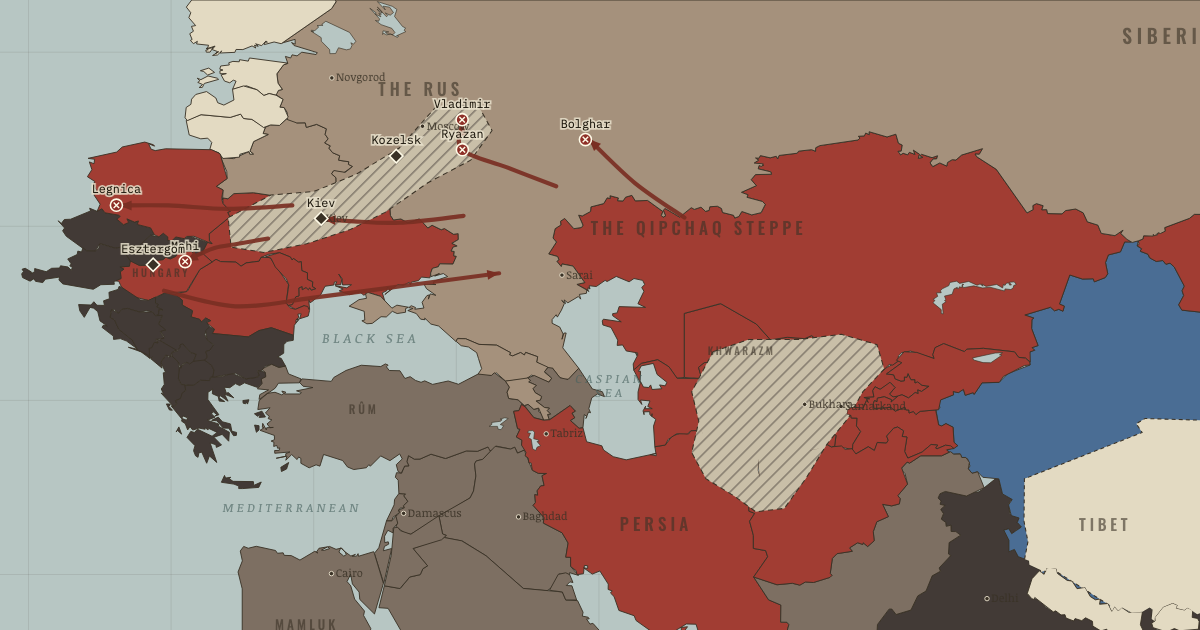
The map above is the world of 1241 — The furthest west.
BRIEF EXPLANATION — THE ESSENTIAL ARGUMENT
The western invasion of 1236–42 was a full state campaign rather than another raid, and the difference decided its scale. Batu carried the authority of the whole dynasty while Subötai directed operations shaped by the earlier reconnaissance. Volga Bulgaria fell first, and then winter movement over frozen rivers let the Mongol armies fall on the divided Rus principalities during the season European rulers thought war impossible.
In 1241 separate columns struck into Poland and Hungary, winning at Legnica and Mohi within days of each other. Hungary was devastated, yet the armies withdrew in 1242 after the death of Great Khan Ögedei. Historians still debate how far that withdrawal owed to succession politics and how far to ecological limits. The Rus lands remained tributary, while Hungary and Poland never became lasting Mongol possessions.
GUIDED EXPLANATION
The campaign opened at Volga Bulgaria in 1236 and then drove into the Rus lands, where winter became an asset because frozen rivers turned into roads leading to the cities, even as the cold also burdened horses and men. Ryazan and Vladimir fell, while Novgorod escaped when the thaw turned the roads to mud, and Kiev was stormed in December 1240 after refusing to surrender. The destruction was severe, and the surviving principalities entered a tributary relationship with the Golden Horde rather than suffering direct day-to-day occupation.
The campaign of 1241 divided into two thrusts. A northern army entered Poland and won at Legnica on 9 April, while the main force crossed the Carpathians and defeated King Béla IV at Mohi on 11 April after forcing the Sajó River under covering fire, a coordination that kept Polish or Bohemian help from ever reaching Hungary. The Mongols then occupied much of the kingdom and chased Béla toward the Adriatic before withdrawing in 1242. News of Ögedei’s death made the coming succession dangerous, and damaged pasture together with the more fortified landscape to the west raised the cost of further war, so the exact balance of motives stays uncertain. The outcome is clear enough: tributary rule endured in the Rus lands while occupation of central Europe did not.
The reversal between 1241 and 1242, when Poland and Hungary return to their old status while the Rus belt stays tributary, illustrates two different forms of power. A raid or a temporary occupation extracts destruction without building any lasting administration, whereas tributary rule leaves local princes in place but demands payment, census and the khan’s approval. The withdrawal did not erase the campaign’s effects, because Hungary rebuilt around stone castles, the displaced Qipchaqs reshaped regional politics, and the Rus rulers were drawn into Horde succession contests for generations to come.
DEEP EXPLANATION — EVIDENCE & INTERPRETATION
Winter as a chosen operating season
The familiar claim that frozen rivers simply became highways is useful but incomplete. Ice did offer level routes and led straight to settlements built along the waterways, yet variable thickness, deep snow and scarce forage could also slow an army badly. Mongol success came from preparing a whole system for winter, including hardy remounts, dispersed columns, intelligence from the earlier campaign and the ability to carry or find food. Their opponents expected little activity in the cold months and could not combine across separate principalities in time, so the surprise was doctrinal rather than meteorological. A season that others treated as a barrier became usable because one army planned around its risks, and the later thaw near Novgorod shows that the same environmental approach still met a hard limit. The map records the result. Historical explanation must also keep institutions, environmental limits and decisions visible, because none of those forces worked alone.
Why the armies left Hungary
The traditional explanation points to Ögedei’s death in December 1241, since the leading princes had reasons to guard their position in the succession, and Mongol campaigns repeatedly changed course after a Great Khan died. Yet Batu did not hurry to the election, and the withdrawal routes suggest further campaigning in the Balkans along the way. Environmental historians stress the unusually wet spring of 1242, the poor pasture, and the difficulty of supporting many horses across cultivated and fortified Europe. Neither case settles the matter alone, because politics can explain why commanders chose to stop while ecology helps explain why they never returned at the same scale. The safest reading is compound: the succession changed priorities just as the western theatre offered rising costs and shrinking returns. That distinction prevents a visible event from becoming a single-cause story. Outcomes emerged through interacting political, material and human constraints over time.
New here? Chapters 1–2 of every atlas are free to sample, and the WW2 atlas is free in full. One membership opens all thirteen — the Cartographer’s Circle.
THE SITES
ON THIS DAY
WHY IT HAPPENED
An empire’s full attention, this time. 1223 was 20,000 men moonlighting; 1236 was the state: a kurultai decision, princes of all four family lines under Batu, and Subötai applying thirteen-year-old reconnaissance. The difference names something important — the Mongols distinguished raids from conquests and resourced them differently. Europe’s chroniclers, who had filed 1223 as a raid, never registered the category change until it was inside Hungary.
Winter as a chosen weapon. Every premodern army avoided winter; the Mongols audited it and found assets: frozen rivers into roads leading to city gates, hard ground for hooves, granaries conveniently full from harvest, and horses trained to dig for grass through snow. The Rus defense assumed a campaign season; Subötai declined to hold one. When your enemy’s certainties are your opportunities, doctrine itself is the surprise.
A fractured target set. The Rus lands were a quarreling family of principalities; Poland was partitioned among feuding Piast dukes; Emperor Frederick II and the Pope were busy excommunicating and invading each other and treated Béla’s pleas as someone else’s weather. Batu’s ultimatum to Hungary even cited the Qipchaq refugees — a legalism aimed at keeping Christendom divided. It stayed divided; no relief army ever marched.
The refugee trigger. Hungary’s crime was sheltering the Qipchaqs — by steppe logic, harboring the khan’s runaway subjects. Then Hungarian nobles, whipped by rumor, murdered the Qipchaq khan Köten in Pest, and his enraged horsemen — Béla’s best light cavalry — burned their way out of the kingdom weeks before Mohi. The kingdom thus expelled its own steppe defense at the worst hour: fear of the refugees accomplished what the Mongols could not have arranged better by design.
THE TURN
Legnica and Mohi, 9–11 April 1241. One week broke two kingdoms and revealed the capability gap in full: continent-scale coordination, columns keeping schedule across six hundred kilometers, engineering (a bombardment-covered night bridge assault) casually exceeding anything west of it. Europe’s military system — feudal hosts raised slowly, led by whoever outranked whom — had no answer; the after-battle letters from Hungary to the papal court read like reports of a natural disaster. The turning point is the demonstration itself: after April 1241, Europe survives by the Mongols’ choices, not its own.
WHAT IT CHANGED
The yoke: Rus enters the Horde’s world. The principalities keep their princes, faiths and wars — and pay tribute, take census, and travel to Sarai for patents of rule, for 240 years. Moscow, a minor town (find its small dot), will rise precisely by collecting the khan’s taxes; historians still argue how much of Muscovite autocracy is Horde inheritance. Either way, the map’s hatched belt is the hinge where Rus history separates from Europe’s.
The withdrawal and its debate. Step the timeline to 1242 and watch the only voluntary retreat on this map. The traditional cause: Ögedei’s death (11 Dec 1241) summoned the princes — Batu’s feud with Güyük made presence at the kurultai existential. The rival thesis: Hungary’s trampled pastures and burned granaries couldn’t winter the herds — Europe’s farmland simply doesn’t run on grass — so the army was leaving anyway. Evidence is genuinely split (Batu, note, never attended the kurultai — but also never came back for Hungary). Most historians now weigh both: politics chose the moment; ecology set the limit.
Europe’s narrow education. The terror of 1241 produced embassies instead of armies — Carpini (1245) and Rubruck (1253) ride east and return with the medieval West’s first real intelligence on Asia (follow their arrow in Chapter 7). Europe’s active defense was never tested again: the Horde’s later raids burn borderlands, but the succession crisis, the Berke–Hülegü war (Ch. 9) and Hungary’s new stone castles mean the full storm never re-forms. Luck, in the historical ledger, is not the same as deliverance — though a generation of grateful chroniclers recorded it as such.
FIELD QUESTION — Did the death of Ögedei save Europe? Argue it both ways with the evidence on this map.
For the “saved Europe” case, the timing matters: withdrawal followed news of Ögedei’s death, and rival princes faced a dangerous succession. A similar recall followed Möngke’s death in 1259. Against it, Batu did not rush to the election, Hungary’s forage was badly damaged and campaigning beyond the plain meant more forests and fortifications. The best conclusion is mixed. Succession helps explain the decision in 1242; ecological and strategic limits help explain why full conquest was not resumed.
AN INTERESTING FACT
The panic ran ahead of the horsemen to places no Mongol ever rode. Matthew Paris, the St Albans chronicler, records that in 1238 the merchants of Gotland and Frisia, fearing the Tatars, dared not sail to the herring fair at Yarmouth — so the unsold catch glutted the English coast, and herring went, he says, at forty or fifty for a piece of silver. Take his prices as a chronicler’s color if you like; the mechanism is on the page: three years before Legnica, a rumor from the steppe was already moving fish prices in England.
THE DISPATCH
One short letter when a new atlas opens — and the printable study guide for The Mongol Empire is yours now, free.
NO TRACKING · YOUR ADDRESS IS USED FOR THE DISPATCH AND NOTHING ELSE · UNSUBSCRIBE ANYTIME