MAPS OF HISTORY · The Mongol Empire · ALL CHAPTERS · CHAPTER 7
CHAPTER 7 · 1229–1259 · 1255
The Machinery of Empire
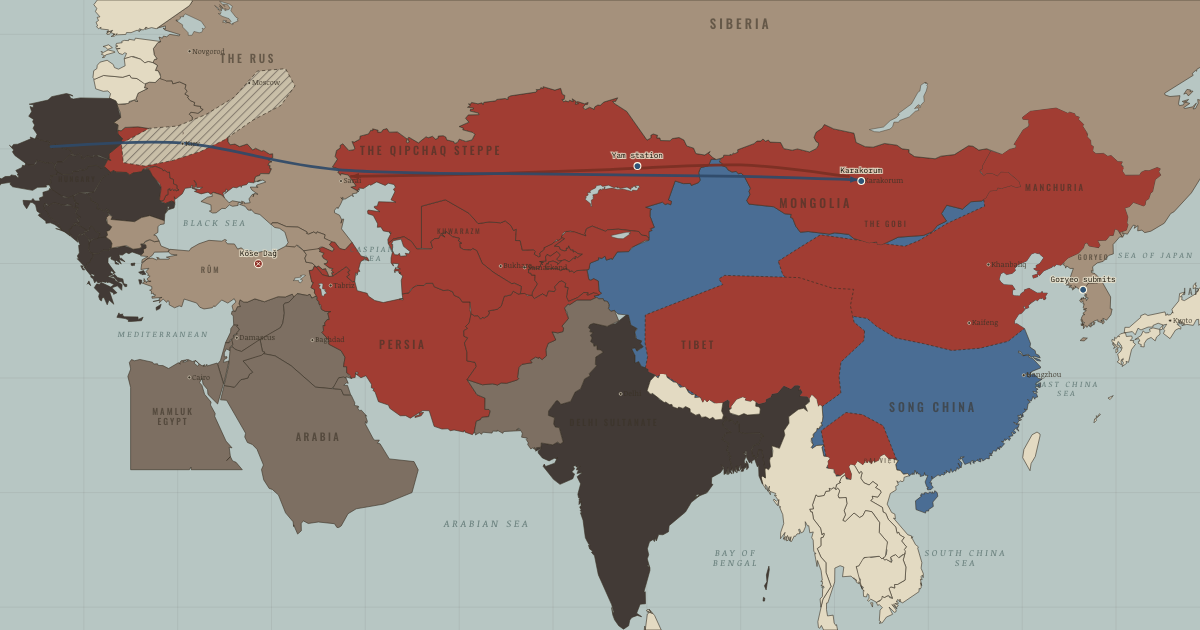
The map above is the world of 1254 — The empire of Möngke.
BRIEF EXPLANATION — THE ESSENTIAL ARGUMENT
By the 1250s a small Mongol ruling class governed tens of millions of people, and it did so through communication, delegated authority and fear rather than through sheer numbers. The yam relay carried messages and officials between staffed stations, regular censuses identified taxable households, and a paiza tablet authorized its bearer to demand transport and supplies across the empire.
Most daily administration was left to local rulers, clerks and religious institutions, which lowered the cost of occupation and gave many subjects positive reasons to cooperate, while the memory of earlier massacres discouraged refusal. Karakorum displayed the same system in miniature, since specialists and envoys from across Eurasia worked side by side there, often because conquest had displaced or compelled them in the first place.
GUIDED EXPLANATION
The scale of the empire explains its methods, because no state could garrison every settlement, so the Mongols controlled the key routes and governed through existing institutions. The yam placed relay stations along the major roads, each stocked with horses, fodder and staff, so that a protected messenger could cross great distances at speed. Censuses counted households, herds and labour obligations, and a paiza, or tablet of authority, told local officials that its bearer acted in the khan’s name.
Karakorum was tiny beside the territory it directed. Its court held Muslim, Christian, Buddhist and other communities, along with artisans carried in from conquered lands, and its religious exemptions were a practical calculation, since clergy who prayed for the khan and steadied their communities cost less than standing garrisons. Administrators such as Yelü Chucai argued that farming populations should be taxed rather than cleared for pasture, and the famous story of that arithmetic captures a genuine policy debate even where later sources sharpen the scene. This machinery did not replace violence; it made the results of conquest governable, and Korea’s negotiated submission alongside the censuses imposed on the Rus lands shows the full spectrum from client rule to enforced extraction.
Every stop on the relay reveals what the system required, because horses needed fodder, couriers needed recognized documents, and local communities had to surrender supplies, sometimes willingly and sometimes under pressure. The relay was therefore communication and taxation moving together. Its speed helped the centre issue orders, yet distance still left regional rulers room to interpret them, and the same network that bound the empire together also helped its eastern and western branches build reliable governments of their own.
DEEP EXPLANATION — EVIDENCE & INTERPRETATION
How thin imperial rule worked
Most subjects rarely met an ethnic Mongol official, because existing princes, magistrates, tax farmers and clergy went on mediating government while now owing revenue and service upward. The arrangement lowered administrative cost and let local elites use imperial backing against their own rivals. It also bred corruption and uneven burdens, since tax farming encouraged agents to extract more than the court intended and relay privileges were frequently abused. Great khans issued reform after reform precisely because the system’s strengths generated its problems. Delegation made rapid expansion possible, while weak oversight left subjects exposed, and the empire held together only while local cooperation stayed more useful than rebellion and the threat standing behind imperial orders remained credible. The map records the result. Historical explanation must also keep institutions, environmental limits and decisions visible, because none of those forces worked alone.
Connection under coercion
Karakorum’s cosmopolitan court can look like voluntary globalization, and many people did travel there for opportunity, trade or diplomacy, yet others arrived as captives or requisitioned specialists. Guillaume Boucher, the Parisian goldsmith linked to the famous silver fountain, had been seized in Hungary. Religious pluralism combined openness with supremacy in the same way, because every faith could operate provided it recognized the khan’s political authority. The most useful description is integration under coercion, since roads, safe-conducts and a broad labour market created genuine exchange while conquest decided who controlled movement and who paid its price. Holding both sides together keeps the story of administration from collapsing into either a celebration of tolerance or an account of violence alone. That distinction prevents a visible event from becoming a single-cause story. Outcomes emerged through interacting political, material and human constraints over time.
New here? Chapters 1–2 of every atlas are free to sample, and the WW2 atlas is free in full. One membership opens all thirteen — the Cartographer’s Circle.
THE SITES
ON THIS DAY
WHY IT HAPPENED
Steppe institutions, scaled. Nothing in the toolkit was invented from zero: the yam scales the nomad habit of remount relays; the census scales the decimal army’s muster rolls; the paiza scales a chief’s safe-conduct token. The genius was believing herding-camp institutions could run continents — and staffing the gaps with the conquered: Khitan clerks, Uyghur scribes (whose alphabet wrote Mongol), Persian tax-farmers, Chinese engineers. The empire was a joint venture in which the junior partners did the paperwork.
Pluralism as control theory. Exempting every faith’s clergy from tax and requiring only prayers for the khan bought the empire its cheapest loyalty: the men who spoke to the masses each week had a stake in Mongol peace. Rubruck found the khan’s court staging Christian–Muslim–Buddhist debates for sport (his own side, he admits, fared poorly once the drinking started). Cynical, tolerant, effective — pick any three.
Terror’s dividend, spent on administration. Be precise about the sequence: the machinery worked because the massacres had already happened. Cities paid census-takers politely for the same reason the next ten cities had opened their gates to Genghis. Chapters 4 and 7 are one system observed at two moments — the empire economized on garrisons by having spent lavishly on fear. An honest account keeps both ledgers open at once.
THE TURN
The silver fountain of Karakorum. Take Boucher’s fountain as the hinge-image of mid-century: a Parisian artisan, seized in the Hungarian catastrophe, building courtly wonders where the Orkhon khans were crowned, beside envoys from Lyon, Baghdad, Kiev and Hangzhou. The world’s regions, which had touched only through chains of middlemen, now met in one room — under duress. Globalization’s first draft was written here, and its author was an army.
WHAT IT CHANGED
The roads outlive the swords. Census, yam and paiza make the Silk Road briefly one jurisdiction — the precondition for Chapter 12’s whole story: the Polos’ journey, the technology flows, and the pathogen that follows them. Infrastructure, this atlas keeps insisting, is destiny with a lag.
Clients learn to work the system. Vassalage cut both ways: Rus princes, Seljuk sultans and Korean kings discovered the khans would enforce succession claims for loyal clients — so they competed in usefulness. Moscow’s later rise as chief tax-collector (Ch. 6) and Goryeo’s survival-by-marriage are graduates of this school. Empires govern longest where the governed find the arrangement locally rational.
Centralization loads the succession gun. Möngke’s audits pulled power to the center just as the family’s branches — Jochids on the Volga, Toluids in China and Persia — grew regional roots. A system this centralized has no procedure for two centers; when Möngke dies at Diaoyu (Ch. 10) with brothers in Syria and China, the machinery itself becomes the prize, and the family war begins.
FIELD QUESTION — A million rulers, a hundred million ruled: why did the mathematically impossible occupation hold?
The occupation held because it was deliberately thin. Local officials and rulers collected taxes and managed ordinary life, while the Mongol layer controlled routes, censuses, appointments and military punishment. Religious exemptions and trade protection gave some groups positive reasons to cooperate. Fear reduced the number of garrisons needed. The ratio was therefore not one Mongol directly ruling one hundred subjects; it was a small imperial command structure ruling through many local intermediaries.
AN INTERESTING FACT
One of these tablets can be inspected today: a silver paiza dug up near Minusinsk in Siberia in 1846 and now in the Hermitage, a later Yuan-era issue with its lettering inlaid in gold. The text is the empire’s voice at its most compressed — “By the strength of Eternal Heaven, may the name of the Khan be holy; whoever does not revere it shall be killed and die.” A passport, a threat and a theology in a single sentence, built to work at a gallop anywhere from Korea to the Volga.
THE DISPATCH
One short letter when a new atlas opens — and the printable study guide for The Mongol Empire is yours now, free.
NO TRACKING · YOUR ADDRESS IS USED FOR THE DISPATCH AND NOTHING ELSE · UNSUBSCRIBE ANYTIME