MAPS OF HISTORY · The Age of Revolutions · ALL CHAPTERS · CHAPTER 8
CHAPTER 8 · 1812 · SEP 1812
1812: The Russian Campaign
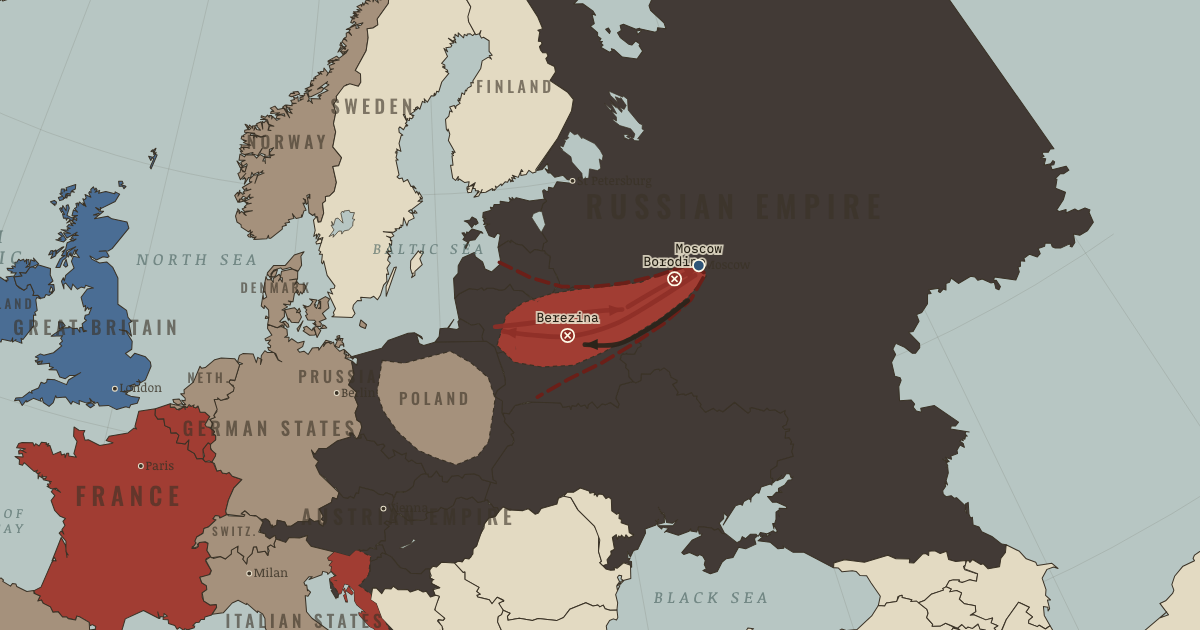
The map above is the world of SEP 1812 — To Moscow.
BRIEF EXPLANATION — THE ESSENTIAL ARGUMENT
Napoleon invaded Russia in June 1812 after the Tilsit partnership failed and Russia relaxed the Continental System. He expected a short campaign ending in a decisive frontier battle. Russian armies instead retreated, whether by design or necessity, forcing the invaders deeper into a sparse supply environment.
Borodino was enormously costly but did not destroy the Russian army. Moscow’s occupation produced no peace, and five weeks of waiting delayed retreat. Most losses began before severe winter through disease, heat, hunger and desertion; cold then intensified the collapse. The disaster destroyed horses, veterans and allied confidence, making a new coalition possible.
GUIDED EXPLANATION
The invasion of Russia was built around a single expectation that failed. About 600,000 troops, many of them from allied or subject states, crossed the Niemen on 24 June 1812 so that Napoleon could trap the Russian armies in a decisive battle near the frontier. The Russians withdrew instead, whether by deliberate design or through the confusion of divided command, and every eastward march after that lengthened French supply lines and thinned the available forage. Typhus, dysentery, heat and desertion removed large numbers of men before the first major battle was even fought.
The campaign’s central paradox appeared at Borodino on 7 September, where both sides lost more than 70,000 men and the Russian army still escaped. Napoleon entered Moscow a week later. Fires destroyed much of the city, and Alexander I refused peace. Napoleon waited about five weeks, hoping possession of Moscow would force negotiation. The retreat began on 19 October along territory already stripped of food. Russian forces marched alongside and attacked vulnerable columns. Cold then became severe, but it was the finisher rather than the sole cause. At the Berezina, engineers built bridges under attack and saved part of the force. Fewer than 100,000 effective troops returned. Loss of horses and trained personnel mattered beyond the body count: France could replace young conscripts more easily than cavalry, gunners and officers.
The outward and return arrows run along the same narrow corridor, and that is the heart of the disaster. The army had consumed the local food on its way east, so it found that same ground stripped bare on the way back. Russian forces never needed to block every road, because they could harass the flanks and the river crossings while hunger did the work of breaking cohesion. Moscow is the political hinge of the campaign, since occupying the city failed to change Alexander’s decision at all: Napoleon had captured a place without creating any reason for the Russian government to negotiate, and every day he waited made the retreat more lethal.
DEEP EXPLANATION — EVIDENCE & INTERPRETATION
The plan depended on a short war
Napoleon prepared supply depots and wagon battalions, so the campaign was not launched without logistics. The system could not support its own scale far into Russia. Draft animals consumed much of what wagons carried; roads broke vehicles; dispersed troops foraged from a population and landscape unable to meet demand. This was a timetable problem. Supplies were intended to bridge the period before a decisive battle and negotiated peace, not sustain a six-month advance and retreat. When Russia refused the expected battle near the frontier, operational success no longer produced political success. A strategy that works only while the opponent follows its schedule contains a hidden dependency, and Russia exploited it by continuing to exist as an army and government. The map records the result. Explanation must also keep institutions, material pressure and political choice visible, because none of those forces worked alone.
Why “General Winter” is incomplete
Severe cold killed people and animals and turned retreat into catastrophe. Yet large losses had already occurred during warm months from disease, exhaustion, hunger and desertion. Napoleon’s own later emphasis on weather shifted responsibility toward an uncontrollable event; Russian patriotic memory also made climate a national defender. Modern estimates vary because unit returns are incomplete and troops left the ranks for many reasons. The correction keeps winter’s lethal role while insisting on its place in that sequence. A weakened army, far from supply, delayed in Moscow and forced onto a devastated route was exceptionally exposed when temperatures collapsed. Weather had causal force because earlier decisions had removed resilience. Contingency completed a structural failure. That distinction prevents a dramatic moment from becoming a single-cause story. Revolutionary outcomes emerged through interacting interests, constraints and decisions over time.
New here? Chapters 1–2 of every atlas are free to sample, and the WW2 atlas is free in full. One membership opens all thirteen — the Cartographer’s Circle.
THE SITES
ON THIS DAY
WHY IT HAPPENED
Logistics against arithmetic. Napoleon’s method — march fast, live off the land, win quickly — was engineered for dense, rich, road-webbed Western Europe. Russia offered sparse forage, sand tracks, and distances that made supply trains mathematically inadequate (the wagons’ draft horses ate their own cargo). The army was dying of ordinary attrition — typhus above all, ~120,000 casualties before Smolensk — while winning every engagement. He had planned a three-week war at Vilna; strategy that cannot survive its own timetable slipping is not strategy but hope.
Scorched earth and the refused battle. Whether by Barclay’s design or improvisation, retreat denied Napoleon the one thing his system converted into victory: a decisive battle near his supply base. Every league east made the eventual battle less decisive and the return journey more lethal. Compare Chapter 7: Spain denied him a target by dissolving; Russia denied him one by receding. Same lesson, opposite geometry.
An empire of conscripted allies. Half the invasion force was Prussian, Austrian, German, Italian, Polish — contingents extracted by treaty from recently defeated nations (only the Poles truly believed). Such an army melts under hardship and defects after defeat: the Prussian corps neutralized itself by convention in December, Austria stepped politely aside. Coalition empires fight at the loyalty of their weakest levy.
Winter was the finisher, not the cause. Name the debate precisely: two-thirds of the losses predate the first hard frost (November). Heat, typhus, dysentery and desertion hollowed the army in summer; winter executed the remainder. “General Winter” was Russian propaganda gladly adopted by Napoleon himself — “the weather” being a more bearable conqueror than “my plan.” Distrust any explanation of disaster that exculpates the planner.
THE TURN
Moscow, September–October 1812. The battle Napoleon needed never mattered as much as the letter that never came. Possessing the enemy’s ancient capital — the move that had ended every previous war — produced nothing, because Alexander’s throne, unlike Austria’s or Prussia’s, did not depend on any city Napoleon could take; and each of the 35 waiting days converted autumn roads into winter graves. The deepest military lesson in this atlas: victory is not taking things; it is making the enemy’s government prefer peace. If no such preference can be produced, the war has no winning move — and the time spent discovering that is billed in lives.
WHAT IT CHANGED
The spell breaks in public. The 29th Bulletin admits catastrophe (while assuring France the Emperor’s health “has never been better”). Prussia defects within weeks, Austria within months; the Sixth Coalition — for once including everyone simultaneously — assembles on Russian bayonets. What Bailén cracked, the Berezina shattered.
The instrument is gone. France can conscript boys (the “Marie-Louises” of 1814 fight superbly), but horses, veteran NCOs and gunners cannot be decreed. At Leipzig the Emperor will command a half-trained army too slow to exploit its own successes — genius with a broken sword.
Russia marches west, twice. The pursuit to Paris (1814) plants the Tsar as arbiter of Europe and marches young Russian officers through constitutional France — they return carrying the comparison that becomes the Decembrist revolt (1825). Autocracy’s victory imports the ideas it defeated; Chapter 11 collects that irony.
FIELD QUESTION — Napoleon had studied Charles XII’s 1709 disaster in Russia and carried the history books on campaign. Why did knowing the precedent not save him?
Napoleon corrected visible features of Charles XII’s failure — he brought more men, supply formations and began in summer. Greater mass also consumed more food and slowed movement. He treated the precedent as a checklist while retaining the same desired mechanism: force Russia into a decisive battle and peace before distance became fatal. Russian retreat denied that mechanism. The lesson was not merely “prepare better for winter”; it was that an enemy able to exchange space for time could make his entire victory condition unavailable.
AN INTERESTING FACT
The campaign produced what is often called the best statistical chart ever drawn: in 1869 Charles-Joseph Minard, a retired French engineer of eighty-eight, rendered the Grande Armée as a flowing band that leaves the Niemen 422,000 men wide and returns 10,000 — thinning at every river crossing while a temperature line falls away along the bottom of the page. One ribbon of ink carries six variables — strength, position, direction, distance, temperature, time — and an argument. No prose history of 1812 has ever said it faster.
THE DISPATCH
One short letter when a new atlas opens — and the printable study guide for The Age of Revolutions is yours now, free.
NO TRACKING · YOUR ADDRESS IS USED FOR THE DISPATCH AND NOTHING ELSE · UNSUBSCRIBE ANYTIME