MAPS OF HISTORY · The American Civil War · ALL CHAPTERS · CHAPTER 5
CHAPTER 5 · MAR–AUG 1862 · JUL 1862
The Virginia Deadlock
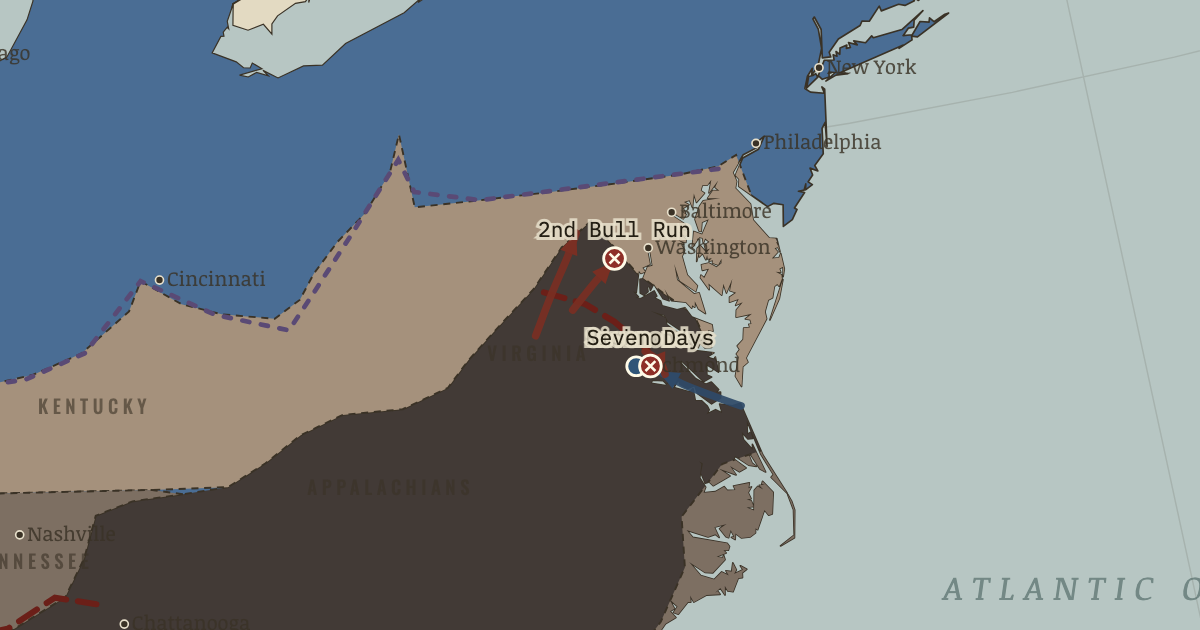
The map above is the world of JUN 1862 — New Orleans and Memphis fall.
BRIEF EXPLANATION — THE ESSENTIAL ARGUMENT
The Eastern theater settled into a pattern that would hold for years, in which Confederate tactical brilliance produced strategic stalemate. McClellan shipped the Army of the Potomac by sea to the Virginia Peninsula and advanced on Richmond slowly, held back by his belief in badly inflated estimates of Confederate numbers. In the Shenandoah Valley, Jackson’s small force moved so quickly between separate Union armies that it threatened Washington and tied down the very troops McClellan wanted as reinforcements.
Lee then took command outside Richmond and chose to attack rather than wait to be besieged. The Seven Days battles cost him more men than they cost the Union, yet they broke McClellan’s nerve and drove his army back to its gunboats, and Lee’s later victory at Second Bull Run carried the front nearly to Washington. Confederate initiative had restored Richmond’s safety, but it did so at a rate of loss the South could not sustain, and that contradiction would come to define the war in the East.
GUIDED EXPLANATION
McClellan’s Peninsula campaign was designed to avoid a costly overland march by using the Union’s command of the sea. He built and supplied a great army with real skill, but his intelligence service consistently doubled the enemy’s true numbers, and his preference for a limited war of reconciliation reinforced his caution. By late May 1862 his men were close enough to hear Richmond’s church bells, yet he waited for reinforcements that Washington, suddenly fearful for its own safety, refused to send.
That fear was Jackson’s creation. In the Shenandoah Valley his roughly 17,000 men marched hundreds of miles, defeated portions of three separate Union armies, and pinned down tens of thousands of Federals guarding the capital, an economy of force that turned a small army into a strategic weapon. Lee then assumed command near Richmond and attacked McClellan for a week. The Seven Days battles were poorly coordinated and extremely bloody, costing Lee more men than the Union lost, but they changed McClellan’s judgment and sent his army retreating to the protection of its gunboats. Lee next defeated a second Union army on the old Bull Run ground, so the front snapped north because Confederate operations altered Union decisions rather than because Lee had destroyed his opponent.
The campaign is the clearest illustration in the war of the difference between winning battles and winning a war. Lee lost more men in the Seven Days and failed in several individual assaults, yet he removed the immediate threat to Richmond and recovered the freedom to move north. McClellan preserved a powerful army but failed at the purpose for which it had sailed to the Peninsula. Jackson’s Valley campaign worked through what soldiers call interior lines, the shorter routes that let a smaller force strike separated enemies before they can combine, and Washington’s fear for its capital magnified that advantage. The trade was severe for the Confederacy, because offensive action bought morale and initiative while consuming experienced soldiers from a smaller population. By August the front again stood near Washington, and the western river losses remained exactly where they were. Eastern success could postpone defeat, but it could not by itself reverse the wider map.
DEEP EXPLANATION — EVIDENCE & INTERPRETATION
Operational success, strategic cost
Lee’s offensive method solved an immediate and real problem. A passive defense around Richmond invited a siege by a larger army, so repeated attacks disrupted Union plans and restored Confederate initiative, which makes the Seven Days an operational success despite higher Confederate casualties and several tactical failures. The trade was attrition, because experienced soldiers lost near Richmond could not be replaced as readily as Union losses. Historians differ over whether Lee had a realistic defensive alternative, since fortifications later proved powerful at Petersburg, yet in 1862 Union naval access and growing numbers made simple waiting dangerous. The useful distinction is between levels of war: an operation can meet its local objective while weakening the resources needed for the larger contest. Lee bought time and freedom of movement, and he paid for both from the Confederacy’s smaller reserve of trained manpower.
How intelligence reinforced preference
The inflated estimates that reached McClellan did more than deceive him from outside, because they fit his existing expectations. He already believed the enemy larger and held that preserving the Army of the Potomac was essential, so uncertain reports from Pinkerton’s agents became persuasive precisely because they supported the policy he preferred. Intelligence failures often work in this way. McClellan’s caution also carried a political charge, since he wanted the Union restored with as little disruption to Southern society as possible and opposed turning the war into an attack on slavery, and a slow, careful campaign matched that aim. This does not reduce every delay to ideology, because roads, weather, disease, divided authority, and genuine concern for Washington were all real constraints. It shows why more troops did not automatically produce more boldness, since evidence is read through a theory of what victory should look like, and McClellan’s theory was drifting out of step with the war Lincoln was preparing to fight.
New here? Chapters 1–2 of every atlas are free to sample, and the WW2 atlas is free in full. One membership opens all thirteen — the Cartographer’s Circle.
THE SITES
ON THIS DAY
WHY IT HAPPENED
McClellan’s mathematics of caution. He commanded the largest army ever assembled in the hemisphere and believed himself always outnumbered. Pinkerton’s intelligence fed him figures double reality because that is what he asked for, another lesson in leaders hearing what they want. But his caution had a political root too: a Democrat who opposed emancipation, he wanted a tidy, limited war ending in reconciliation, and fought like it.
Interior lines and the Valley. The Confederacy’s strategic problem. Smaller everywhere. Was answerable in Virginia because it held the interior: railroads and valleys let Richmond swing forces between threats faster than the Union could coordinate converging ones. Jackson’s Valley campaign is the textbook: threaten one point (Washington) to paralyze many. Study it as leverage, not mystique.
Lee’s gamble on the offensive. Lee reasoned that the South could not win a siege war against superior numbers. Richmond besieged was Richmond lost, only slowly. His answer, all war long, was the offensive: seize initiative, disrupt Union plans, feed Southern morale and Northern war-weariness. It worked repeatedly and cost proportionally more men than the South could replace. Both facts are true, and Chapter 8 is their collision.
THE TURN
Gaines’ Mill and the Seven Days, 25 June–1 July 1862. The hinge is psychological. McClellan was not destroyed. His army fought superbly in retreat and mauled Lee at Malvern Hill. But he wired Washington that the government had “sacrificed” his army and stopped fighting to save Richmond. Lee learned the opposite lesson: audacity against this enemy pays. One battle-week set both armies’ characters for two years, and ended the possibility that 1862 would be the war’s last year.
WHAT IT CHANGED
The war radicalizes. The failure before Richmond killed the limited-war school. In July Congress passed the Confiscation Act freeing the slaves of rebels. Lincoln, the same month, read his cabinet a draft emancipation proclamation and was told to wait for a victory to announce it from. The chain from Seven Days to Antietam to the Proclamation is direct.
Lee’s ascendancy — and its cost. From June 1862 the Army of Northern Virginia becomes the Confederacy’s center of gravity and its legend. But note the ledger even in victory: Lee lost a quarter of his army in the Seven Days. The South is winning battles while losing the arithmetic. Hold that thought until Grant arrives.
Second Bull Run opens the door north. With Union forces beaten and scattered, Lee can carry the war across the Potomac. To feed his army in Maryland’s unburned fields, to menace Washington before the fall elections, and perhaps to win the victory on Northern soil that brings British recognition. Every strand of the war now runs through the next chapter.
FIELD QUESTION — Jackson in the Valley and Lee in the Seven Days beat larger armies repeatedly. Does “the better general” actually decide wars?
Distinguish battles from wars. Generalship at the operational level. Jackson’s marches, Lee’s audacity. Repeatedly reversed local odds and bought the Confederacy time, which for a side needing a draw was strategy itself. But zoom out: nothing won in the Valley or the Seven Days reopened the Tennessee River, lifted the blockade, or replaced the 20,000 veterans Lee spent. Wars are decided where operational brilliance intersects (or fails to intersect) the logistics and politics underneath. The South produced more celebrated generals. The North produced generals. Grant, Sherman, Thomas. Whose gifts matched the war actually being fought. Prefer the question: better at what, toward what end?
AN INTERESTING FACT
When Johnston’s army slipped out of its Centreville lines in March 1862, the Federals who walked in found part of what had held McClellan motionless all winter: logs stripped, painted black, and mounted in the embrasures where heavy artillery was supposed to be — “Quaker guns,” in the soldiers’ joke, ordnance too peaceable to fire. Photographers recorded them and Northern papers howled; the episode fed the doubts about McClellan that Washington never afterward put down. The trick was as old as the Revolution — but rarely has felled timber immobilized a hundred thousand men so completely.
THE DISPATCH
One short letter when a new atlas opens — and the printable study guide for The American Civil War is yours now, free.
NO TRACKING · YOUR ADDRESS IS USED FOR THE DISPATCH AND NOTHING ELSE · UNSUBSCRIBE ANYTIME