MAPS OF HISTORY · The Crusades · ALL CHAPTERS · CHAPTER 1
CHAPTER 1 · THE WORLD OF 1095 · 1095
Three Civilizations, One Sea
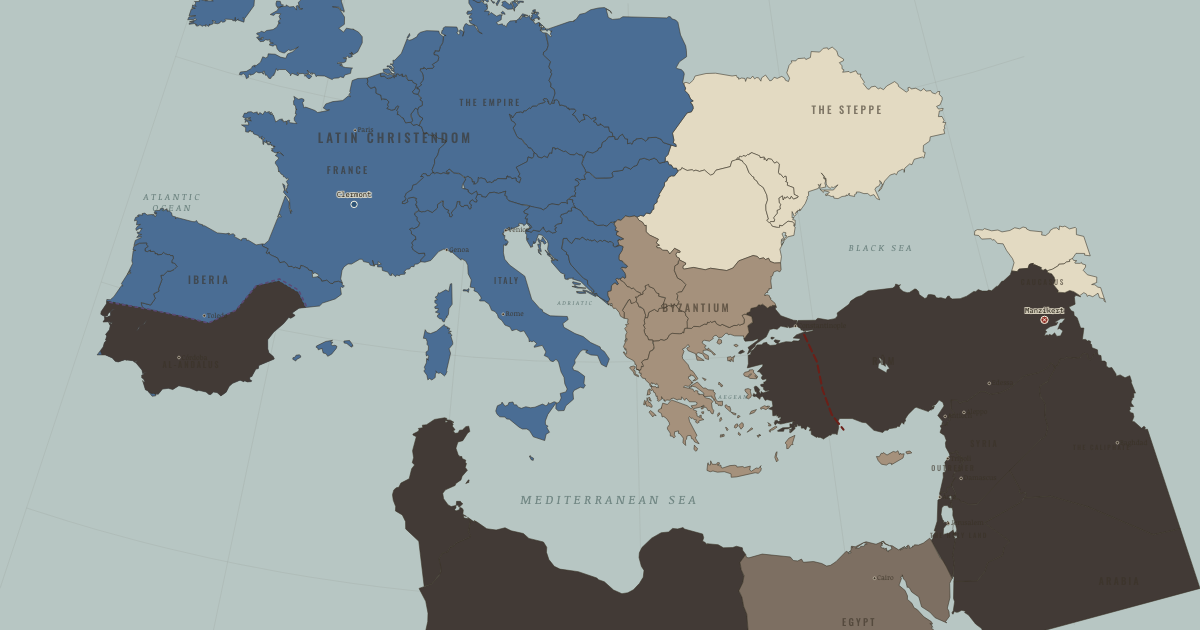
The map above is the world of 1095 — The eve of the crusade.
BRIEF EXPLANATION — THE ESSENTIAL ARGUMENT
This atlas asks how a distant, thinly populated society of Western knights came to plant Christian states on the far shore of the Mediterranean, and the answer begins with a rare alignment of weakness and opportunity. In 1095 three civilizations pressed around one sea, and each was more fragile than it looked. Latin Christendom was a patchwork of feudal kingdoms only loosely obedient to a reforming papacy in Rome. Byzantium was an ancient Christian empire that had lost most of Anatolia after its army was destroyed at Manzikert in 1071. The Islamic world stretched from Iberia to Iraq, yet it was split between the Sunni Seljuk sultans, the Shia Fatimid caliphs of Egypt and a scatter of rival Syrian emirs. That division, more than any Western strength, created the opening the crusade would exploit.
Pope Urban II turned that opening into a movement at the Council of Clermont in 1095. He joined together several things that had until then been separate: military aid for Eastern Christians, the old practice of pilgrimage, the penance owed for sin, and the warfare of a violent knightly class. To those who took up the armed pilgrimage he offered an indulgence, meaning the remission of the Church-imposed penalty for confessed sin, much as a modern amnesty cancels a debt owed to authority. The summons worked because it let many motives point one way at once. A knight could seek salvation, defend fellow Christians, win honour and hope for land in a single act, and Urban had made that act holy.
GUIDED EXPLANATION
The crusade became possible because the Islamic Near East, which looked like a single vast enemy on the map, was in fact deeply divided against itself. Nominal authority lay with the Sunni Seljuk sultans, who ruled in the name of the Abbasid caliph in Baghdad, a figure by then reduced to a religious figurehead with little real power. Against them stood the Shia Fatimid caliphs of Egypt, regarded by the Seljuks as heretics rather than mere rivals, and between the two lay Syria, broken into quarrelling emirates. When the great sultan Malik-Shah died in 1092, his realm dissolved into a war of succession among his heirs. A united Islamic power could have crushed any Western expedition at the frontier, so the fracture of Seljuk authority was the precondition without which the First Crusade is difficult to imagine.
Byzantium supplied the immediate occasion. After Manzikert the empire had watched Turkish emirs advance almost to the Aegean, and Emperor Alexios I appealed to the West for mercenaries to help recover the Anatolian heartland that had once fed and manned his army. Urban II answered at Clermont in November 1095 with something far larger than the paid soldiers Alexios expected. The five surviving accounts of his speech, all written after the crusade had already succeeded, disagree on his exact words, but they agree that he called Western Christians to an armed journey east and attached to it the reward of an indulgence. Jerusalem, the centre of the medieval Christian map and the goal of a growing pilgrim traffic, soon became the movement’s declared destination.
The genius of Urban’s appeal and its permanent weakness came from the same source. By framing warfare as penance he allowed men with very different aims to move together, since salvation, honour, family strategy and the hope of wealth could all be pursued under one banner that made them holy, which is why the summons mobilized on a scale no ordinary political call could reach. Yet the same design gave the expedition no single commander, no shared budget and no agreed plan, because each lord raised his own force, chose his own route and answered to a personal vow rather than to any state. Shared belief could carry these armies through enormous hardship, but it could not settle who would own the land they took, how they would be supplied, or how they would deal with the Byzantine empire that connected them to home. The crusade therefore set out combining unusual energy with a weakness in coordination that would shape every stage of the road to Jerusalem.
DEEP EXPLANATION — EVIDENCE & INTERPRETATION
What We Can Actually Know Urban Said
No transcript of the Council of Clermont survives, and the four fullest accounts of Urban’s sermon were written by men — Fulcher of Chartres, Robert the Monk, Baldric of Dol and Guibert of Nogent — who composed them only after Jerusalem had already fallen. Their versions therefore preserve later memory alongside the original event, so historians separate the themes that recur across all of them from the famous wording that may be invention. Aid to Eastern Christians, the remission of sins and the call to an eastern expedition are secure; the heavy emphasis on Jerusalem and the cry “God wills it” are far less certain in the form we remember them. This matters because movements routinely rewrite their own beginnings in the light of how they turned out. The capture of the Holy City made Jerusalem look like the inevitable goal from the very first moment, even though the initial appeal was probably broader and vaguer than the triumphant retellings allow.
Why Layered Motives Explain More Than One
Modern analysis likes to sort religion, ambition and family interest into separate boxes, but the crusaders did not experience them that way. A single nobleman could believe at once that fighting served God, protected his lineage and won him honour, and he saw no contradiction among the three. The surviving charters make the point concrete, because many crusaders sold or mortgaged land to afford the journey, which is poor evidence for a simple hunt after easy profit, while the same documents record anxious gifts to monasteries for the good of their souls. Conquest did nonetheless produce lordships, plunder and coercion once the armies arrived. The strongest reading treats these motives as layered rather than competing, and it locates Urban’s real innovation in something institutional, namely that he attached a spiritual reward to an armed journey placed under Church authority. That arrangement let men with different private goals travel in the same direction, which helps explain both the sudden scale of the response and the bitter quarrels that later broke out inside the expedition.
New here? Chapters 1–2 of every atlas are free to sample, and the WW2 atlas is free in full. One membership opens all thirteen — the Cartographer’s Circle.
THE SITES
ON THIS DAY
WHY IT HAPPENED
Manzikert and the Byzantine appeal. The catastrophe of 1071 cost Byzantium the Anatolian heartland that fed and manned it. Emperor Alexios I Komnenos wrote west asking for mercenaries to help claw it back. What he got instead was an armed migration of tens of thousands with its own agenda — the difference between a hired sword and a holy war he did not control.
The Seljuk fracture. Malik-Shah’s death in 1092 split the Seljuk realm among feuding heirs and atabegs; Syria dissolved into rival emirates; the Sunni-Shia schism set Baghdad against Cairo. A united Islam could have crushed the First Crusade at the frontier. A divided one let it pass. Disunity, here, is not background — it is the cause.
The reform papacy and the Peace of God. The Gregorian reform had just made the papacy a power that could command kings. The Peace and Truce of God movements tried to curb the private wars of a violent knightly class. Urban’s genius was to fuse the two: redirect that violence outward, sanctify it as penance, and make the pope its author.
Jerusalem and the pull of pilgrimage. Jerusalem was the centre of the medieval Christian map and the goal of a growing pilgrim traffic. Fused with apocalyptic expectation and the promise that dying on the road washed away all sin, the idea of an armed pilgrimage to the Holy City had a motive force no purely political summons could match.
THE TURN
Clermont, 27 November 1095. We do not have Urban’s exact words — five later versions disagree. But the effect is unmistakable: an idea that a layman’s war could be an act of penance, rewarded in heaven and (people assumed) on earth. It is a spiritual technology as much as a military order, and once released it cannot be recalled.
WHAT IT CHANGED
An armed pilgrimage, not an army. What set out had no single commander, no budget, and no state behind it — great lords who had sold or mortgaged their lands, and behind them a crowd of the poor. Its strengths (zeal, self-selection) and its weaknesses (no logistics, no unity of command) both flow from this. It is a movement, not a campaign.
A new spiritual technology. The indulgence — remission of the temporal penalty for sin — was refined and generalized by the crusade. It would be aimed, in time, at heretics, pagans and the pope’s political enemies (Ch. 9), and its later sale would help crack the Church at the Reformation. Ideas outlive the wars that forge them.
A blow the target barely felt. The Islamic world did not, at first, perceive a civilizational assault. The response to the First Crusade was local and slow; the idea of a unifying counter-crusade had to be built, over fifty years, by Zengi and Nur al-Din. Understanding that lag is the key to the whole century.
FIELD QUESTION — Was the First Crusade caused by religion or by material self-interest?
The honest answer refuses the “either.” Crusaders faced enormous cost and mortal risk for a journey most would not survive; cynical land-hunger alone does not explain a younger son mortgaging everything for a war he was likely to die in. Yet piety alone does not explain the plunder, the settlement, or the sanctified violence. The mechanism is that Urban offered a way to satisfy several hungers at once — for salvation, for adventure, for land, for an outlet for a warrior culture’s aggression — under one banner that made them all holy. Beware both the cynic who reduces it to greed and the apologist who reduces it to faith; the power of the idea was precisely that it did not make people choose.
AN INTERESTING FACT
Urban II never learned that his summons had worked. Jerusalem fell on 15 July 1099; the pope died in Rome fourteen days later, on 29 July, before any ship could carry the news across the Mediterranean. The movement that bears his stamp outlived him from its very first victory — a fitting start for an idea that would keep outrunning everyone who tried to command it.
THE DISPATCH
One short letter when a new atlas opens — and the printable study guide for The Crusades is yours now, free.
NO TRACKING · YOUR ADDRESS IS USED FOR THE DISPATCH AND NOTHING ELSE · UNSUBSCRIBE ANYTIME