MAPS OF HISTORY · The Road to War · ALL CHAPTERS · CHAPTER 12
CHAPTER 12 · DECEMBER 1941 · 1941
Pearl Harbor: The Roads Meet
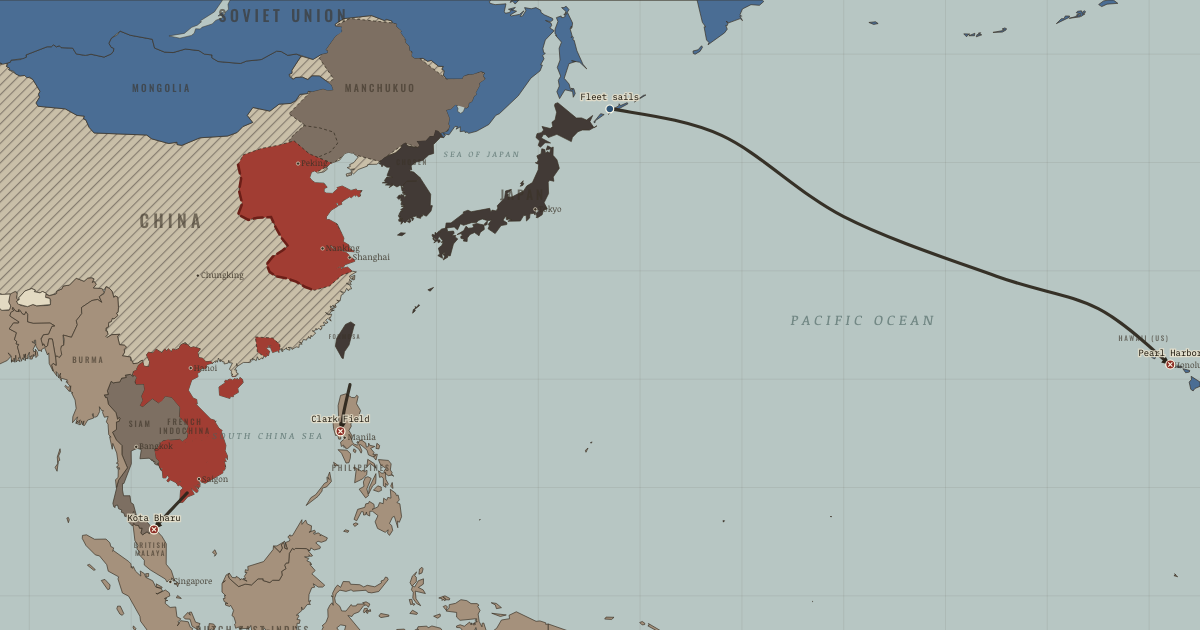
The map above is the world of DEC 1941 — Pearl Harbor — the world war.
BRIEF EXPLANATION — THE ESSENTIAL ARGUMENT
Pearl Harbor is where the two roads this atlas has followed, one running from Manchuria and one from Europe, finally met in a single global war. Japan attacked the American fleet in Hawaii while launching simultaneous operations against British Malaya, the American-held Philippines and other Western positions across the Pacific. The purpose was defensive within Japan’s own logic, because the goal was to protect a southern offensive for oil and resources by disabling American power long enough to build a fortified perimeter that a war-weary United States might not think worth breaching.
The attack achieved complete surprise and crippled the battleship fleet, yet it missed the American aircraft carriers, the repair yards and the fuel storage, leaving the base able to recover. Its deeper effect was political, since it destroyed the divisions in American opinion and united the country for war. Germany then declared war on the United States four days later, without any treaty requiring it to do so, and with that the separate crises begun in Manchuria and Europe fused into one conflict. The aggressors now faced a coalition whose productive capacity vastly exceeded their own, which is the fact that decided the long war their gambles had assembled.
GUIDED EXPLANATION
Six Japanese carriers left Hitokappu Bay on 26 November 1941 while diplomacy was still under way, and on 7 December their 353 aircraft attacked Pearl Harbor. The raid killed 2,403 Americans and sank or damaged eight battleships, a stunning tactical success. Yet it missed the American carriers, left the fuel stores and repair yards intact, and so much of the base remained usable, which meant the fleet could be rebuilt far faster than Japan had assumed.
Japan struck Malaya, the Philippines and other targets at almost the same moment, all to protect its drive toward the oil of Southeast Asia. The United States declared war on Japan on 8 December, and four days later Hitler declared war on the United States even though the Tripartite Pact did not oblige him to. The two roads traced by this atlas now met, as separate acts of expansion produced one global coalition war that the aggressors lacked the resources to win over time.
Pearl Harbor was an operational success wrapped inside a weak political strategy. Admiral Yamamoto believed the Pacific Fleet had to be disabled while Japan seized the southern resource zone, and he warned that he could run wild for only six months or a year. The attack damaged the battleships, but most could be recovered, and it missed the carriers while leaving fuel and repair yards intact. More important still, it removed the last American uncertainty about entering the war instead of creating pressure to negotiate. American commanders had expected an attack, mainly in Southeast Asia, and the radar and submarine warnings near Hawaii were collected but misread, which shows that a warning is not the same as readiness. Hitler’s voluntary declaration then let Roosevelt pursue a Europe-first strategy without a divisive political fight. Tactical surprise had done the one thing the Axis most needed to avoid, which was to unite the industrial coalition it could not hope to outproduce.
DEEP EXPLANATION — EVIDENCE & INTERPRETATION
Operational success, strategic failure
Pearl Harbor was meticulously planned to achieve surprise across a great distance and to deliver a shallow-water torpedo attack, and it protected the opening phase of Japan’s southern campaign by briefly reducing the threat from American battleships. Yet the strategy behind it needed far more than physical damage to succeed. Japanese leaders hoped that rapid conquest and a fortified perimeter would make a long American war look too costly to pursue, and that judgment misread both the political response and the industrial capacity of the United States. Most of the damaged battleships were recoverable, the carriers were absent, and the base infrastructure survived. More important, the attack removed the domestic uncertainty about entering the war rather than deepening it. An operation can therefore succeed against its assigned targets while undermining the very political objective it was meant to serve. Yamamoto’s warning that he could act freely for only six months identified exactly the missing piece, which was any credible route from early victories to a negotiated settlement once America had mobilised.
From warning to readiness
American officials expected a war with Japan and possessed intelligence showing that diplomacy was near collapse, yet they had no reliable evidence naming Pearl Harbor as the target. Commanders concentrated on the more probable attacks in Southeast Asia and on the danger of sabotage in Hawaii. Radar detected the incoming formation, but the operators took it for expected American aircraft, and a destroyer’s report of a submarine moved too slowly through the command channels to matter. These failures reveal three distinct stages, which are collecting information, interpreting it, and acting on it, and success at one stage never guarantees success at the next. Claims that Roosevelt knowingly allowed the attack have not survived examination of the intercept record. The historically useful explanation is institutional fragmentation combined with confirmation bias, because the warning genuinely existed but was fitted into an expectation that placed the attack somewhere else.
New here? Chapters 1–2 of every atlas are free to sample, and the WW2 atlas is free in full. One membership opens all thirteen — the Cartographer’s Circle.
THE SITES
ON THIS DAY
WHY IT HAPPENED
The oil clock ran out. From the August freeze (Ch. 10), Japan’s planners calculated capability declining monthly; the Imperial Conference of 6 September set the sequence — negotiate until October, then decide for war. Konoe’s government fell seeking a summit Washington wouldn’t grant without prior concession on China; Tōjō’s government inherited the timetable. The Hull note of 26 November was the formal end of the diplomatic road, but the fleet had sailed that morning: the machine was running on fuel arithmetic, not on the last exchange of documents.
Yamamoto’s wager against his own judgment. The Combined Fleet commander had told Konoe he could “run wild for six months or a year,” with no confidence thereafter — he knew America (Harvard, naval attaché in Washington) and opposed the war his plan enabled. His logic for Pearl Harbor was conditional: if war is forced, the US battle fleet must not be free to interdict the southern operation; a stunning opening blow might also break American will to fight a long war. The first premise was operationally sound; the second inverted the country he knew — and he suspected as much. Planners who brief “six months” should be asked, as history asked Yamamoto, what happens in month seven.
Washington expected war — somewhere else. American commanders knew from decrypts (MAGIC) that war was imminent; the war warnings of 27 November went to all Pacific commands. The failure was of imagination and correlation: the Philippines and Malaya were the obvious targets; Pearl Harbor was judged too far, too shallow for torpedoes (Taranto’s lesson, Ch. 11, had been studied more carefully in Tokyo than in Hawaii), too audacious. Radar on Oahu detected the first wave 132 miles out; the duty officer read it as a flight of B-17s due from California. Surprise is rarely a failure to collect information; it is a failure to believe it.
Hitler chose the world war. Nothing obliged Germany to declare war on America on 11 December — the Tripartite Pact covered only a Japan attacked. Hitler’s reasoning, reconstructed from his 11 December Reichstag speech and table talk: the U-boat war against American convoys was already undeclared war; Japan would pin the US in the Pacific for years; and racial-ideological contempt for a “mongrel” nation misjudged, one last time, an adversary’s capacity. It was the decade’s final unforced gamble, and it unified the two wars this atlas has kept on separate maps into the one its title promised.
THE TURN
Pearl Harbor, 7:48 a.m., 7 December 1941. The turn is not the sinking of battleships — most rose again — but the annihilation, in ninety minutes, of American ambivalence. On 6 December the America First Committee had 800,000 members and the draft-extension had passed the House by a single vote; by the evening of the 7th isolationism was politically extinct, and a war economy that would build more aircraft in 1944 than Japan built in the entire war had its mandate. Yamamoto’s strategic premise — that a wounded America might negotiate — was the decade’s last and largest misreading of a democracy. In the long ledger this atlas keeps, Pearl Harbor is where the aggressors’ meta-gamble, the bet running since Mukden that the status-quo powers would always prefer acquiescence to cost, finally and permanently lost.
WHAT IT CHANGED
The perimeter, then the tide. Japan’s six months ran almost exactly to Yamamoto’s schedule: Malaya, Singapore (the empire’s worst capitulation, February 1942), the Indies and the Philippines all fell. Then Coral Sea checked the advance in May 1942, and at Midway in June the carriers missed at Pearl sank four of the six that had attacked it. The war this atlas ends by starting is told in the WW2 atlas — this map hands its final snapshot to that one’s first.
The arsenal opens both doors. Germany’s declaration let Roosevelt pursue “Europe first” with public consent. Lend-Lease, already flowing to Britain and the USSR, became the bloodstream of a global coalition. By war’s end it had supplied some $50 billion in matériel. That aid ranged from Studebaker trucks on the road to Moscow to the food shipments that kept Britain fed.
Asia’s empires never come back. The tan on this map’s southern half did not survive the demonstration that European empires could be beaten by an Asian power in weeks. The colonial restorations of 1945 were rearguard actions; India was gone by 1947, Indonesia by 1949, Indochina after wars that fill the Cold War atlas. Japan’s war of conquest, defeated, still ended the world it attacked.
FIELD QUESTION — “A date which will live in infamy” — but was Pearl Harbor a surprise attack or a foreseen war with a surprising address?
Both, and the distinction is the lesson. War with Japan was so far from a surprise that Washington had war-gamed it for two decades (War Plan Orange), read Japan’s diplomatic cipher in real time, and sent explicit war warnings ten days early; conspiracy theories that Roosevelt knew Pearl Harbor specifically have been repeatedly tested against the decrypt record and have failed — the intercepts pointed clearly at Southeast Asia, and no message named Hawaii. What failed was the last mile: the assumption that Japan would not attempt the operationally spectacular, the radar contact explained away, the fleet moored in rows because sabotage, not air attack, headed the local threat list. The congressional inquiry (39 volumes) and every serious study since converge on system failure without a hidden hand. The transferable seminar point, which intelligence services still teach with this case: warning is not the same as expectation, and expectation is not the same as readiness — each conversion has to be made deliberately, and each can fail separately.
AN INTERESTING FACT
The attack’s first shots were actually American, and they came ninety minutes early: at 6:37 a.m. the destroyer USS Ward depth-charged and sank a Japanese midget submarine prowling the harbor entrance — the report was working its way up the chain when the first wave arrived. The Ward’s gun crew were reservists from St. Paul, Minnesota; their No. 3 gun stands today on the Minnesota capitol grounds. Exactly three years later, on 7 December 1944, the Ward — converted to a fast transport — was hit by a kamikaze off Leyte and had to be scuttled by gunfire from an escorting destroyer: the USS O’Brien, commanded that day by the same officer who had commanded the Ward at Pearl Harbor.
THE DISPATCH
One short letter when a new atlas opens — and the printable study guide for The Road to War is yours now, free.
NO TRACKING · YOUR ADDRESS IS USED FOR THE DISPATCH AND NOTHING ELSE · UNSUBSCRIBE ANYTIME