MAPS OF HISTORY · The Age of Revolutions · ALL CHAPTERS · CHAPTER 2
CHAPTER 2 · 1775–1783 · SEP 1783
The American Revolution
The map above is the world of SEP 1783 — A republic among empires.
BRIEF EXPLANATION — THE ESSENTIAL ARGUMENT
The rebels who took up arms against Britain in 1775 never had to defeat every British army in the field. What they needed was to preserve an army and a political coalition long enough to make reconquest more expensive than Britain would tolerate. Distance and a century of local self-government made occupying the colonies far harder than capturing their major cities.
Saratoga in 1777 persuaded France to enter openly. The conflict then became global, forcing Britain to defend the Caribbean, Europe and India as well as North America. French troops and de Grasse’s fleet enabled the Yorktown trap in 1781. Independence followed, but slavery and Native dispossession remained unresolved.
GUIDED EXPLANATION
The fighting opened around Boston and immediately revealed the pattern that would decide the war. British troops sent to seize colonial military stores met local militia at Lexington and Concord on 19 April 1775 and suffered heavily on their retreat. Washington’s problem followed directly, because Britain could capture cities while the Continental Army could not risk destruction in one decisive battle, so keeping that army in existence was what kept Congress and foreign hopes alive.
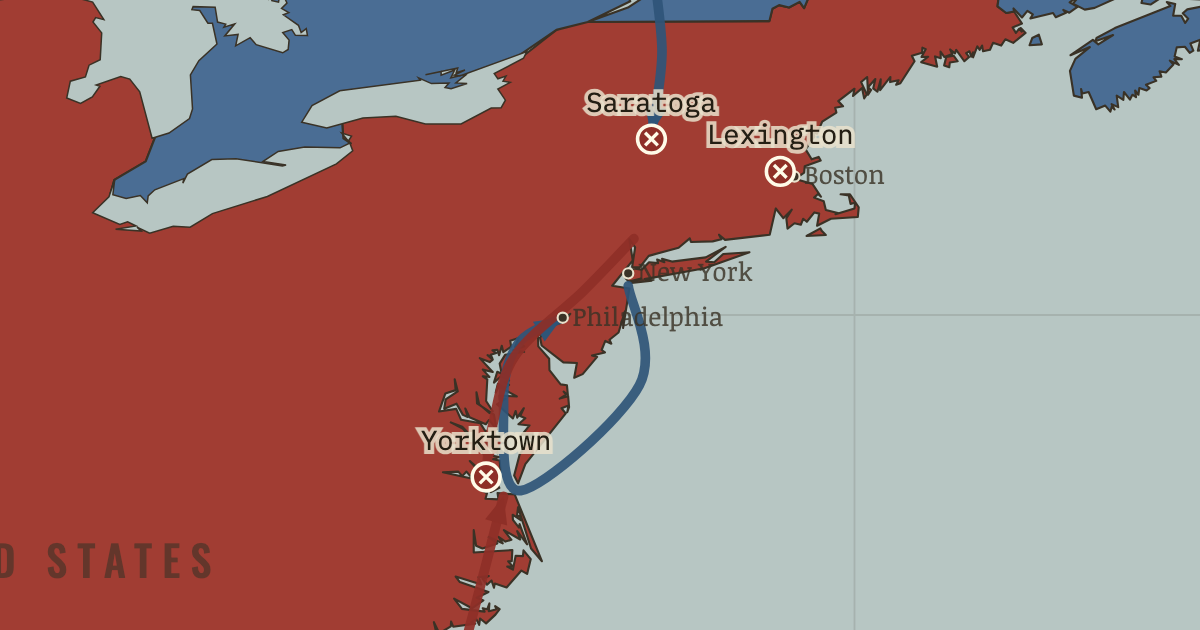
The map shows Britain’s 1777 attempt to isolate New England. Burgoyne came south from Canada, but coordination failed and his force surrendered at Saratoga. France interpreted the result as evidence that the rebellion could survive. Its 1778 alliance brought money, soldiers and a navy, while Spain and the Dutch widened the global war. In 1781 Washington and Rochambeau marched south as Admiral de Grasse controlled Chesapeake Bay. Cornwallis surrendered at Yorktown. The 1783 peace recognized a republic to the Mississippi. It did not free most enslaved people or consult Native nations whose lands were transferred on paper. Military independence and social transformation were separate outcomes.
The two final arrows make sense only together. The land march from New York could trap Cornwallis at Yorktown only because the French fleet closed the sea against escape or relief, which makes that victory a piece of coalition warfare rather than a single army’s triumph. The postwar boundary tells a second story, because the treaty granted the new republic territory its negotiators did not control and Native nations had never surrendered. Independence settled the question of imperial sovereignty while opening new conflicts over who could actually exercise power inside the claimed borders.
DEEP EXPLANATION — EVIDENCE & INTERPRETATION
Why taking cities was not enough
British forces held New York for most of the war and occupied Philadelphia and Charleston, yet control faded beyond garrisons. The colonies had assemblies, committees and militias capable of rebuilding political authority locally. This made the conflict an insurgency as well as a conventional war. Britain had to identify supporters, protect supply routes and make imperial rule credible across a wide population; the rebels had to prevent their movement from collapsing. Atlantic distance lengthened decisions and raised transport costs, but it did not make British victory impossible. In 1776 Washington’s army nearly dissolved. The decisive constraint was the combination of distance, resilient local institutions and, after 1778, a foreign coalition. The map records the result. Explanation must also keep institutions, material pressure and political choice visible, because none of those forces worked alone.
Saratoga changed the scale of war
Saratoga mattered because of the decision it produced in Paris. France had already supplied covert aid, motivated by rivalry after its defeat in 1763. Open alliance exposed French colonies and finances, so ministers wanted proof that the Americans could continue fighting. Burgoyne’s surrender supplied that proof. Once France entered, Britain had to allocate ships and troops among the Channel, Caribbean sugar islands, Gibraltar, India and North America. Yorktown then depended on a temporary concentration: de Grasse’s Caribbean fleet denied evacuation while allied land forces closed the siege. The American victory was local in purpose but coalition-dependent in mechanism. France gained revenge and strategic advantage while adding debt that would deepen its own fiscal crisis. That distinction prevents a dramatic moment from becoming a single-cause story. Revolutionary outcomes emerged through interacting interests, constraints and decisions over time.
New here? Chapters 1–2 of every atlas are free to sample, and the WW2 atlas is free in full. One membership opens all thirteen — the Cartographer’s Circle.
THE SITES
ON THIS DAY
WHY IT HAPPENED
Distance as a weapon. Britain had to project force 3,000 miles by sail — three months for an order and its answer. The rebels didn’t need to win; they needed to not lose long enough for London’s will and credit to crack. Insurgencies against distant powers keep rediscovering this arithmetic.
Saratoga and the French wager. Vergennes had smuggled arms to the rebels from 1776 (most of the gunpowder at Saratoga was French). Open alliance in February 1778 brought a fleet, an army, and — decisively — a global war that stretched Britain past breaking. Revenge for 1763 was the motive; the 1.3 billion livres it cost will be the Bastille’s down payment.
A militia society. The colonies had armed, self-governing local institutions a century old. Britain could take any city (and did — New York, Philadelphia, Charleston) yet control nothing beyond musket range of its garrisons. Political infrastructure, not marksmanship, made the rebellion unkillable.
THE TURN
Saratoga, 17 October 1777. A plan drawn in London — three columns converging on Albany — dissolved in American woods: Howe went to Philadelphia instead, and Burgoyne, cut off, surrendered 5,800 men. The battlefield mattered less than the news of it in Paris: within four months France signed the alliance. The hinge of the war was the moment it stopped being one war and became Britain against a world coalition.
WHAT IT CHANGED
A constitution that exports. The state constitutions, then the federal one of 1787 — written, ratified, amendable — turn Enlightenment theory into working precedent. Every revolutionary from Paris to Caracas will carry the American example, agreeing or arguing with it.
What was not revolutionized. Half a million people remain enslaved; the Constitution counts them as three-fifths and shields the slave trade for twenty years. Northern states begin gradual abolition, and tens of thousands of Black Loyalists leave with the British — having judged, reasonably, that liberty wore a red coat. The revolution’s greatest word and greatest silence share one document.
The losers of the peace. Native nations — most of whom had fought with Britain precisely to stop settler expansion — appear nowhere in the Treaty of Paris, which hands their lands to the republic on paper. The frontier wars that follow are the revolution’s longest, least-remembered consequence.
France wins the war and loses the treasury. Glorious, victorious, and broke: the war costs France ~1.3 billion livres, all borrowed. Interest now devours half the royal budget. The road from Yorktown runs straight to the Estates-General.
FIELD QUESTION — Britain had the world’s best navy, deepest purse and most professional army. Make the case that it could never have won.
Britain could have defeated the Continental Army, especially in 1776, so victory was not impossible. The harder task was restoring durable control over self-governing communities across a large coast. After France entered, Britain also had to defend more valuable positions worldwide. City occupation addressed the field army but not the political network supporting rebellion. The war became unwinnable at acceptable cost when local resistance, Atlantic distance and global coalition pressure operated together.
AN INTERESTING FACT
The Revolution’s deadliest ground was not a battlefield but an anchorage: more Americans died aboard Britain’s prison hulks in New York’s Wallabout Bay — perhaps 11,000, though estimates run higher — than were killed in every battle of the war combined, roughly 6,800. Survivors of the worst ship, the Jersey, called her “Hell afloat.” The bones of the dead kept washing out of the Brooklyn shoreline for decades, until a crypt at Fort Greene finally gathered them in 1908.
THE DISPATCH
One short letter when a new atlas opens — and the printable study guide for The Age of Revolutions is yours now, free.
NO TRACKING · YOUR ADDRESS IS USED FOR THE DISPATCH AND NOTHING ELSE · UNSUBSCRIBE ANYTIME