MAPS OF HISTORY · The Russian Revolution · ALL CHAPTERS · CHAPTER 11
CHAPTER 11 · 1920–1922 · JUL 1921
Victors Against the People
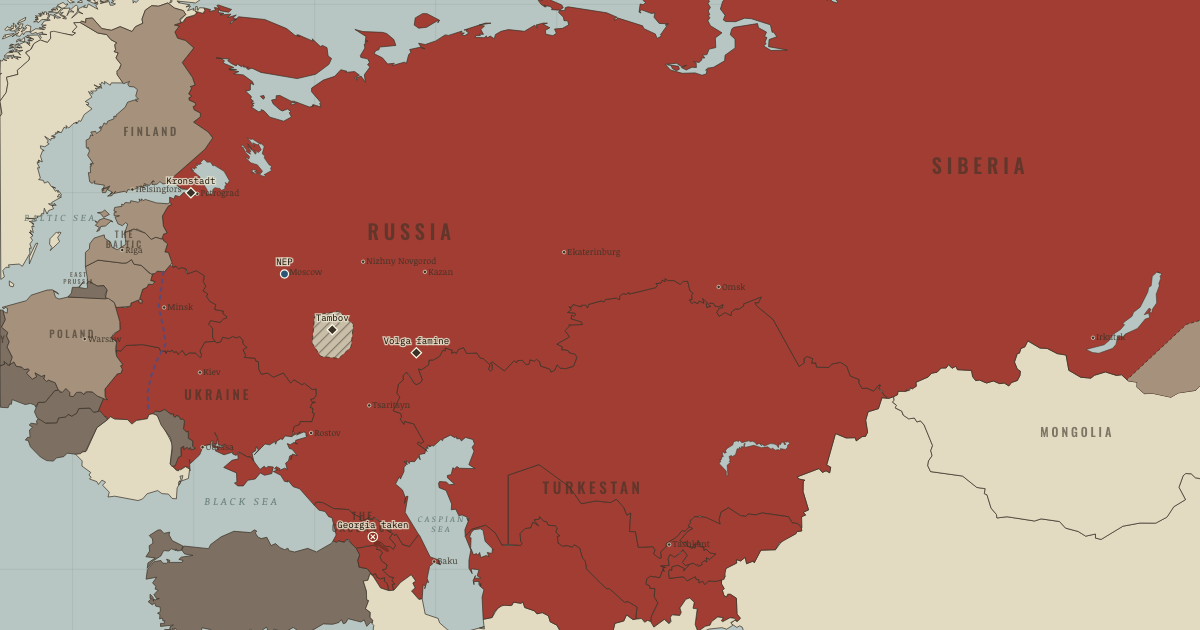
The map above is the world of 1921 — Victors against the people.
BRIEF EXPLANATION — THE ESSENTIAL ARGUMENT
The Reds won the civil war and then faced a new enemy in the very people they claimed to have freed. Once the White threat was gone, the peasants had no further reason to tolerate the grain requisitions of War Communism, and they rose: in Tambov a vast peasant war blazed through 1920 and 1921 and was crushed with hostages, camps, artillery and, by written order, poison gas. Then the revolution’s own children turned, when the sailors of Kronstadt, who had helped make October, rebelled in 1921 demanding freely elected soviets without Bolshevik dictatorship, and were stormed across the ice.
Over everything came the famine of 1921 and 1922, in which drought, requisition and ruin killed perhaps five million people along the Volga, until the regime swallowed its pride and let American relief feed millions. Cornered by revolt and hunger, with the economy at a fraction of its pre-war output, Lenin made the sharpest turn of his career: the New Economic Policy ended grain requisitioning and legalized small trade and private farming. Yet the same congress that opened the economy banned factions inside the party, so that as the state relaxed its grip on the country it tightened its grip on itself.
GUIDED EXPLANATION
The system that had won the war could not survive its own victory. War Communism meant the requisitioning of grain, the militarizing of labor, and the nationalizing of everything, and it had concentrated a poor country’s whole surplus on the front. It had also cut industrial output to roughly a fifth of its 1913 level and emptied the cities, and peasants stopped sowing what would only be seized. While the Whites threatened to restore the landlords, the villages endured these exactions. Once that threat was gone their tolerance ended, and Tambov became a full peasant war, which the Red command answered with collective punishment, concentration camps for rebels’ families, and poison gas in the forests where the rebels hid.
The revolt at Kronstadt was more dangerous still, because it came from within the revolution’s own base and spoke its language. The sailors who had been the pride of 1917 rose in March 1921, demanding soviets freely elected without Communist control. A demand for soviet democracy without the party was a threat the regime could not survive, so Trotsky and Tukhachevsky sent the Red Army across the ice to storm the fortress before the thaw could shield it. Over the same months the famine deepened, combining drought with years of war, requisition and transport ruin. Perhaps five million died, and the regime accepted Herbert Hoover’s American Relief Administration to feed millions, a rescue it took and later wrote out of its histories.
Faced with revolt on every side and an economy in ruins, Lenin executed a deliberate retreat. At the party congress of March 1921, with Kronstadt’s guns still firing, he abolished grain requisitioning, replaced it with a tax in kind, and legalized small trade and private farming under the New Economic Policy, calling it a retreat made in order to leap. The policy worked, reviving agriculture and light industry within a few years. But the same congress banned factions inside the party and treated organized disagreement as a threat. The economy was allowed to breathe while the dictatorship sealed itself against internal dissent. The invasion of Menshevik Georgia in early 1921 showed that neither borderland independence nor rival socialism would be permitted to survive. The revolution had triumphed over all its enemies, and then it turned its weapons on the sailors, peasants and socialists who had made it.
DEEP EXPLANATION — EVIDENCE & INTERPRETATION
How to explain the famine responsibly
The famine of 1921 and 1922 had several interacting causes, and no single one should be allowed to erase the others. Drought reduced the harvests, years of world war and civil war had destroyed the transport network and the draft animals, and requisitioning had removed grain while discouraging both its production and its concealment. Calling the famine simply natural hides the role of policy, while calling it wholly planned overstates the evidence for this particular famine, since Bolshevik delay, hostility to independent relief, and coercive collection worsened a vulnerability they did not entirely create. The American Relief Administration eventually fed more than ten million people a day, which demonstrates both the scale of the need and the capacity of outside logistics to meet it. The death estimates remain uncertain and often cluster around five million. The analytical and moral task is to trace the mechanisms without turning the suffering into a debating token: weather created the scarcity, war destroyed the resilience that might have absorbed it, and policy shaped who kept food and how quickly relief was allowed to reach them.
An opening economy and a closing party
The New Economic Policy was a strategic retreat from compulsory grain seizure and near-total nationalization. A tax in kind let peasants keep and sell their surplus, and legal small trade restored the incentives and the urban supply that War Communism had destroyed, so that agriculture and light industry revived. At the same congress, the Tenth, the party banned factions within its own ranks. Leaders described this as an emergency response to crisis rather than a permanent rule, but the ban became a standing tool against organized opposition. The two moves were not contradictory from Lenin’s point of view, because economic flexibility could preserve the state’s power while political competition could threaten it, and Kronstadt had just made that distinction urgent by demanding soviets without a Bolshevik monopoly. The regime accepted the markets it had once denounced and rejected the institutions that might have removed it, so the New Economic Policy shows pragmatic capacity and authoritarian consolidation working together rather than any simple liberalization.
New here? Chapters 1–2 of every atlas are free to sample, and the WW2 atlas is free in full. One membership opens all thirteen — the Cartographer’s Circle.
THE SITES
WHY IT HAPPENED
War Communism’s exactions. The requisitioning, forced labor and total nationalization that had won the war were economically catastrophic and, once the Whites were gone, politically unbearable. Industrial output had collapsed to roughly a fifth of 1913. The cities emptied. The peasants stopped sowing what would only be seized. The system that beat the Whites could not survive its own victory.
Revolt from below, from the regime’s own base. Tambov’s peasants and Kronstadt’s sailors were not Whites or foreigners. They were the workers-and-peasants the revolution claimed to embody, demanding that its promises be kept. That the regime crushed its own social base is the chapter’s hardest truth: by 1921 the “dictatorship of the proletariat” was suppressing the proletariat.
Famine as the final argument. The starving Volga made continuation of requisitioning impossible. There was nothing left to requisition. Hunger, not ideology, forced the retreat. And hunger, exploited and denied, also let the regime accept foreign relief while suppressing the political meaning of accepting it.
Kronstadt as the alarm bell. Lenin called Kronstadt “the flash that lit up reality.” A revolt by the revolution’s own heroes, under the banner of the revolution’s own slogans, convinced him that the regime would fall unless it eased the economic terror at once. NEP was the answer to Kronstadt as much as to the famine.
THE TURN
The New Economic Policy, March 1921. The retreat that saved the regime. And revealed what it had become. Cornered by revolt and famine, Lenin ended requisitioning and let the market breathe, buying peace with the peasants and reviving the economy within a few years. But the same congress that opened the economy banned factions inside the Party, so the loosening outside was matched by a tightening within. NEP is the model of the strategic retreat. “retreating in order to leap”. And also the moment the Party sealed itself against internal dissent, preparing, though no one meant it to, the ground on which a single man could later stand alone. The economy relaxed. The dictatorship did not.
WHAT IT CHANGED
Recovery bought by retreat. NEP worked: by the mid-1920s agriculture and light industry had largely recovered, the cities refilled, and a battered normality returned. It proved the regime could bend without breaking. And left an argument, unresolved at Lenin’s death, about whether the retreat was a temporary tactic or a road to a mixed economy.
The Party closes ranks. The 1921 ban on factions ended open debate inside the only institution that still had any, and concentrated authority in the leadership and its apparatus. Meant as a temporary emergency measure, it became permanent. And it is the instrument through which the coming succession struggle would be decided.
The empire completed. The sovietization of Georgia in 1921 brought the last independent piece of the old empire back under Moscow. With the borderlands reconquered or fixed by treaty, the territory of the future USSR was essentially settled. The map stops moving, and the struggle turns inward.
FIELD QUESTION — The sailors of Kronstadt had helped make the revolution; in 1921 the revolution destroyed them. What does that tell you about what the revolution had become?
It tells you that by 1921 the revolution had become the state, and the state would tolerate no rival claim to speak for “the people”. Not even from the people themselves. Kronstadt demanded the revolution’s original promise, freely elected soviets, and that was precisely the threat: free soviets would have ended the Party’s monopoly. The regime chose the monopoly. The episode marks the completion of a logic visible since the dispersal of the Constituent Assembly in Chapter 4. Power exercised in the name of a class but never subject to that class’s vote. NEP softened the economics of this dictatorship without softening the politics. Indeed the same month sealed the Party against internal dissent. The transferable lesson is grim and general: revolutions made in the name of popular power routinely end by suppressing popular power, because a party that has justified any means by the goal of holding the state will, in the end, defend the state against the very people it claims to embody.
AN INTERESTING FACT
At its height in the summer of 1922, the American Relief Administration was feeding some ten and a half million Soviet citizens a day, alongside seed, medicine and clothing shipped across the famine zone. The rescue had been set in motion partly by Maxim Gorky’s open appeal “to all honest people,” and Gorky wrote to Hoover that the effort would “enter history as a unique, gigantic achievement.” Within a generation, official Soviet histories had recast the ARA as an espionage front — the kitchens that kept millions alive written out of the story they had made survivable.
THE DISPATCH
One short letter when a new atlas opens — and the printable study guide for The Russian Revolution is yours now, free.
NO TRACKING · YOUR ADDRESS IS USED FOR THE DISPATCH AND NOTHING ELSE · UNSUBSCRIBE ANYTIME