MAPS OF HISTORY · The Russian Revolution · ALL CHAPTERS · CHAPTER 9
CHAPTER 9 · 1917–1921 · AUG 1919
The Borderlands’ Own Revolutions
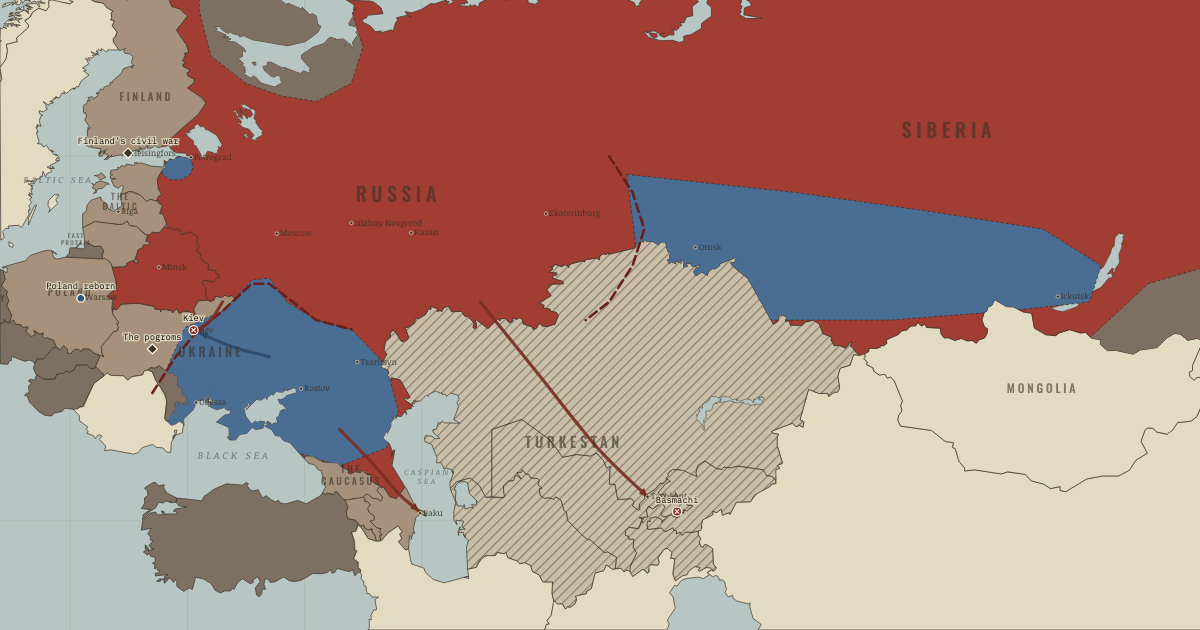
The map above is the world of OCT 1919 — The crisis: Soviet power at its smallest.
BRIEF EXPLANATION — THE ESSENTIAL ARGUMENT
The Russian Revolution was also the collapse of an empire, and around its rim a dozen nations reached for their own futures at once. When the imperial center fell, the peripheries rose. Finland won independence and then fought a savage civil war of its own, while the Baltic states fought their way out with British and their own support. Poland, partitioned for 123 years, became a state again in 1918 and battled on every frontier to fix its shape. Ukraine lay at the tragic center, fought over by nationalists, Germans, Whites, Reds, Poles and peasant armies. Kiev changed hands more than a dozen times, amid pogroms that murdered perhaps a hundred thousand Jews.
The empire was then largely reassembled, because the Reds’ interior lines let them reach far. Wherever they could reach, the breakaway states were reconquered, in Ukraine, the Caucasus, and Central Asia, where Muslim resistance known as the Basmachi smoldered for years. The Bolshevik solution was to reconquer in the name of self-determination, turning the recaptured lands into nominally sovereign Soviet republics bound together under the party. Some borderlands escaped for good, among them Finland, the Baltics and Poland. Most were gathered back in, so that the Union taking shape on the map was the old empire’s territory wearing the revolution’s clothes.
GUIDED EXPLANATION
The fall of the imperial center opened several revolutions at the same time around the empire’s edge. Finland became independent in December 1917 and immediately tore itself apart in a civil war between Red workers and a German-backed White army, whose victors ran prison camps in which thousands of the defeated died. The Baltic states fought Soviet and other forces to a standstill with British naval help and their own riflemen, and Poland, restored after 123 years of partition among three empires, fielded an army and fought on every frontier to define its borders. These were not separate from the Russian Revolution; they were its centrifugal half, the outward flight of every nationalism the empire had held down.
Ukraine was the tragedy at the center of the borderland wars. Its open geography and its grain made it a prize for every armed force, a national movement under Petliura, the anarchist peasant armies of Makhno, the Reds, the Whites, the Germans and the Poles, and Kiev changed hands more than a dozen times. Into that collapse of all authority came the pogroms, in which perhaps a hundred thousand Jews were murdered across Ukraine between 1918 and 1920 by Directory troops, Whites, Greens and freebooters alike. The marker at Proskurov, where some fifteen hundred people died in a single day, stands for that vast and deliberate anti-Jewish violence, named here plainly and mourned rather than folded into any faction’s balance sheet.
The empire was rebuilt because the Reds could reach where the breakaway states were weakest. Their interior lines carried them into Ukraine through 1919 and 1920, into the Caucasus in 1920 and 1921, and across Turkestan, where Muslim resistance called the Basmachi fought on for years. The genius of the Bolshevik answer to the national question was to reconquer under the banner of self-determination, so that the recaptured lands became Soviet republics, sovereign in form and controlled by the party in fact. That formula let the Red Army pose as a liberator, split moderate nationalists from outright separatists, and rebuild the empire as a federation. Some borderlands, backed by great powers and shielded by defensible geography, escaped for good, while those without a patron or a defensible line were gathered back in, and the Union that emerged was the old imperial space refounded on new terms.
DEEP EXPLANATION — EVIDENCE & INTERPRETATION
Why some new states survived
National will existed across the borderlands, but survival depended as much on military capacity, geography and outside support as on the strength of the desire for independence. Finland had defensible terrain and shifting German and then Western connections; the Baltic states received British naval help; and Poland fielded an army able to defeat the Red Army and gained diplomatic standing from the postwar settlement. Ukraine, by contrast, lay open to converging armies, was internally divided among rival movements, and was valued by every side for its grain and its position, while the Caucasus republics became isolated once Soviet forces could concentrate against them. This comparison should not suggest that great powers simply granted independence, since local armies and institutions were essential to it, but it shows that self-determination operated inside a system of power. A movement needed enough force and enough external room to make recognition effective, and those without a patron or a defensible line could win their declarations of independence and still lose their states.
Naming agency in the pogroms
The collapse of the state created the opportunity for anti-Jewish violence, but collapse by itself did not commit the murders, because armed units and local leaders made choices, frequently using accusations of Bolshevism, economic resentment or inherited antisemitism to mark Jewish communities as targets. Forces linked to the Directory, the Whites, the Greens and independent bands all committed major pogroms, and estimates of the total dead vary but commonly reach around a hundred thousand. Red units also committed abuses, though the Red command more consistently forbade pogroms and punished some of those responsible, and that comparative point must not be allowed to turn the victims into evidence for one faction’s virtue. The historian’s task is to identify the perpetrators, the chains of command responsibility, the genuine uncertainty in the totals, and the conditions that let the violence recur across the same spaces. Chaos is the context and not an actor, and memorial treatment resists converting the atrocity into a score in the contest over who ultimately won Ukraine.
New here? Chapters 1–2 of every atlas are free to sample, and the WW2 atlas is free in full. One membership opens all thirteen — the Cartographer’s Circle.
THE SITES
WHY IT HAPPENED
Empire’s collapse is the nations’ opportunity. When the center falls, the peripheries rise. The abdication, October, and above all Brest-Litovsk removed the imperial hand and let every suppressed nationalism. Finnish, Polish, Ukrainian, Georgian, Azeri. Reach for statehood at once. The borderland revolutions were not separate from the Russian one. They were its centrifugal half.
Great-power sponsorship decided who survived. The nations that kept their independence mostly had a great-power patron and defensible geography: Finland (German then Western backing, forests and distance), the Baltics and Poland (Western support, and the buffer of the Polish war). Those with neither. Ukraine open on the plain, the Caucasus republics isolated. Were reconquered. Independence in 1917–21 was as much about who backed you as about how hard you fought.
The Reds’ double policy on nationality. The Bolsheviks proclaimed the right of nations to self-determination and then reconquered the nations that used it. Resolving the contradiction by making the reconquered lands “sovereign” Soviet republics. It was cynical and it worked: it let the Red Army pose as liberator, split moderate nationalists from separatists, and rebuild the empire as a federation.
Ethnic hatred with no state to restrain it. The collapse of all authority across Ukraine turned old antisemitism into mass murder. With no state, no police and armies that lived off the land, the Jewish towns of the Pale became targets for every armed group. The pogroms were not incidental to the borderland wars. They were among their defining atrocities.
THE TURN
Kiev — the borderlands’ ordeal in one city. No place shows the borderland wars better than Kiev, which changed hands among Rada, Bolsheviks, Germans, Hetman, Directory, Whites, Poles and Reds more than a dozen times in three years. Each new master brought requisitions, conscription and, too often, a pogrom. Each was swept away by the next. Kiev’s agony is the borderlands’ story in miniature: nations reaching for freedom, ground between larger armies, and. For Ukraine, unlike Finland or Poland. Finally reconquered. The city that suffered most from the empire’s collapse ended the war back inside its successor.
WHAT IT CHANGED
A ring of new nation-states — and a new border. Finland, Estonia, Latvia, Lithuania and Poland emerged as independent states that lasted (until 1939–40). Their survival redrew the map of eastern Europe and created the borderland that the next war would contest.
The empire rebuilt as a federation. Ukraine, Belorussia and the three Caucasus republics were reconquered and refounded as Soviet republics, joined in 1922 into the USSR. The revolution had promised self-determination and delivered a federal empire. The model that would hold together, and finally fall apart, seventy years later.
A memorial that must not be softened. The pogroms of 1918–20 killed on a scale that prefigured worse to come, and they were committed by nearly every armed force except, on the whole, the disciplined Red Army. A fact the Bolsheviks used, and one that helped turn many Jews toward the Soviet side. It is remembered here as memory, not as a point scored.
FIELD QUESTION — Why did Finland, the Baltics and Poland win lasting independence while Ukraine and the Caucasus were reconquered?
Three factors, in descending order of weight. First, great-power backing: the survivors had Western (and earlier German) support and, in Poland’s case, an army that could beat the Red Army in the field. The reconquered had little or none. Second, geography: Finland’s forests and the Baltic’s and Poland’s position behind the 1920 war gave defensible space, while Ukraine lay open on the plain astride the Reds’ interior lines and the Caucasus republics were isolated and encircled. Third, Red priorities and capacity: the Bolsheviks could reach and cared most about the grain of Ukraine and the oil of Baku, and reconquered them accordingly, while cutting their losses on the Baltic rim after Warsaw. Notice that national will was necessary everywhere and decisive nowhere by itself. The borderlands that survived combined determination with a patron and a defensible line. Self-determination, in 1921 as often since, went to those the great powers were willing to protect.
AN INTERESTING FACT
Independent Finland very nearly began life as a monarchy. In October 1918 its parliament elected a German prince — Friedrich Karl of Hesse, the Kaiser’s brother-in-law — as King of Finland; Germany’s collapse a month later made the choice untenable before the king-elect had ever set foot in his kingdom. He renounced the throne in December, and Finland quietly became the republic it has been ever since — a reminder that the borderland states were improvising even their forms of government week by week, on the shifting fortunes of the great powers.
THE DISPATCH
One short letter when a new atlas opens — and the printable study guide for The Russian Revolution is yours now, free.
NO TRACKING · YOUR ADDRESS IS USED FOR THE DISPATCH AND NOTHING ELSE · UNSUBSCRIBE ANYTIME