ONE LAND · 14 ATLASES
History of Armenia in maps
Armenia as it appears in 14 interactive history atlases, from 264 BC to 2015: Armenia, Soviet Union, Soviet Armenia. Each era below lists who ruled the land and when control changed, linked to the dated map that shows it.
WW2 is free — every chapter. Try chapters 1–2 of any 2 other atlases (3 with a free account). Opening a new atlas uses one of them. Membership opens all 21 — Join.
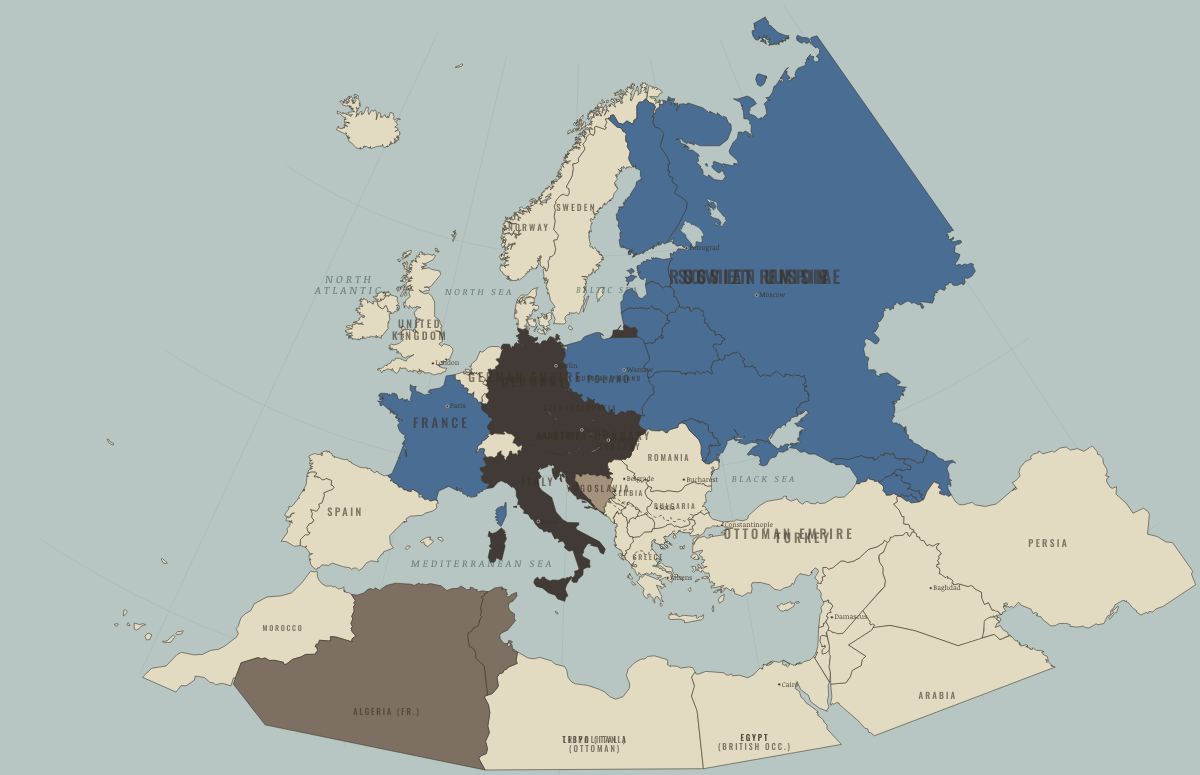
What was Armenia before it was Armenia? Below, every era of this land in the Maps of History atlases — who ruled it, what it was called, and when control changed — each line linked to the dated map that shows it. Modern borders stand in as an honest approximation; every atlas says so on the map itself.
Armenia · Ancient Rome
Armenia: the buffer monarchy both empires needed and neither could tolerate armed — crowned by Roman generals, married to Persian princes, invaded by both. Trajan annexed it (114); Hadrian let it go; the partition of 387 split it between the empires. In 301 it became the first state to adopt Christianity — before Rome itself.
| 264 BC | Hellenistic kingdoms — the opening position |
| 62 BC | Roman clients & allies |
| Roman territory | |
| Roman clients & allies | |
| Rival great powers |
ANCIENT ROME: EVERY CHAPTER AND MAP →
Armenia — highland & Cilician · Crusades
Armenian Christians were Outremer’s indispensable allies from the first winter: Armenian lords guided and fed the First Crusade through the Taurus passes, and Baldwin of Boulogne took Edessa in 1098 by adoption into an Armenian ruler’s house. Cilician Armenia bound itself to Antioch by a century of marriages, became a kingdom when Levon I was crowned in 1198 with a crown sent from the German emperor, and outlasted every mainland crusader state — the Mamluks extinguished it only in 1375. The Armenians of the highland plateau, meanwhile, lived under Seljuk and then Mongol rule: a Christian people caught between empires, for whom the crusades were one chapter in a far longer endurance.
CRUSADES: EVERY CHAPTER AND MAP →
Armenia · Mongol Empire
Greater Armenia passed under Mongol rule in the 1230s and paid heavily in tribute; but Cilician Armenia’s king Het‘um chose voluntary alliance in 1247, rode to Karakorum, and profited as a favored client — his realm fought beside the Ilkhans against the Mamluks and paid the price when the Mongols withdrew. Two Armenian strategies, two fates: study both.
| Other settled powers (Jin China, Christendom, Delhi) — the opening position | |
| Tributaries & vassals |
MONGOL EMPIRE: EVERY CHAPTER AND MAP →
Armenia · Industrial Revolution
| Industrialising — the opening position | |
| Industrialising |
INDUSTRIAL REVOLUTION: EVERY CHAPTER AND MAP →
Armenia · Age of Revolutions
| Neutral / uncommitted — the opening position |
AGE OF REVOLUTIONS: EVERY CHAPTER AND MAP →
Armenia · Meiji Japan and post-Soviet Russia
Armenia’s movement to unite with Nagorno-Karabakh began in 1988 and turned a Soviet republic’s politics into a national struggle. The Spitak earthquake of December 1988 killed between about 25,000 and 50,000 people in the north and exposed shoddy Soviet construction. By the ceasefire of 1994 Armenian forces held Karabakh and the districts around it, while hundreds of thousands of Armenians had fled Azerbaijan and Azerbaijanis had fled Armenia.
| The USSR, then Russia — the opening position | |
| Independent neighbours |
MEIJI JAPAN AND POST-SOVIET RUSSIA: EVERY CHAPTER AND MAP →
Armenia · Russian Revolution
Independent from 1918, Armenia was crushed between Turkey and Bolshevik Russia after the genocide its people had suffered under the Ottomans. Sovietized in late 1920, it became a Soviet republic — survival under Moscow chosen over annihilation between empires.
| The Tsarist empire — the opening position | |
| Provisional Government, then the Whites | |
| Breakaway national states | |
| Soviet power |
RUSSIAN REVOLUTION: EVERY CHAPTER AND MAP →
Armenia (Russian Empire) · WWI
Russian Armenia — across the border from the genocide (Ch. 6) that destroyed Ottoman Armenia. An independent republic emerged in 1918 in the Caucasus chaos, fought Turkey with the survivors of the deportations in its ranks, and was divided between Kemalist Turkey and Soviet Russia by 1921. The diaspora the genocide created carries its memory worldwide.
| The Entente & Allies — the opening position | |
| The Entente & Allies | |
| Russia in revolution | |
| Neutral or unaligned | |
| Russia in revolution | |
| Neutral or unaligned |
Armenia (Armenian SSR) · Stalin’s Soviet Union
Soviet Armenia was a small, mountainous republic whose people carried the memory of the Ottoman genocide of 1915. It was part of the Transcaucasian federation until 1936. Its party leader Aghasi Khanjian died in Beria’s office in 1936, and the Terror took much of its intelligentsia. After the war Stalin invited diaspora Armenians to “return”, and about 90,000 came in 1946–49; many were later deported to Siberia as suspect foreigners.
| The Soviet Union — the opening position |
STALIN’S SOVIET UNION: EVERY CHAPTER AND MAP →
Armenia · Road to WW2
| Neutral & unaligned — the opening position | |
| Aggressor clients & partners | |
| Democracies & powers fighting them |
ROAD TO WW2: EVERY CHAPTER AND MAP →
Armenia · WW2
| Soviet Union — the opening position |
Armenia · Cold War
| USSR & Warsaw Pact — the opening position | |
| Non-aligned & neutral | |
| Non-aligned & neutral |
COLD WAR: EVERY CHAPTER AND MAP →
Soviet Union (Armenia) · Feminism and the Tunisian Revolution
| Right won in law — the opening position | |
| No reform yet / outside this story | |
| Right won in law |
FEMINISM AND THE TUNISIAN REVOLUTION: EVERY CHAPTER AND MAP →
Soviet Armenia · Refugee crises
| Soviet-occupied or communist — the opening position |
REFUGEE CRISES: EVERY CHAPTER AND MAP →
Related
THE FREE PRINTABLE STUDY GUIDE
Join the Dispatch — a short welcome series, then a letter when a new atlas opens — and a printable atlas study guide of your choice is yours now, free.
NO TRACKING · YOUR ADDRESS IS USED FOR THE DISPATCH AND NOTHING ELSE · UNSUBSCRIBE ANYTIME