ONE LAND · 13 ATLASES
History of Greece in maps
Greece as it appears in 13 interactive history atlases, from 264 BC to 2015: Greece, Greece — Byzantine, then Frankish, Latin & Byzantine Greece. Each era below lists who ruled the land and when control changed, linked to the dated map that shows it.
WW2 is free — every chapter. No sign-up.
What was Greece before it was Greece? Below, every era of this land in the Maps of History atlases — who ruled it, what it was called, and when control changed — each line linked to the dated map that shows it. Modern borders stand in as an honest approximation; every atlas says so on the map itself.
Greece · Ancient Rome
The teacher of its conqueror. Macedon’s phalanx broke against the legion (Cynoscephalae, Pydna); Corinth’s destruction in 146 announced the terms of Roman “liberation.” Yet Greek language, philosophy, art and civic culture captured Rome so completely that the empire’s surviving half was Greek-speaking — and called itself Roman until 1453.
| 264 BC | Hellenistic kingdoms — the opening position |
| 146 BC | Roman territory |
ANCIENT ROME: EVERY CHAPTER AND MAP →
Greece — Byzantine, then Frankish · Crusades
The Byzantine core, and the crusades’ great victim. Byzantium ferried and fed the First Crusade, then watched the Franks keep Antioch in defiance of their oaths; distrust hardened for a century until, in 1204, a crusade sacked Constantinople itself and carved Greece into Frankish principalities. The empire was restored in 1261 but never made whole — and the Orthodox Church has never forgotten.
| Byzantium (and Latin Constantinople 1204–61) — the opening position | |
| Latin Christendom | |
| Byzantium (and Latin Constantinople 1204–61) |
CRUSADES: EVERY CHAPTER AND MAP →
Latin & Byzantine Greece · Mongol Empire
| Other settled powers (Jin China, Christendom, Delhi) — the opening position |
MONGOL EMPIRE: EVERY CHAPTER AND MAP →
Greece · Industrial Revolution
INDUSTRIAL REVOLUTION: EVERY CHAPTER AND MAP →
Greece · Age of Revolutions
The revolt that broke the Restoration’s rules: rising against a legitimate sovereign (1821), sustained by European public opinion — Chios’s martyrs, Byron’s death, Navarino’s cannon — until the powers midwifed an independent kingdom (1830). The first new nation-state carved from an empire by the combination that would define the next century: local insurgency plus great-power rivalry plus publicity.
| Neutral / uncommitted — the opening position | |
| Republics & revolutionary states |
AGE OF REVOLUTIONS: EVERY CHAPTER AND MAP →
Greece · Meiji Japan and post-Soviet Russia
| Western powers and allies — the opening position |
MEIJI JAPAN AND POST-SOVIET RUSSIA: EVERY CHAPTER AND MAP →
Greece · WWI
Greece spent the war at war with itself — the National Schism: a pro-Entente premier (Venizelos) against a pro-neutrality king, rival governments, Allied fleets at Athens — before joining the Entente in June 1917. It fought well on the Salonika front, then cashed Anatolian promises at Smyrna in 1919 (Ch. 14) and marched into catastrophe: the 1922 disaster and the population exchange ended three thousand years of Greek Asia Minor.
| The Entente & Allies — the opening position | |
| The Entente & Allies | |
| The Entente & Allies |
Greece · Stalin’s Soviet Union
| Nazi Germany & its allies — the opening position | |
| Nazi Germany & its allies | |
| Other states | |
| Rivals & the Western bloc |
STALIN’S SOVIET UNION: EVERY CHAPTER AND MAP →
Greece · Road to WW2
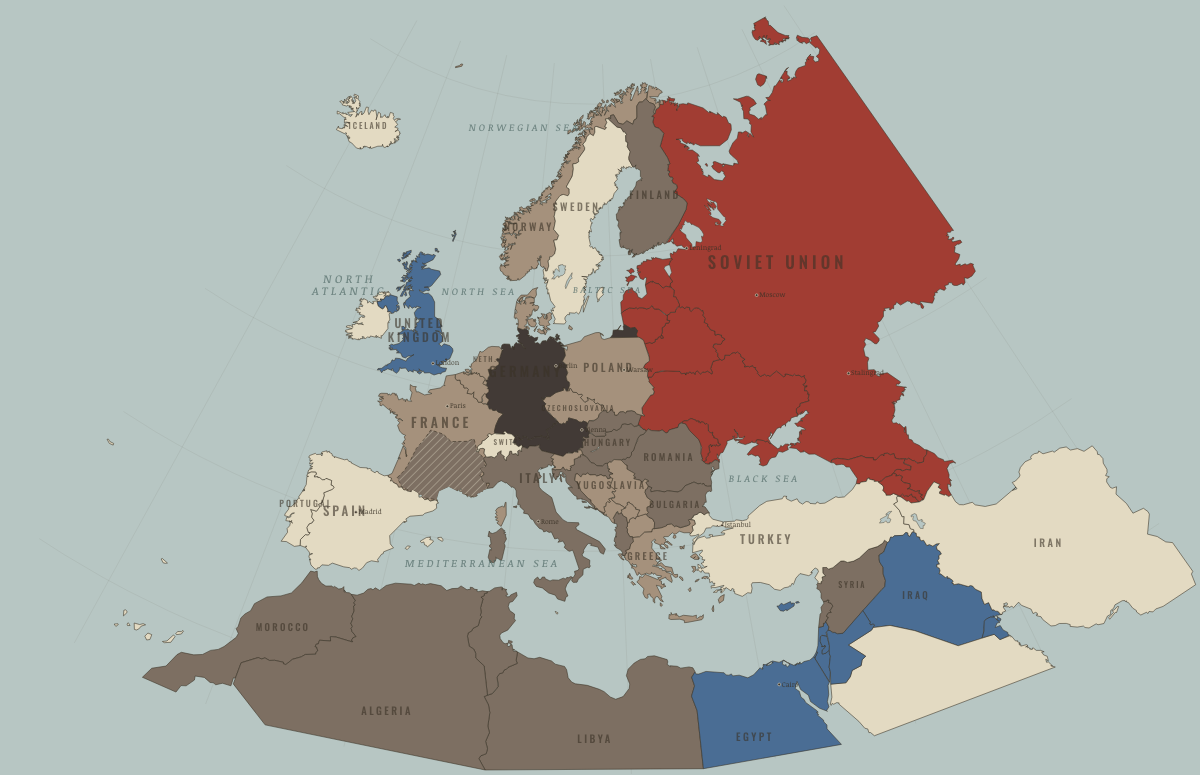
Mussolini’s intended easy victory and the Axis’s first land defeat: invaded from Albania in October 1940, it threw the invaders back across the border and had to be conquered by Germany instead in April 1941 — a Balkan detour some historians still tally against Barbarossa’s timetable. Occupied, it suffered one of the war’s terrible famines in the winter of 1941–42.
| Neutral & unaligned — the opening position | |
| Occupied — held by force |
ROAD TO WW2: EVERY CHAPTER AND MAP →
Greece · WW2
Threw back Italy (1940) — the Axis’s first land defeat — before falling to Germany (Ch. 5). Endured a famine winter that killed tens of thousands, fierce resistance and reprisals, then slid from world war into civil war (1946–49): the Cold War’s first battlefield.
| Axis-occupied — the opening position | |
| Axis-occupied | |
| Western Allies |
Greece · Cold War
| US-aligned states — the opening position | |
| NATO & core Western allies |
COLD WAR: EVERY CHAPTER AND MAP →
Greece · Feminism and the Tunisian Revolution
| Refused: women excluded; ERA never ratified — the opening position | |
| Right won in law | |
| No reform yet / outside this story | |
| Right won in law |
FEMINISM AND THE TUNISIAN REVOLUTION: EVERY CHAPTER AND MAP →
Greece · Refugee crises
| Western bloc or democracy — the opening position |
REFUGEE CRISES: EVERY CHAPTER AND MAP →
Related
THE FREE PRINTABLE STUDY GUIDE
Join the Dispatch — a short welcome series, then a letter when a new atlas opens — and a printable atlas study guide of your choice is yours now, free.
NO TRACKING · YOUR ADDRESS IS USED FOR THE DISPATCH AND NOTHING ELSE · UNSUBSCRIBE ANYTIME