ONE LAND · 12 ATLASES
History of Japan in maps
Japan as it appears in 12 interactive history atlases, from 1840 to 2000: Japan. Each era below lists who ruled the land and when control changed, linked to the dated map that shows it.
WW2 is free — every chapter. No sign-up.
What was Japan before it was Japan? Below, every era of this land in the Maps of History atlases — who ruled it, what it was called, and when control changed — each line linked to the dated map that shows it. Modern borders stand in as an honest approximation; every atlas says so on the map itself.
Japan (Kamakura shogunate) · Mongol Empire
The Kamakura shogunate beheaded Khubilai’s envoys and prepared: the Hakata wall held the 1281 armada offshore until the typhoon — kamikaze, the divine wind — destroyed it. Victory bankrupted the regime (no conquered land to pay the samurai) and gave Japan a national legend with a long, dark afterlife. The strait did what no wall on the mainland could.
| Beyond the storm — the opening position |
MONGOL EMPIRE: EVERY CHAPTER AND MAP →
Japan · Industrial Revolution
Forced open by American warships in 1853–58, Japan became the first non-Western country to industrialise. Its government built railways and model factories, private firms built cotton mills and shipyards, and young women reeling silk and spinning cotton paid for much of it. Victories over China in 1895 and Russia in 1905 brought an empire in Taiwan, southern Manchuria and Korea.
| Opened by force or treaty — the opening position | |
| Opened by force or treaty | |
| Industrialising |
INDUSTRIAL REVOLUTION: EVERY CHAPTER AND MAP →
Japan · Meiji Japan and post-Soviet Russia
The state remade in this atlas’s first half. In 1840 Japan was a patchwork of some 260 domains under a shogun; by 1871 it was a centralised state with one army and one tax; by 1910 it ruled Taiwan, Korea and southern Sakhalin. On the Eurasia map it appears as an American ally, its own transition long finished. Its later path, from military rule in the 1930s to defeat in 1945, is a reminder that a strong state built from above can turn its strength outward.
| The shogun’s lands and allies — the opening position | |
| Domains, vassals, protectorates | |
| Meiji Japan and its empire |
MEIJI JAPAN AND POST-SOVIET RUSSIA: EVERY CHAPTER AND MAP →
Japan · Russian Revolution
Japan, having beaten Russia in 1905, sent the largest intervention force and kept it longest — up to 70,000 troops in the Far East until October 1922 — with real ambitions of carving out a Siberian sphere. Its withdrawal marked the civil war’s final foreign departure; its appetite for the Asian mainland was only postponed.
| Foreign powers & intervention — the opening position |
RUSSIAN REVOLUTION: EVERY CHAPTER AND MAP →
Japan · WWI
Japan joined the Entente in August 1914, took Tsingtao and Germany’s Pacific islands in weeks (Ch. 9), pressed China with the Twenty-One Demands, and sat at Versailles as a great power — where its racial-equality clause was voted down. It kept Shandong and the islands; the Pacific war of 1941 would be fought across the archipelagos this war gave it.
| The Entente & Allies — the opening position | |
| The Entente & Allies |
Japan (Empire of Japan) · Chinese Revolution
The empire whose army audited itself. Japan enters this atlas already holding Taiwan and Korea, takes Shandong in 1914, Manchuria in 1931 by a field conspiracy Tokyo dared not punish, and China’s coast in 1937 through an escalation no one in Tokyo could stop. Its planners called Manchuria a lifeline and China an incident; the incident consumed a million-man garrison, licensed its enemies’ revolutions, and ended with the home islands occupied — the charcoal on this map hatched into defeat. No power on this map did more to decide who would rule China, or intended it less.
| The Empire of Japan & its puppets — the opening position | |
| Japan defeated & under occupation (1945) |
CHINESE REVOLUTION: EVERY CHAPTER AND MAP →
Japan · Stalin’s Soviet Union
Japan was the Soviet Union’s rival in the east throughout the Stalin years. It held southern Sakhalin and the Kurils, created the puppet state of Manchukuo on the Soviet border in 1932, and fought Soviet troops at Lake Khasan in 1938 and Khalkhin Gol in 1939. The neutrality pact of April 1941 freed both sides for other wars, until the Soviet Union attacked Manchuria in August 1945 and took Sakhalin and the Kurils.
| Rivals & the Western bloc — the opening position |
STALIN’S SOVIET UNION: EVERY CHAPTER AND MAP →
Japan · Road to WW2
The first mover. A constitutional empire whose army answered to no cabinet: Mukden (1931) was insubordination ratified, the China war (1937) escalation nobody ordered, and Pearl Harbor the endpoint of an oil clock its own conquests wound. Every gamble worked until the one that mattered; the six months Yamamoto promised ran out at Midway, six months and three days after this atlas ends.
| The aggressors (Japan, Germany, Italy) — the opening position |
ROAD TO WW2: EVERY CHAPTER AND MAP →
Japan · WW2
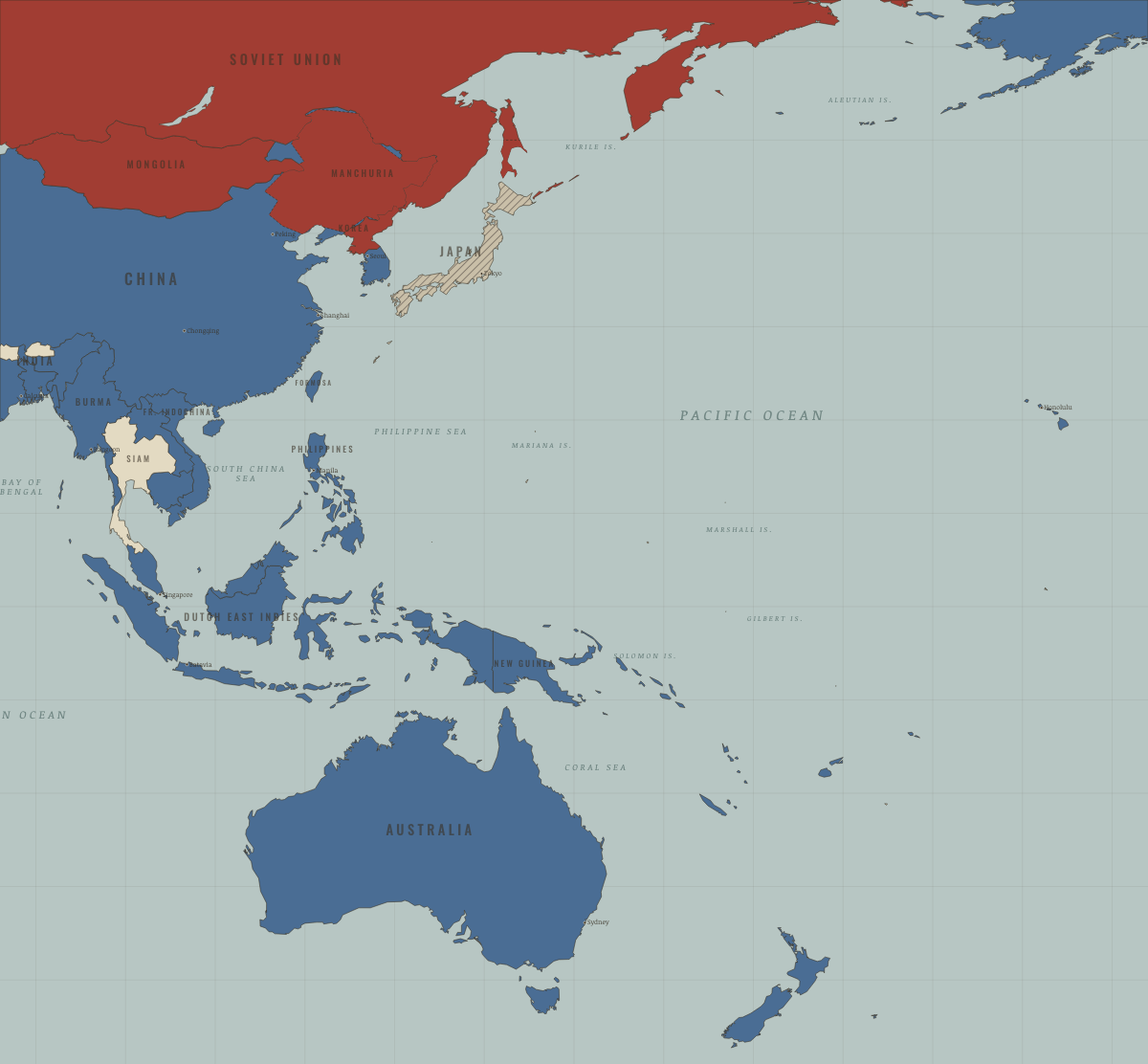
An island empire that gambled it could conquer resources faster than America could mobilize anger (Ch. 7). Its army committed vast atrocities in Asia; its cities were burned and atom-bombed; its surrender came only when Emperor overrode military deadlock (Ch. 14). Occupied, democratized, and pacifist by constitution since.
| Axis powers — the opening position | |
| Defeated Axis (occupied) |
Japan · Cold War
| NATO & core Western allies — the opening position |
COLD WAR: EVERY CHAPTER AND MAP →
Japan · Refugee crises
| Western bloc or democracy — the opening position |
REFUGEE CRISES: EVERY CHAPTER AND MAP →
Japan · Mao’s China
Japan, occupied by the United States until 1952, followed Washington in recognising Taiwan, though it traded with the mainland. Many Chinese remembered its invasion of 1937–45. After Nixon’s visit, Prime Minister Tanaka Kakuei flew to Beijing in September 1972, established relations with the People’s Republic and broke them with Taiwan, and China waived its claim to war reparations.
| Beijing’s adversaries — the opening position | |
| Neutral, non-aligned or colonial |
MAO’S CHINA: EVERY CHAPTER AND MAP →
Related
THE FREE PRINTABLE STUDY GUIDE
Join the Dispatch — a short welcome series, then a letter when a new atlas opens — and a printable atlas study guide of your choice is yours now, free.
NO TRACKING · YOUR ADDRESS IS USED FOR THE DISPATCH AND NOTHING ELSE · UNSUBSCRIBE ANYTIME