ONE LAND · 11 ATLASES
History of Uzbekistan in maps
Uzbekistan as it appears in 11 interactive history atlases, from 1206 to 2000: Transoxiana, Turkestan, Uzbekistan, Russian Turkestan, Soviet Central Asia, the Uzbek SSR, Soviet Uzbekistan. Each era below lists who ruled the land and when control changed, linked to the dated map that shows it.
WW2 is free — every chapter. Try chapters 1–2 of any 2 other atlases (3 with a free account). Opening a new atlas uses one of them. Membership opens all 21 — Join.
Free printable Russian Revolution study guide, sent by email ↓
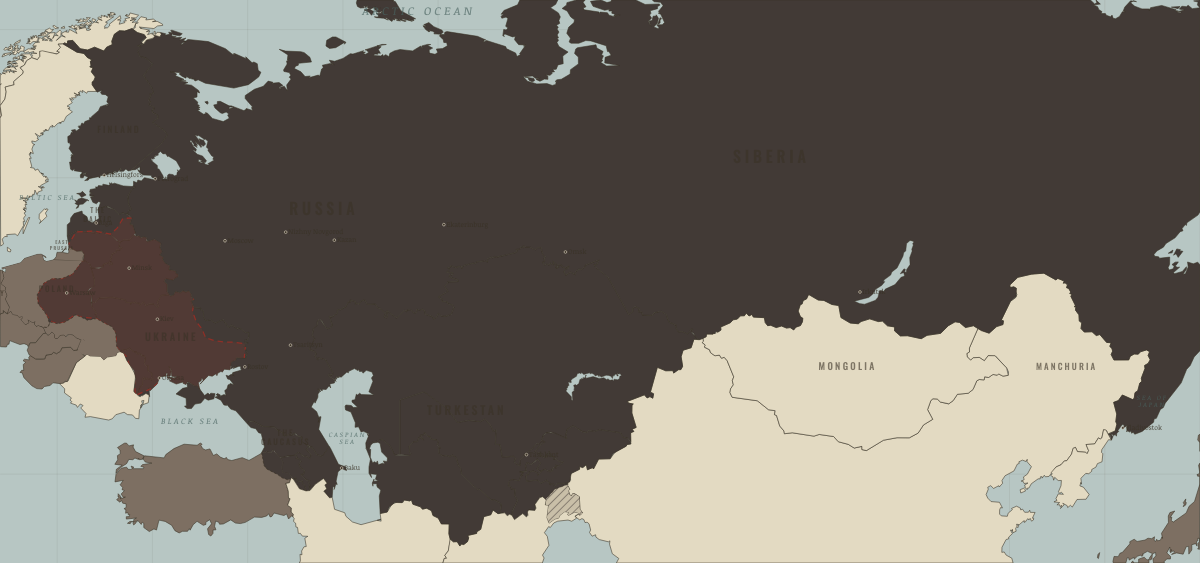
What was Uzbekistan before it was Uzbekistan? Below, every era of this land in the Maps of History atlases — who ruled it, what it was called, and when control changed — each line linked to the dated map that shows it. Modern borders stand in as an honest approximation; every atlas says so on the map itself.
Transoxiana (mod. Uzbekistan) · Mongol Empire
Transoxiana — Bukhara and Samarkand, Islam’s eastern lamps — took the war’s first full force in 1220: “I am the punishment of God” was spoken from Bukhara’s pulpit. Rebuilt under the Chagatai khanate’s loose rule, the region would produce the era’s last act: Timur, who claimed the Chinggisid mantle from Samarkand a century later.
| The Islamic powers — the opening position | |
| The Mongol Empire |
MONGOL EMPIRE: EVERY CHAPTER AND MAP →
Turkestan (Russian Empire) · Industrial Revolution
| Colony or dependency — the opening position | |
| Colony or dependency |
INDUSTRIAL REVOLUTION: EVERY CHAPTER AND MAP →
Uzbekistan · Meiji Japan and post-Soviet Russia
Uzbekistan, the most populous Central Asian republic, was the heart of the Soviet cotton economy, whose irrigation canals drained the Aral Sea. In the 1980s a scandal over falsified cotton figures led to thousands of prosecutions. Its party leader Islam Karimov became president of the independent state in 1991 and ruled it with little change to the old system of control until his death in 2016.
| The USSR, then Russia — the opening position | |
| Independent neighbours |
MEIJI JAPAN AND POST-SOVIET RUSSIA: EVERY CHAPTER AND MAP →
Russian Turkestan (mod. Uzbekistan) · Russian Revolution
Russia conquered these lands between 1865 and 1876: it stormed Tashkent in 1865, annexed Samarkand in 1868, made Bukhara a protectorate that kept its emir but obeyed Russia, subdued Khiva in 1873 and abolished Kokand in 1876. The heart of Russian Turkestan, with the ancient cities of the khanates of Khiva and Bukhara. The isolated Tashkent Soviet held on from 1917; Frunze’s Turkestan Front reconnected and reconquered the region in 1920, ending the khanates. Muslim resistance (the Basmachi) fought on for years.
| Neutral or independent — the opening position | |
| The Tsarist empire | |
| Provisional Government, then the Whites | |
| Contested / peasant war | |
| Soviet power |
RUSSIAN REVOLUTION: EVERY CHAPTER AND MAP →
Russian Turkestan (mod. Uzbekistan) · Indian independence
Russian Turkestan’s heart — Bukhara and Samarkand under tsarist rule since the 1860s, the emirate of Bukhara a princely state in all but name until the Red Army ended it in 1920. Soviet power redrew the whole region into national republics in 1924: Moscow’s answer to the empire-and-nation question the Raj was failing to answer further south. The parallels — indirect rule, cotton extraction, engineered borders — made Central Asia the subcontinent’s unheeded mirror.
| Beyond the Raj · Portuguese & French India — the opening position |
INDIAN INDEPENDENCE: EVERY CHAPTER AND MAP →
Uzbekistan · WWI
| The Entente & Allies — the opening position | |
| Russia in revolution |
Soviet Central Asia (mod. Uzbekistan) · Chinese Revolution
| Foreign empires — British, French, Russian, American — the opening position |
CHINESE REVOLUTION: EVERY CHAPTER AND MAP →
The Uzbek SSR · Stalin’s Soviet Union
The Uzbek republic was created in October 1924 when Moscow redrew Central Asia along national lines, dissolving the Bukhara and Khorezm republics. Its capital was Samarkand until 1930 and then Tashkent. Stalin’s plans turned it into the Union’s cotton field, a dependence that later drained the Aral Sea. The campaign against the veil began here in 1927, and in 1944 it received most of the deported Crimean Tatars.
| The Soviet Union — the opening position |
STALIN’S SOVIET UNION: EVERY CHAPTER AND MAP →
Soviet Uzbekistan · Road to WW2
| Neutral & unaligned — the opening position | |
| Aggressor clients & partners | |
| Democracies & powers fighting them |
ROAD TO WW2: EVERY CHAPTER AND MAP →
Uzbekistan · Cold War
| USSR & Warsaw Pact — the opening position | |
| Non-aligned & neutral |
COLD WAR: EVERY CHAPTER AND MAP →
Soviet Central Asia (mod. Uzbekistan) · Mao’s China
| Beijing’s allies and friends — the opening position | |
| Beijing’s adversaries |
MAO’S CHINA: EVERY CHAPTER AND MAP →
Related
THE FREE PRINTABLE STUDY GUIDE
Join the Dispatch — a short welcome series, then a letter when a new atlas opens — and a printable atlas study guide of your choice is yours now, free.
NO TRACKING · YOUR ADDRESS IS USED FOR THE DISPATCH AND NOTHING ELSE · UNSUBSCRIBE ANYTIME