ON THIS DAY ·
Death of Lenin
21 Jan 1924 — Silenced by strokes, Lenin dies at 53, his “Testament” warning against Stalin unheeded. Petrograd becomes Leningrad; the succession struggle he feared is already under way.
WW2 is free — every chapter. Try chapters 1–2 of any 2 other atlases (3 with a free account). Opening a new atlas uses one of them. Membership opens all 21 — Join.
Free printable Russian Revolution study guide, sent by email ↓
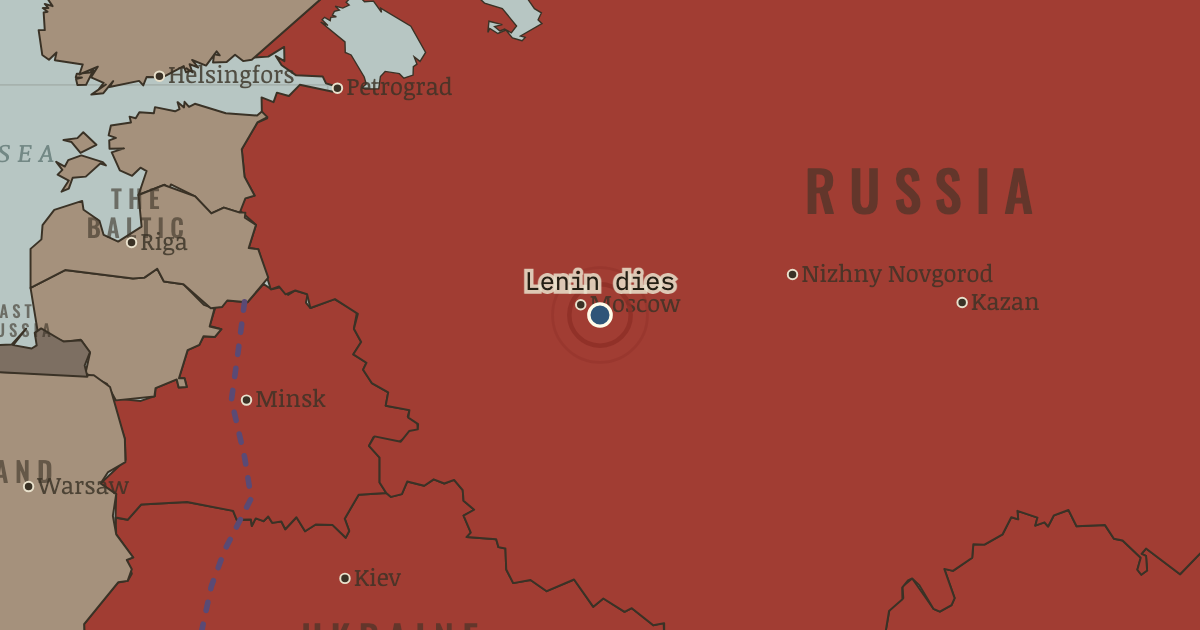
The moment in context
The settled red map should not be mistaken for a simple restoration of the old empire, because the country that emerged in 1922 differed from the one that had fallen. Finland, Poland and the Baltic states remained outside it, and inside the new union the republic borders, official languages and national institutions gave nationality a formal place that tsarist autocracy had always denied. The founding of the USSR at Moscow on 30 December 1922 recognized the force of national identity while withholding any competitive sovereignty, since one command structure controlled security, the major appointments and policy across every republic. This was a durable arrangement precisely because its federal form and its party centralization solved two different problems at once.
From Legacy of the Russian Revolution, chapter 14 of The Russian Revolution, 1855–1924 (JAN 1924).
The place: Death of Lenin — map and full story →
Teach this in 5 minutes
- Why it happened — The civil war forged the state. The USSR of 1924 was the child of its war, not of 1917’s hopes. Centralization, one-party rule, the security police, the militarized economy and the…
- The turn — Lenin dies at Gorki, 21 January 1924. The revolution’s founder died at fifty-three, his final warnings unheeded and his succession unsettled. Lenin’s death matters less for the man than…
- What it changed — Stalin’s rise. The man who held the dull administrative offices. General Secretary above all. Controlled who joined the Party, who was promoted, who was posted…
Then ask the room: Was the Soviet outcome — a one-party dictatorship — the inevitable result of 1917, or a contingent product of the civil war and its aftermath? The argued answer is on the chapter page →
The atlas that shows it
THE FREE PRINTABLE STUDY GUIDE
Join the Dispatch — a short welcome series, then a letter when a new atlas opens — and the printable study guide for The Russian Revolution is yours now, free.
NO TRACKING · YOUR ADDRESS IS USED FOR THE DISPATCH AND NOTHING ELSE · UNSUBSCRIBE ANYTIME