ON THIS DAY · 15 MARCH 44 BC
Assassination of Julius Caesar
The Ides of March. Caesar is stabbed twenty-three times at a meeting of the Senate — by men convinced they are saving the Republic they are about to bury.
WW2 is free — every chapter. Try chapters 1–2 of any 2 other atlases (3 with a free account). Opening a new atlas uses one of them. Membership opens all 21 — Join.
The moment in context
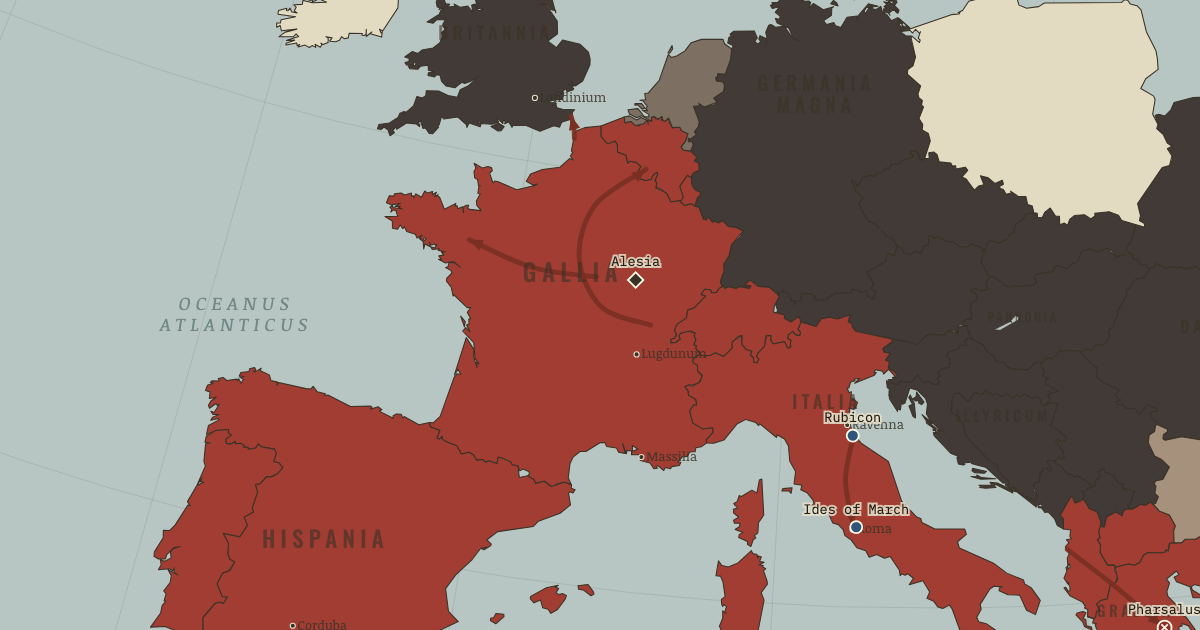
Caesar’s conquest of Gaul was in large part a war of choice, undertaken to build a career, and reading it honestly means holding its achievement and its brutality in view together. He arrived in 58 BC as a governor with heavy debts and a name to make. He intervened in the quarrels of a divided Gaul, presented each new campaign as defence or prevention, and reported his own version of events to readers in Rome through his Commentaries, a plain and hugely effective piece of political writing. Ancient authors claim roughly a million Gauls killed and a million enslaved across the decade. Modern historians distrust the exact figures while accepting that the violence and displacement were vast, and some apply the word genocide to particular episodes. Organised resistance came together only in 52 BC under Vercingetorix. It ended at Alesia, where Caesar built two rings of siege works, one facing the town he was starving and one facing the army marching to relieve it, and defeated both.
From Julius Caesar and the civil war, chapter 5 of The Rise and Fall of Rome, 264 BC – AD 476 (52 BC).
Teach this in 5 minutes
- Why it happened — A war chosen as a career move. Caesar needed conquest the way a modern politician needs funding: his debts were colossal, his rivals’ glory (Pompey’s east) needed answering, and…
- The turn — The Rubicon, 10 January 49 BC. A provincial boundary stream so small its exact course is still disputed — crossed in armor, it was constitutional death. Caesar reportedly…
- What it changed — Gaul: a province that changes the empire’s shape. Eight years of blood buy four centuries of Roman Gaul — which becomes, as you’ll see by Chapter 7, the empire’s western engine: Lyon its…
Then ask the room: Was the Gallic War a war of aggression — and did Romans themselves think so? The argued answer is on the chapter page →
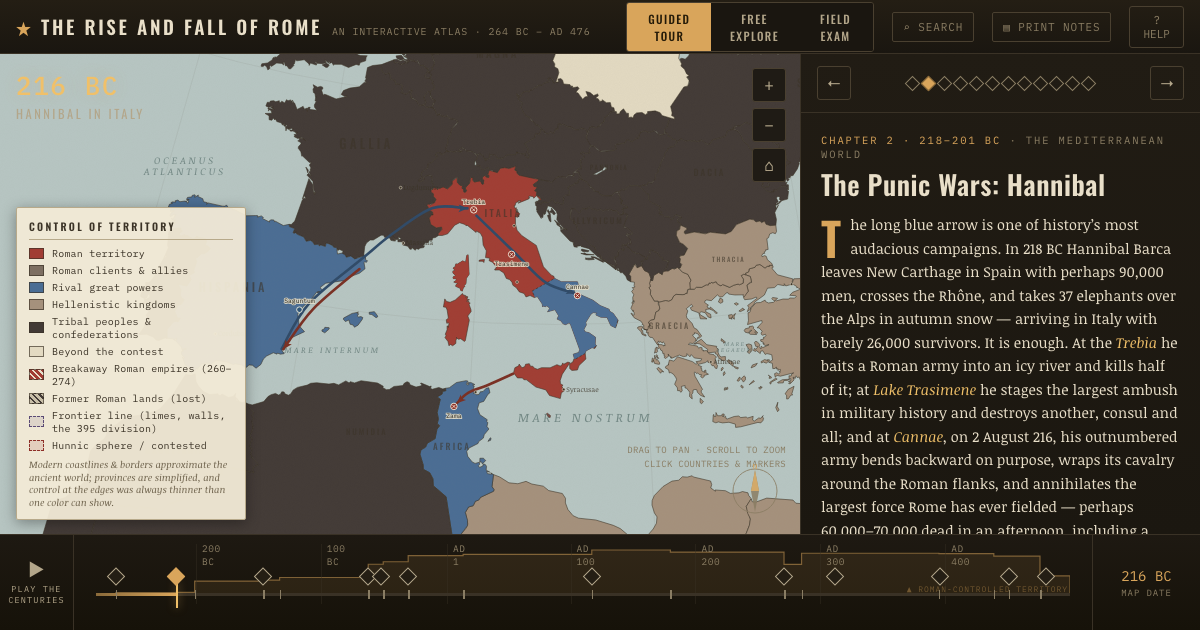
The atlas that shows it
THE FREE PRINTABLE STUDY GUIDE
Join the Dispatch — a short welcome series, then a letter when a new atlas opens — and the printable study guide for Rome is yours now, free.
NO TRACKING · YOUR ADDRESS IS USED FOR THE DISPATCH AND NOTHING ELSE · UNSUBSCRIBE ANYTIME