ON THIS DAY ·
Battle of Yamen
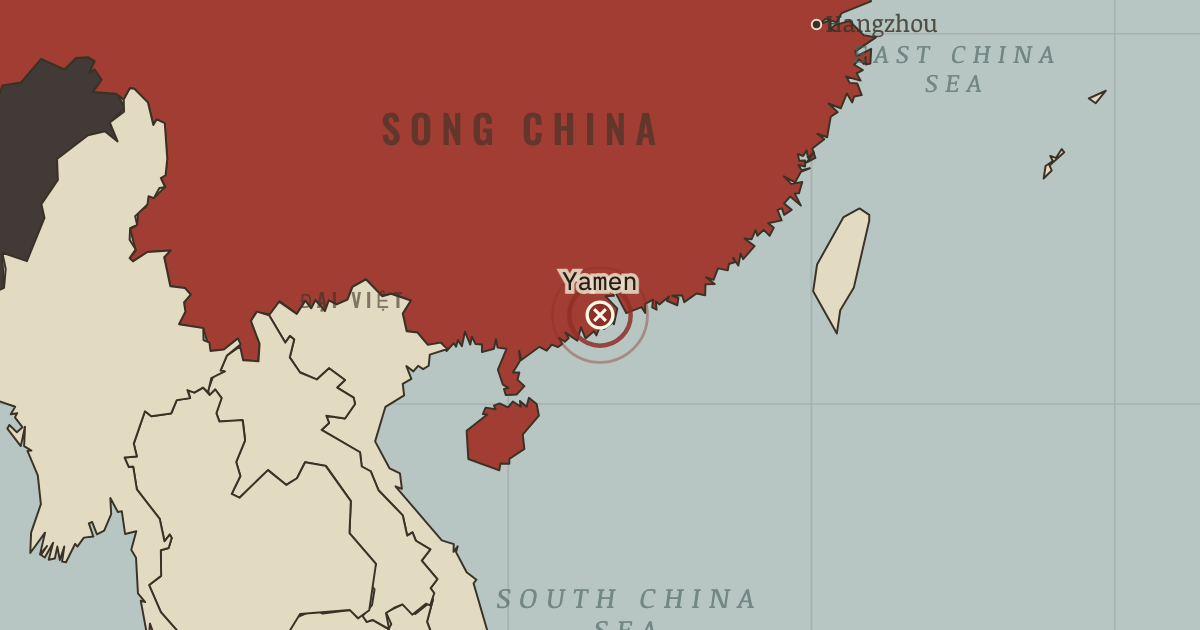
19 Mar 1279 — The last Song fleet, carrying the court in exile, is destroyed off this headland; the chancellor Lu Xiufu takes the eight-year-old emperor on his back and steps into the sea. For the first time in history, all of China is ruled by conquerors from the steppe.
WW2 is free — every chapter. Try chapters 1–2 of any 2 other atlases (3 with a free account). Opening a new atlas uses one of them. Membership opens all 21 — Join.
The moment in context
The Song war lasted far longer than any earlier campaign because southern China denied the Mongols everything their method relied on. There was little pasture, and the country was laced with rivers, rice fields and fortified cities supplied by water, so cavalry could win battles without ever controlling that network. Möngke’s three-front offensive collapsed when he died near Diaoyu in 1259, and Khubilai then changed the approach. He took the dynastic name Yuan, moved his political centre toward Beijing, governed through Chinese administrators, and expanded fleets built by Korean and surrendered Song specialists.
From Mongol conquest of the Song dynasty, chapter 10 of The Mongol Empire, 1206–1294 (1279).
The place: Battle of Yamen — map and full story →
Teach this in 5 minutes
- Why it happened — The longest war on the map, explained by water. Cavalry superiority ends at the paddy line: horses founder in wet fields, pasture is nil, and the Song supplied every fortress by river while Mongol…
- The turn — Xiangyang, 1268–1273. Five years for two fortresses — and the whole war inside them. When the Persian counterweight engines breached what Chinese ones could not, the…
- What it changed — China whole, under the Yuan. Khubilai reunifies China after three centuries of partition — the frame the Ming and Qing inherit, with Beijing as capital and Yunnan (Dali’s old…
Then ask the room: Why did Song China — richer, more populous and more technologically advanced than any Mongol enemy — fall, when far weaker Japan and Vietnam did not? The argued answer is on the chapter page →
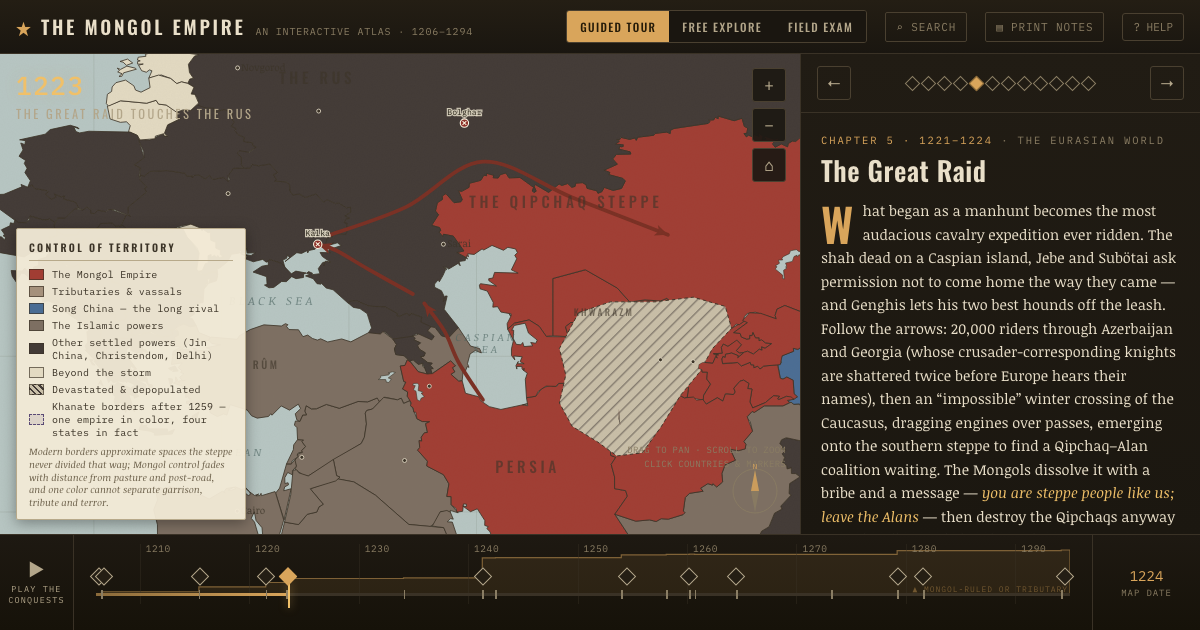
The atlas that shows it
THE FREE PRINTABLE STUDY GUIDE
Join the Dispatch — a short welcome series, then a letter when a new atlas opens — and the printable study guide for The Mongol Empire is yours now, free.
NO TRACKING · YOUR ADDRESS IS USED FOR THE DISPATCH AND NOTHING ELSE · UNSUBSCRIBE ANYTIME