ON THIS DAY ·
Founding of Constantinople
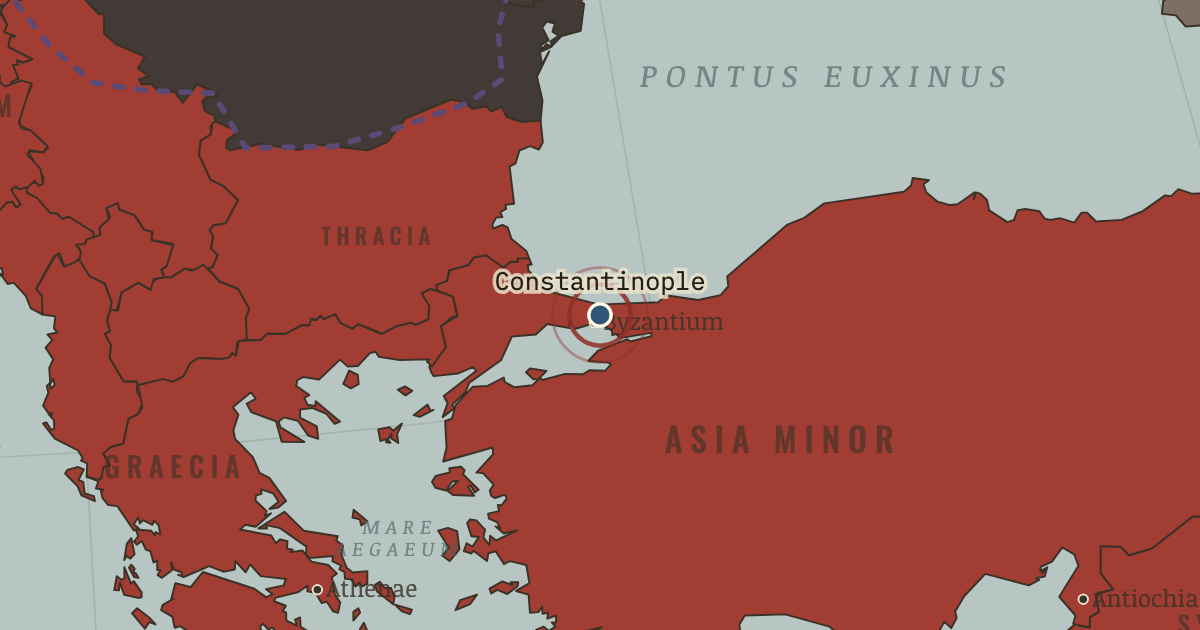
11 May 330 — A new Rome on the Bosporus: peninsula, harbor, and the junction of Europe and Asia. The best-defended city in the world will not fall for 1,123 years.
WW2 is free — every chapter. Try chapters 1–2 of any 2 other atlases (3 with a free account). Opening a new atlas uses one of them. Membership opens all 21 — Join.
The moment in context
Diocletian’s answer to the crisis was to replace the old disguise of one-man rule with an openly heavier monarchy, governed from the Greek east at Nicomedia rather than from Rome. Where Augustus had played the modest first citizen, Diocletian presented himself as a sacred, half-divine ruler surrounded by ceremony, on the reasoning that men are less willing to murder what they are taught to worship. This new style is often called the Dominate, from the Latin for “lord and master.” Against the constitutional flaw that had produced the century of usurpers, he built the Tetrarchy, sharing rule among four emperors each based near a frontier, so that four armies had four legitimate masters instead of one throne and many bidders. Against the machinery of collapse he added structure. He roughly doubled the provinces to around a hundred, separated civilian governors from military commanders, enlarged the army toward half a million men with mobile forces held behind the line, and rebuilt taxation in kind and tied to an annual budget.
From Diocletian and Constantine, chapter 9 of The Rise and Fall of Rome, 264 BC – AD 476 (AD 312).
The place: Founding of Constantinople — map and full story →
Teach this in 5 minutes
- Why it happened — Reform by survivor’s logic. Every Diocletianic structure answers a specific third-century failure: tetrarchy answers usurpation, civil/military separation answers…
- The turn — The Milvian Bridge, 28 October 312. Strip the vision story to its verifiable core and it is still a hinge: a Roman emperor bet his war on the god of a persecuted minority — perhaps a…
- What it changed — A heavier state as the new normal. Late Roman government — the Dominate’s courts, compulsory guilds, hereditary tenant-farmers (coloni) bound to estates, tax collectors with soldiers…
Then ask the room: Diocletian and Constantine saved the Roman Empire by roughly doubling the state. Did the cure weaken the patient? The argued answer is on the chapter page →
The atlas that shows it
THE FREE PRINTABLE STUDY GUIDE
Join the Dispatch — a short welcome series, then a letter when a new atlas opens — and the printable study guide for Rome is yours now, free.
NO TRACKING · YOUR ADDRESS IS USED FOR THE DISPATCH AND NOTHING ELSE · UNSUBSCRIBE ANYTIME