ON THIS DAY ·
Secession of Katanga
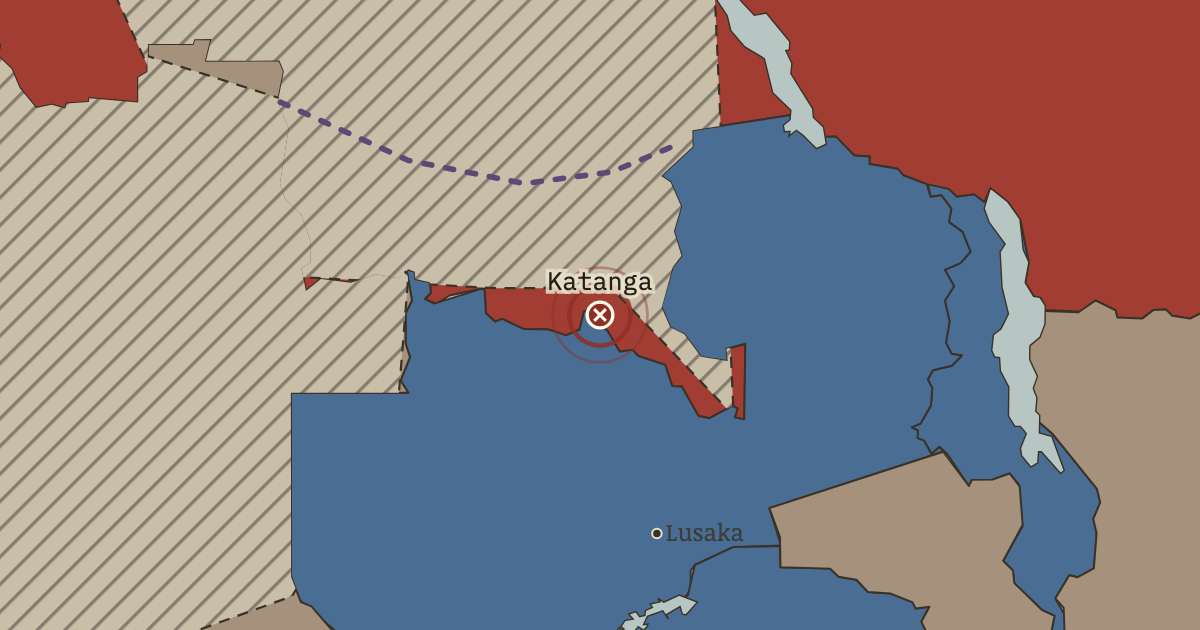
11 Jul 1960 — Backed by Belgium’s Union Minière, Moïse Tshombe declares the copper-rich south independent. A secession defending a mining fortune, not a nation — the UN’s first war will take four years to end it.
WW2 is free — every chapter. Try chapters 1–2 of any 2 other atlases (3 with a free account). Opening a new atlas uses one of them. Membership opens all 21 — Join.
Free printable Decolonization of Africa study guide, sent by email ↓
The moment in context
Independence on 30 June 1960 transferred sovereignty without transferring a working state, because Belgium had built none for Congolese hands. The Force Publique, the colonial army, mutinied against the Belgian officers who still commanded it, and Belgium used the disorder as grounds to send its troops back. On 11 July Moïse Tshombe declared Katanga independent, supported by the mining conglomerate Union Minière, by Belgian officers, and by hired white mercenaries. Since Katanga held the copper, cobalt and uranium that made the Congo wealthy, the secession stripped the new nation of most of its revenue at the moment it could least afford the loss.
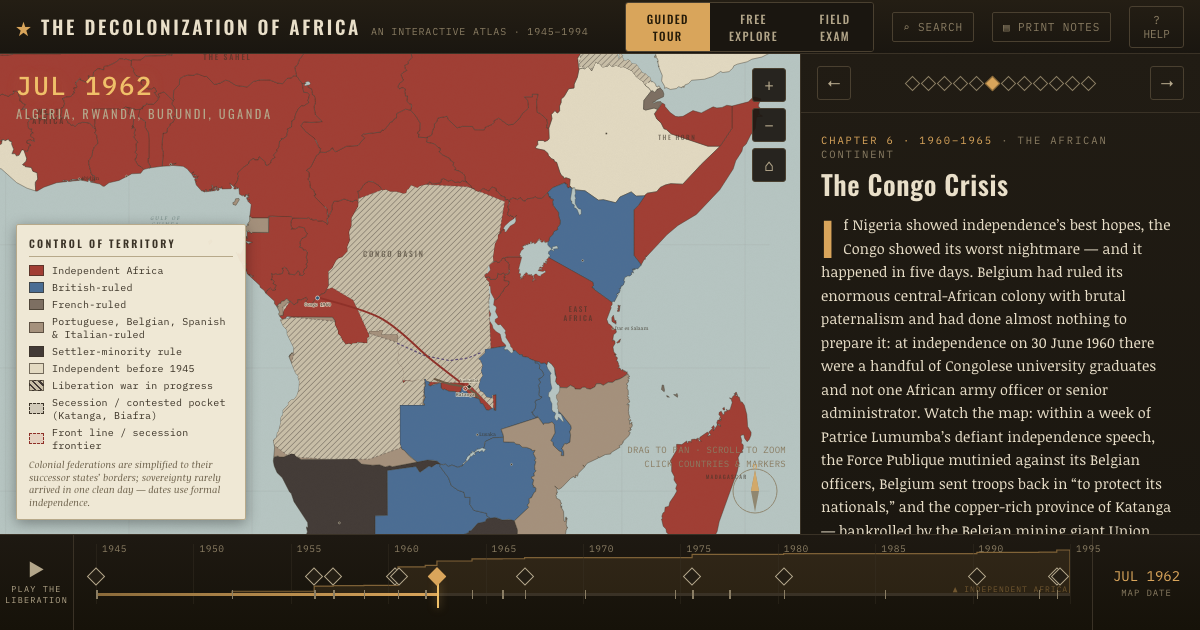
From Congo Crisis, chapter 6 of The Decolonization of Africa, 1945–1994 (JUL 1962).
The place: Secession of Katanga — map and full story →
Teach this in 5 minutes
- Why it happened — A colony deliberately left unprepared. Belgium’s policy had been to suppress African political life and education entirely, betting that a contented, uneducated populace would never…
- The turn — Katanga secedes, 11 July 1960. Eleven days after independence, Tshombe declares the mineral-rich south a separate state, with Belgian officers, Union Minière money and white…
- What it changed — The murder of Lumumba. The elected premier’s removal and killing, with Western hands on it, martyred him across the Third World and taught a generation of African leaders…
Then ask the room: Was the Congo catastrophe caused mainly by Belgian misrule, by Cold War intervention, or by the Congo’s own divisions — and why does it matter which? The argued answer is on the chapter page →
The atlas that shows it
THE FREE PRINTABLE STUDY GUIDE
Join the Dispatch — a short welcome series, then a letter when a new atlas opens — and the printable study guide for The Decolonization of Africa is yours now, free.
NO TRACKING · YOUR ADDRESS IS USED FOR THE DISPATCH AND NOTHING ELSE · UNSUBSCRIBE ANYTIME