ON THIS DAY ·
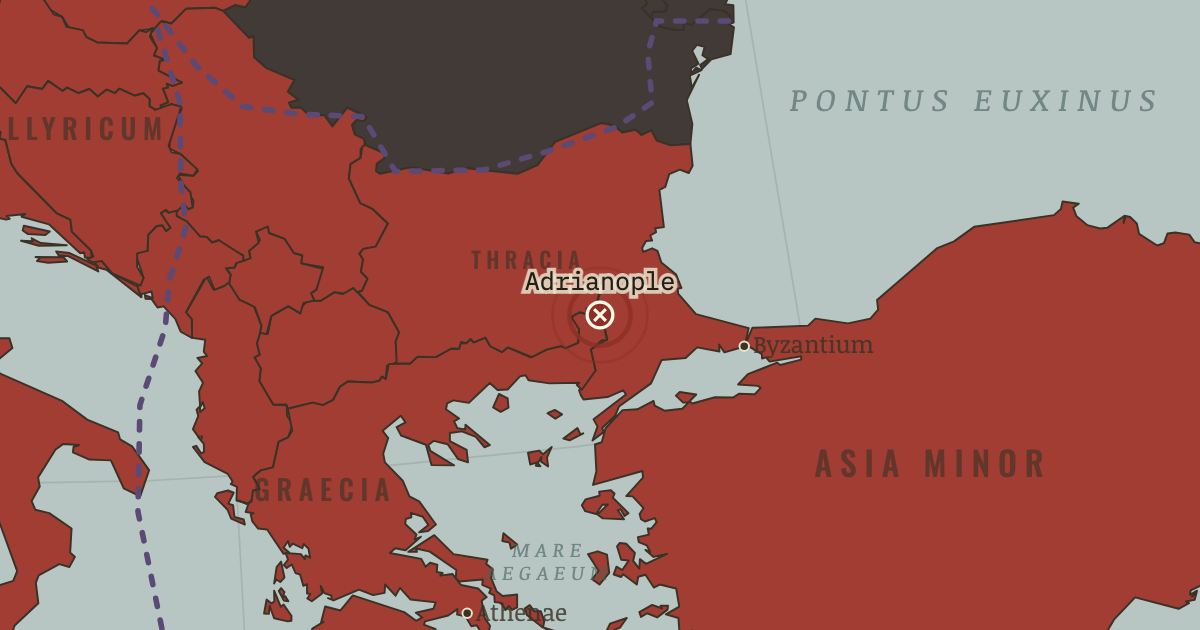
Battle of Adrianople
9 Aug 378 — The Gothic refugees Rome admitted, then starved and cheated, destroy the eastern field army. Emperor Valens dies unfound; two-thirds of his men die with him.
WW2 is free — every chapter. Try chapters 1–2 of any 2 other atlases (3 with a free account). Opening a new atlas uses one of them. Membership opens all 21 — Join.
The moment in context
The people who appeared on the Danube in 376 came as refugees rather than as an invading army, and that distinction is the key to everything that followed. The Huns had broken the Gothic world to the north, and a whole Gothic people, perhaps a hundred thousand strong, asked the eastern emperor Valens for admission to the empire. Valens saw future taxpayers and soldiers, and let them cross. But Roman officials embezzled the food meant to feed them and exploited the starving newcomers so ruthlessly that revolt followed. What should have been a policing problem became a catastrophe at Adrianople on 9 August 378. Valens attacked without waiting for the western army, and the Goths destroyed roughly two-thirds of his field force and killed him. A contemporary called it the worst defeat since Cannae, and this time there was no reservoir of Italian allies to refill the ranks.
From Adrianople and the sack of Rome, chapter 10 of The Rise and Fall of Rome, 264 BC – AD 476 (AD 396).
The place: Battle of Adrianople — map and full story →
Teach this in 5 minutes
- Why it happened — An exogenous shock: the Huns. Nothing in Roman policy caused the Huns, and the strongest modern account (Heather’s) rests on that: the fourth-century empire was strained but…
- The turn — Adrianople, 9 August 378. The military facts are grim but recoverable — Rome had lost whole armies before. What proved irreversible was the settlement: for the first time, a…
- What it changed — The West inherits the exposed half. The 395 division gave the East the short, fortress-anchored frontier (Constantinople, the straits) and two-thirds of the revenue; the West got the…
Then ask the room: In 376 the Goths asked to join the empire; in 410 they sacked its capital. Locate the decisions in between that made the second event grow out of the first — and say which was the last real exit. The argued answer is on the chapter page →
The atlas that shows it
THE FREE PRINTABLE STUDY GUIDE
Join the Dispatch — a short welcome series, then a letter when a new atlas opens — and the printable study guide for Rome is yours now, free.
NO TRACKING · YOUR ADDRESS IS USED FOR THE DISPATCH AND NOTHING ELSE · UNSUBSCRIBE ANYTIME