ON THIS DAY ·
Battle of Britain Day
Battle of Britain Day: the Luftwaffe’s maximum effort against London is met, wave for wave, by radar-guided squadrons. Invasion is quietly shelved.
WW2 is free — every chapter. No sign-up.
The moment in context
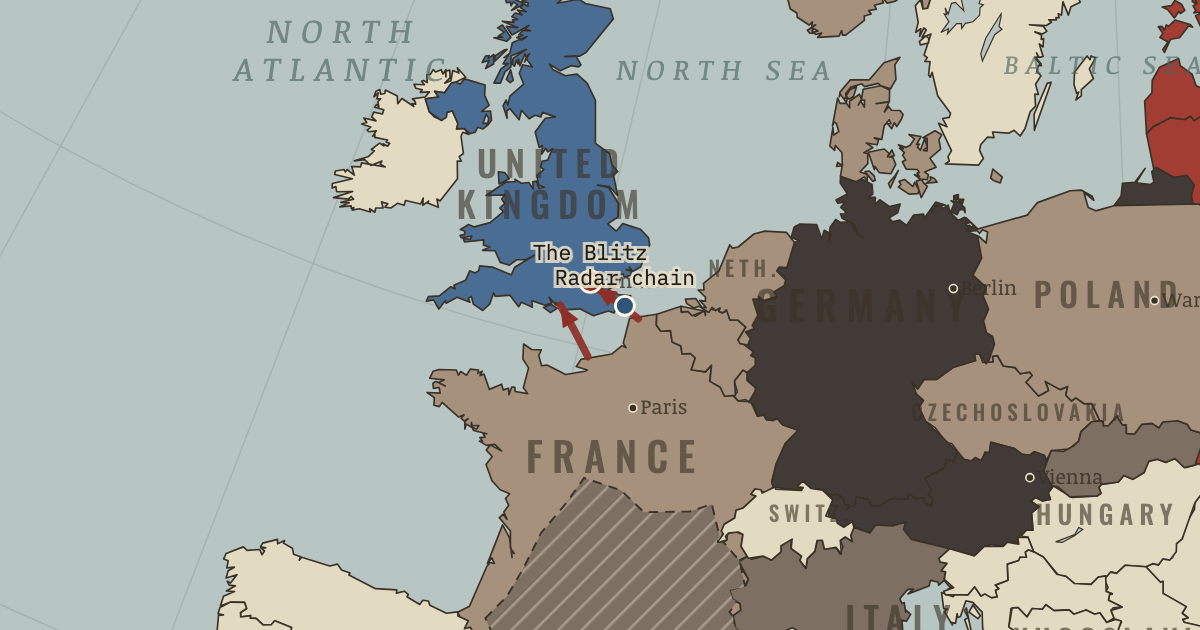
Operation Sea Lion, the German plan to invade Britain, depended entirely on winning control of the air. The German navy, battered in the Norwegian campaign, could not shield a slow invasion fleet from the Royal Navy while RAF Fighter Command remained effective, so the Luftwaffe set out to destroy that force. It struck at shipping, radar stations, sector airfields, and aircraft factories. Britain’s advantage lay in more than radar alone, because information gathered by radar and observers flowed into control rooms that then directed limited fighter forces to intercept incoming raids where they mattered most.
From Battle of Britain, chapter 4 of The War Room — WW2, 1936–1945 (AUG 1940).
Teach this in 5 minutes
- Why it happened — Sea Lion’s impossible arithmetic. Germany’s navy, gutted off Norway, could never protect an invasion fleet from the Royal Navy — unless the Luftwaffe owned the sky completely. Air…
- The turn — The system holds, 15 September. On “Battle of Britain Day” the Luftwaffe mounts its maximum effort against London — and radar-guided squadrons meet every wave. Losing 2:1, Berlin…
- What it changed — The first hinge. Britain’s survival keeps a western front possible — the aircraft carrier off Europe’s coast from which everything in 1944 will be launched.
Then ask the room: Why was switching the bombing from airfields to London a war-losing mistake? The argued answer is on the chapter page →
The atlas that shows it
THE FREE PRINTABLE STUDY GUIDE
Join the Dispatch — a short welcome series, then a letter when a new atlas opens — and the printable study guide for WW2 is yours now, free.
NO TRACKING · YOUR ADDRESS IS USED FOR THE DISPATCH AND NOTHING ELSE · UNSUBSCRIBE ANYTIME