ON THIS DAY ·
Battle of Leipzig
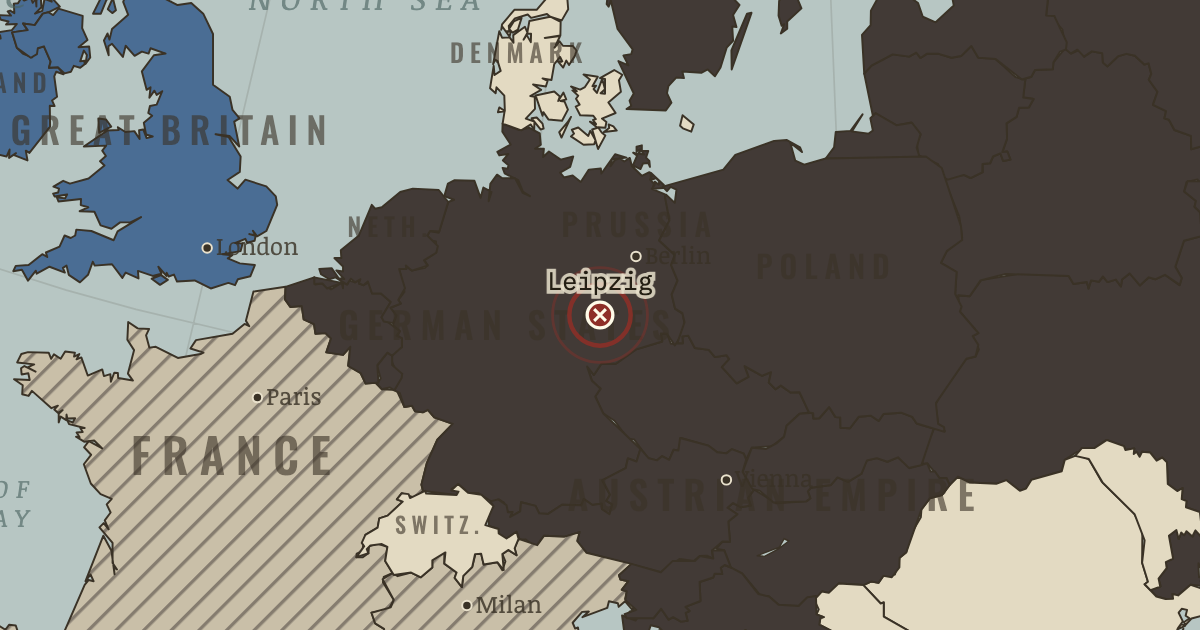
16–19 Oct 1813 — Half a million men, the largest battle in European history to that date. Napoleon’s Germany dissolves in three days.
WW2 is free — every chapter. Try chapters 1–2 of any 2 other atlases (3 with a free account). Opening a new atlas uses one of them. Membership opens all 21 — Join.
Free printable Age of Revolutions study guide, sent by email ↓
The moment in context
The Sixth Coalition finally combined Russia, Prussia, Austria, Sweden and British finance into a single effort, and its armies had by now learned from France itself. At Leipzig in October 1813 their converging forces outnumbered Napoleon and, crucially, refused to dissolve after local setbacks, while several German allies defected in the middle of the battle. The French retreat that followed ended the satellite system east of the Rhine. In 1814 coalition troops entered Paris, and Napoleon abdicated once his own marshals refused to fight on.
From Fall of Napoleon, chapter 9 of The Age of Revolutions, 1775–1848 (JUN 1815).
The place: Battle of Leipzig — map and full story →
Teach this in 5 minutes
- Why it happened — The coalition finally fought as one. Twenty years of separate defeats taught the powers to subordinate rivalry to survival: unified command (Schwarzenberg), British subsidies…
- The turn — Leipzig, 16–19 October 1813. Waterloo is the famous name, but Waterloo only decided how the story ended twice; Leipzig decided that it ended. Outnumbered five to three, with…
- What it changed — A machine for peace, run by policemen. The Concert’s congresses (Aix-la-Chapelle, Troppau, Verona) become standing counter-revolutionary machinery: Troppau (1820) asserts a right of armed…
Then ask the room: Was the Congress of Vienna a masterpiece of statecraft or a conspiracy against the future? The argued answer is on the chapter page →
The atlas that shows it
THE FREE PRINTABLE STUDY GUIDE
Join the Dispatch — a short welcome series, then a letter when a new atlas opens — and the printable study guide for The Age of Revolutions is yours now, free.
NO TRACKING · YOUR ADDRESS IS USED FOR THE DISPATCH AND NOTHING ELSE · UNSUBSCRIBE ANYTIME