ON THIS DAY ·
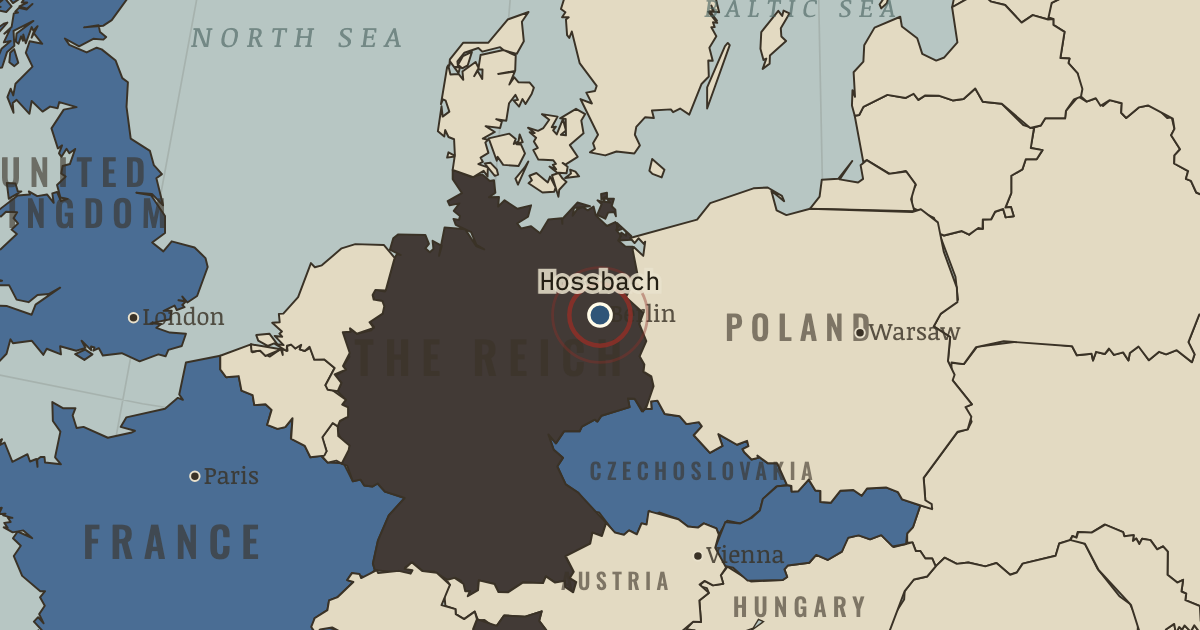
Hossbach Memorandum
5 Nov 1937 — In a four-hour secret conference, Hitler tells his service chiefs Germany must seize living space by force, by 1943–45 at the latest. His adjutant’s minutes become a key exhibit at Nuremberg.
WW2 is free — every chapter. Try chapters 1–2 of any 2 other atlases (3 with a free account). Opening a new atlas uses one of them. Membership opens all 21 — Join.
The moment in context
On 7 March 1936 a small German force entered the demilitarised Rhineland carrying orders to withdraw the moment France moved against it. France would not act without Britain, and it feared that even a limited response might demand a full and politically ruinous mobilisation. Britain, for its part, saw only Germans entering German soil. The bluff succeeded, and its success did more than recover territory, because it made France’s promises to defend its eastern allies far harder to keep.
From Rhineland and the Spanish Civil War, chapter 5 of The Road to War, 1931–1941 (1937).
The place: Hossbach Memorandum — map and full story →
Teach this in 5 minutes
- Why it happened — Versailles’ last physical restraint was psychological. The demilitarized Rhineland worked only as long as Germany believed violating it meant war. By March 1936 Hitler had strong evidence it did not: the…
- The turn — The Rhine bridges, 7 March 1936. Several historians place the “last chance to stop Hitler cheaply” here, and the case is strong. The operation was reversible by design, and the…
- What it changed — Belgium bolts, the Maginot logic breaks. Watching Locarno die unenforced, Belgium renounced its French alliance in October 1936 and returned to neutrality — so the fortified line France had…
Then ask the room: “The dictators intervened and the democracies did not — that is the history of the Spanish war in one sentence.” Fair? The argued answer is on the chapter page →
The atlas that shows it
THE FREE PRINTABLE STUDY GUIDE
Join the Dispatch — a short welcome series, then a letter when a new atlas opens — and the printable study guide for The Road to War is yours now, free.
NO TRACKING · YOUR ADDRESS IS USED FOR THE DISPATCH AND NOTHING ELSE · UNSUBSCRIBE ANYTIME