ON THIS DAY ·
Battle of Austerlitz
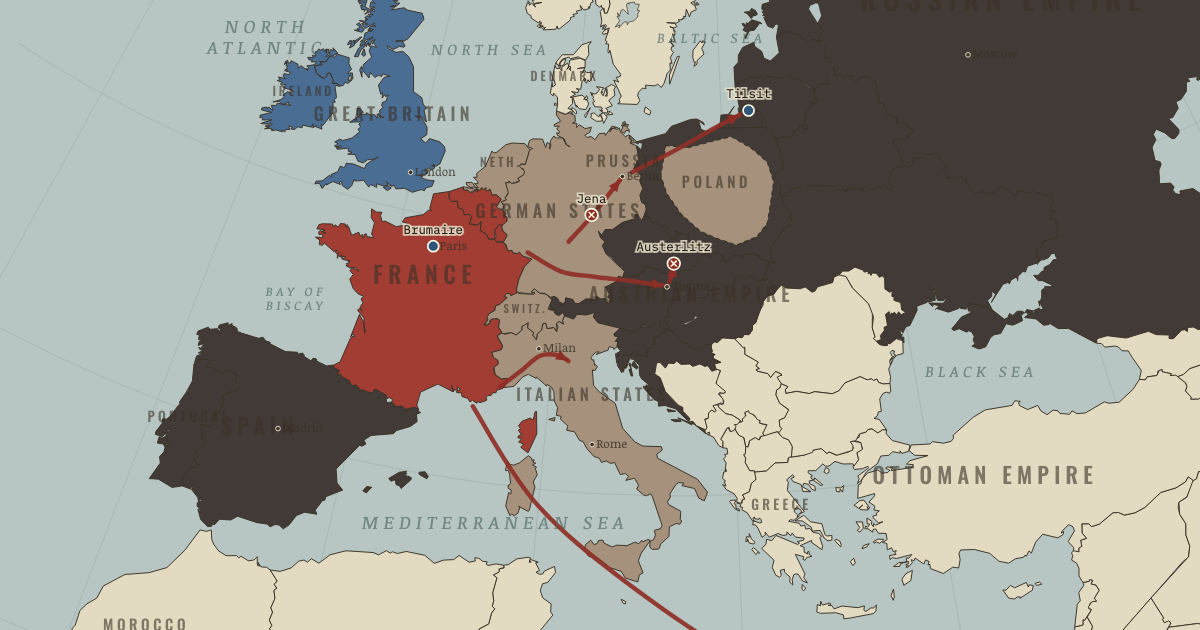
Austerlitz — Napoleon’s masterpiece. He abandons the high ground on purpose, and two empires walk into the trap.
WW2 is free — every chapter. Try chapters 1–2 of any 2 other atlases (3 with a free account). Opening a new atlas uses one of them. Membership opens all 21 — Join.
Free printable Age of Revolutions study guide, sent by email ↓
The moment in context
Napoleon’s rise can be read as a single campaign that began in Italy in 1796, where he used speed to separate enemy armies and defeat them in turn. His Egyptian expedition of 1798 showed both the reach and the limit of that method, since victory near the Pyramids was followed by strategic isolation once Nelson destroyed the French fleet. Returning to France, Napoleon helped overthrow the Directory in the coup of 18 Brumaire in 1799 and took power himself.
From Rise of Napoleon, chapter 6 of The Age of Revolutions, 1775–1848 (JUL 1807).
Teach this in 5 minutes
- Why it happened — The Revolution built the weapon; he aimed it. Mass conscription, promotion by merit, armies that marched on requisition instead of magazines, divisions and corps that moved independently and…
- The turn — Austerlitz, 2 December 1805. The perfect battle, chosen deliberately: he abandoned the dominant Pratzen Heights to invite attack on his weakened right, then took the emptied…
- What it changed — Germany simplified, and awakened. From ~300 statelets to ~40; the Rhine Confederation gets the Code, secularized lands, modern administration — and French garrisons and conscription.…
Then ask the room: Was Napoleon the Revolution’s heir or its gravedigger? The argued answer is on the chapter page →
The atlas that shows it
THE FREE PRINTABLE STUDY GUIDE
Join the Dispatch — a short welcome series, then a letter when a new atlas opens — and the printable study guide for The Age of Revolutions is yours now, free.
NO TRACKING · YOUR ADDRESS IS USED FOR THE DISPATCH AND NOTHING ELSE · UNSUBSCRIBE ANYTIME