ON THIS DAY ·
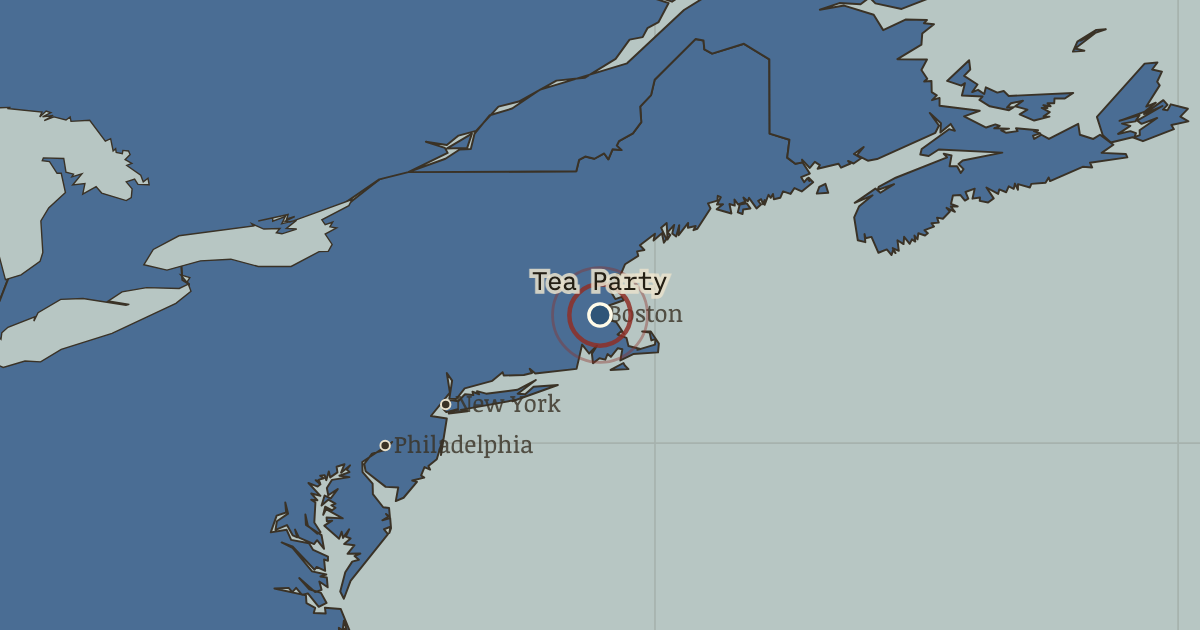
Boston Tea Party
16 Dec 1773 — Three shiploads of taxed tea go into the harbor. Parliament answers with the Coercive Acts; the colonies answer with a Congress.
WW2 is free — every chapter. Try chapters 1–2 of any 2 other atlases (3 with a free account). Opening a new atlas uses one of them. Membership opens all 21 — Join.
Free printable Age of Revolutions study guide, sent by email ↓
The moment in context
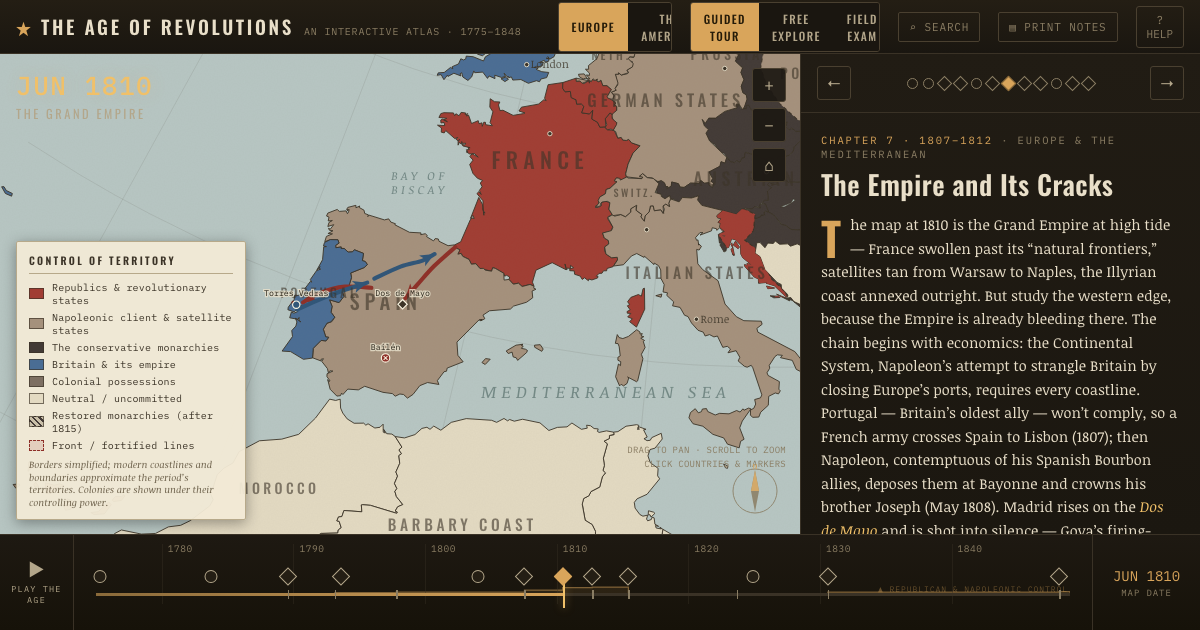
The colonial colors on the map describe a system built for extraction. European crowns claimed ports, mines, plantations and vast inland territories, though their control on the ground was often uneven. Potosí’s silver and Cap-Français’s sugar show how that system earned its money, and enslaved workers produced much of the Atlantic plantation wealth that flowed from it. Indigenous nations, meanwhile, still governed large areas that imperial treaties simply treated as land available for the taking.
From Causes of the American Revolution, chapter 1 of The Age of Revolutions, 1775–1848 (APR 1775).
The place: Boston Tea Party — map and full story →
Teach this in 5 minutes
- Why it happened — War debt in search of a taxpayer. Victory in 1763 left Britain with the world’s biggest empire and biggest debt, plus a new American frontier to garrison. Asking colonists to fund…
- The turn — Boston harbor, 16 December 1773. The tea itself was cheap — the Tea Act actually lowered the price. That was the point: accepting cheap taxed tea meant accepting the principle of…
- What it changed — A Continental Congress. Twelve colonies that had never cooperated on anything sent delegates to Philadelphia in 1774 — creating, before any battle, the institution that…
Then ask the room: Was the American crisis really about taxes? The sums were trivial — a few pence on tea. The argued answer is on the chapter page →
The atlas that shows it
THE FREE PRINTABLE STUDY GUIDE
Join the Dispatch — a short welcome series, then a letter when a new atlas opens — and the printable study guide for The Age of Revolutions is yours now, free.
NO TRACKING · YOUR ADDRESS IS USED FOR THE DISPATCH AND NOTHING ELSE · UNSUBSCRIBE ANYTIME