MAPS OF HISTORY · The American Civil War · ALL CHAPTERS · CHAPTER 10
CHAPTER 10 · JAN–APR 1865 · APR 1865
Appomattox
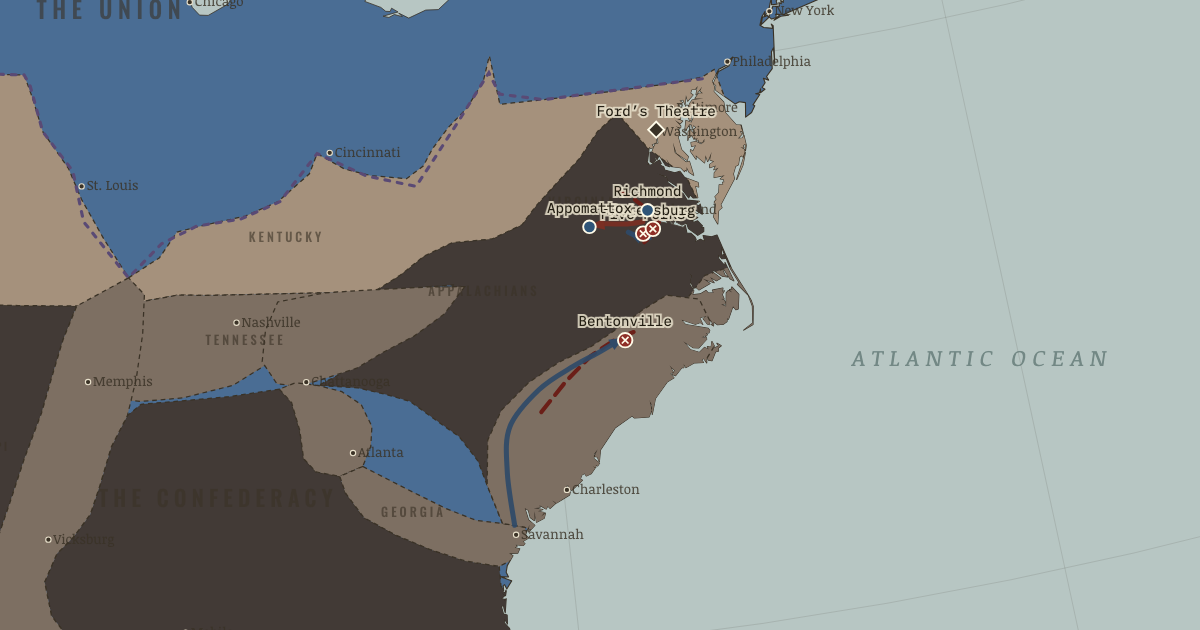
The map above is the world of APR 1865 — Petersburg, Richmond, Appomattox.
BRIEF EXPLANATION — THE ESSENTIAL ARGUMENT
The war ended quickly in the spring of 1865 because Petersburg had never been a siege of walls but a contest over the railroads that fed Lee’s army. Through early 1865 Sherman moved north through the Carolinas while Grant extended the Petersburg lines, and the Confederate armies lacked food, replacements, and secure supply. When Union victory at Five Forks broke the last major rail line, Petersburg and Richmond had to be abandoned.
Lee’s retreat ended at Appomattox on 9 April, where Grant offered paroles, rations, and permission for the men to take their horses home for the spring planting. Those terms helped the army dissolve without turning to guerrilla war. Lincoln’s assassination five days later then changed who would direct the unsettled political peace, transferring that question to men far less inclined to protect the freedpeople.
GUIDED EXPLANATION
Petersburg was a struggle over supply more than a siege of fortifications, and reading it that way explains its sudden end. Grant kept extending his lines west to cut the railroads feeding Richmond, and Lee had too few men to cover each additional mile while desertion and hunger thinned his ranks. Sherman’s advance north through the Carolinas increased the pressure by threatening to join Grant. After the Union victory at Five Forks on 1 April, Petersburg and Richmond could no longer be supplied and were abandoned.
Lee moved west in search of food and a route to join Johnston, but Union cavalry reached the supplies first. At Appomattox, Grant required surrender and parole rather than the imprisonment of the whole army, let the men keep private horses for planting, and sent rations across the lines. Lee, and soon Johnston, rejected the option of continued guerrilla resistance, and that choice helped end organized war. It did not decide the questions of land, voting, labor, or protection for the freedpeople, and Lincoln’s murder passed those questions to Andrew Johnson and Congress.
The final collapse looks sudden on the map because the strain had been accumulating for months. Each lost railroad reduced the food and ammunition reaching the army, and each westward extension forced Lee to defend more ground with fewer soldiers. When Five Forks threatened the Southside line on 1 April, the remaining network could no longer support Richmond. The retreat then became a race between Confederate hunger and Union mobility, as Sheridan’s cavalry blocked the roads and seized supplies while Grant’s infantry kept up the contact. At Appomattox on 9 April, Lee still commanded armed men, but no practical route joined him to another sustainable army. Grant’s terms separated surrender from humiliation, and the military peace held because commanders on both sides accepted that organized resistance should stop. The political peace stayed open, and Lincoln’s assassination on 14 April removed the president at precisely that transition.
DEEP EXPLANATION — EVIDENCE & INTERPRETATION
Why the collapse looked sudden
The final map changes quickly because prolonged pressure often produces a delayed and then abrupt collapse. Petersburg depended on several railroads that fed both Lee’s army and Richmond, and each Union extension reduced their capacity while forcing fewer Confederate troops to hold a longer line. Hunger, desertion, and lost transport accumulated without immediately moving the front. Five Forks mattered because the Southside Railroad was one of the last workable links, and once that connection failed, evacuation became urgent. This pattern is sometimes described as a flat-then-cliff failure, in which a system appears stable while its reserves are quietly consumed, then loses function when a single remaining support breaks. The metaphor should not make the result seem mechanical, because Union maneuver, Sheridan’s attack, Confederate command decisions, and exhausted soldiers all created the break. Structural pressure explains the vulnerability, while contingent action explains the date and the route of collapse.
Military leniency and political settlement
The generous military terms at Appomattox achieved a specific purpose, since parole, food, and visible respect made surrender easier and reduced the incentive for guerrilla resistance, and Lee’s public acceptance reinforced that result. Reconstruction’s later failures do not prove those terms mistaken, because military demobilization and political restoration were different policies made by different authorities. Andrew Johnson’s broad pardons, his restoration of plantation land, and his tolerance of former Confederate leaders were not written into Grant’s surrender terms. This distinction matters when weighing the idea of a “soft peace.” Leniency toward ordinary soldiers could in principle have coexisted with firm protection of civil rights and firm limits on political leaders, though sustaining that combination would have required federal power and Northern consent over many years. Appomattox ended one instrument of conflict, yet it did not answer who would control the South’s courts, labor, land, or elections, and treating the surrender as a complete peace hides the choices that followed.
New here? Chapters 1–2 of every atlas are free to sample, and the WW2 atlas is free in full. One membership opens all thirteen — the Cartographer’s Circle.
THE SITES
ON THIS DAY
WHY IT HAPPENED
Why the end came fast. Four years of siege logic collapsed in a fortnight because Petersburg was never a siege of walls but of railroads: when the Southside line fell at Five Forks, Richmond became unsupplyable overnight. Systems under sustained pressure fail suddenly, not gradually. The tide chart on your timeline is flat, flat, flat, then vertical. Remember that shape. It is how attrition always looks from inside.
The terms as war aims achieved. Grant’s generosity was policy, set in tone by Lincoln at City Point in March: “Let them up easy.” The Union’s objects. Union, and slavery’s death. Were secured by the Amendment and the armies. Humiliating the defeated would purchase nothing but guerrilla war. Paroling 28,000 men to their farms, horses included, was the fastest demobilization of an insurgency ever bought with rations. Note what was NOT settled at Appomattox: everything about the freedpeople’s future. Chapter 11 inherits that silence.
Why no guerrilla war?. It was seriously proposed. Davis wanted the war continued from the hills. Lee refused, publicly: partisan war would “bring on a state of affairs it would take the country years to recover from.” His surrender, and Johnston’s against Davis’s orders, mattered as much as any battle they fought. The war ended because the men with the guns and the prestige chose that it should. Fort Pillow’s Forrest, of all men, told his troopers to go home and “be good citizens.” Endings are decisions, not just outcomes.
THE TURN
Appomattox Court House, 9 April 1865. Not the largest surrender (Johnston’s was), but the decisive one: the Confederacy’s legend-army and its indispensable general accepting that the contest was closed. The scene’s restraint. No prisoners marched through Northern cities, no trials of soldiers, a salute answered. Set the template that let the armies dissolve peacefully. Whether that same gentleness, extended by lesser men to the war’s political architects, also let the defeated cause rewrite the peace is Chapter 12’s question. Both truths begin in McLean’s parlor.
WHAT IT CHANGED
Assassination changes the peace. Lincoln dies at the exact hinge between war powers and reconstruction, replaced by Andrew Johnson. A Unionist Democrat with a white-supremacist’s view of the freedpeople and a pardoner’s pen. The counterfactual is unknowable, but the actual is documented: presidential protection for the old order, two years before Congress wrests the peace back. The bullet at Ford’s Theatre is among the war’s most consequential shots.
The armies vanish. A million Union soldiers muster out within a year. The Grand Review in Washington in May (two days of marching, the USCT regiments conspicuously absent) and then, simply, home. The republic that many feared would be militarized by victory demobilized instead. Keep this in view when comparing civil wars elsewhere. It is rarer than it looks.
What the map settles. Scrub to the final snapshot: no charcoal, no dashed 1860 line, the Union whole. Secession is dead as a constitutional argument (Texas v. White will bury it in law, 1869), and slavery is abolished by the Thirteenth Amendment in December. What the map cannot show. Who rules the courthouse, who votes, whose labor on whose land. Is exactly what remains unsettled.
FIELD QUESTION — Grant’s terms at Appomattox are universally praised — and Reconstruction failed anyway. Was the “soft peace” a mistake?
Distinguish two peaces. The MILITARY soft peace. Paroles, horses, no treason trials of soldiers. Succeeded completely at its object: no insurgency, armies home by summer, a united army of veterans who largely accepted the verdict of arms. The POLITICAL soft peace. Johnson’s wholesale pardons, restored plantations (Field Order 15 revoked), ex-Confederates in Congress by December 1865. Is a separate set of decisions made by different men, and it is where the betrayal of the freedpeople begins. The error is fusing them into one “leniency.” The harder question underneath: could any peace have secured Black freedom without a long federal occupation the Northern electorate was never going to sustain? Answer that honestly and you have the tragedy of Chapter 11 in advance.
AN INTERESTING FACT
The surrender terms Lee signed were inked in a fine clerk’s hand by Lieutenant Colonel Ely S. Parker — Donehogawa, a sachem of the Tonawanda Seneca, a trained engineer once refused admission to the New York bar because, as an Indian, he was not a citizen. By Parker’s own later account, Lee noticed him at the table and said, “I am glad to see one real American here,” to which Parker replied, “We are all Americans” — the exchange rests solely on Parker’s telling, and historians pass it on with that caveat attached. Grant made him the first Native Commissioner of Indian Affairs in 1869; citizenship for his people at large waited until 1924.
THE DISPATCH
One short letter when a new atlas opens — and the printable study guide for The American Civil War is yours now, free.
NO TRACKING · YOUR ADDRESS IS USED FOR THE DISPATCH AND NOTHING ELSE · UNSUBSCRIBE ANYTIME