MAPS OF HISTORY · The American Civil War · ALL CHAPTERS · CHAPTER 11
CHAPTER 11 · 1865–1877 · NOV 1865
Reconstruction — The Unfinished Revolution
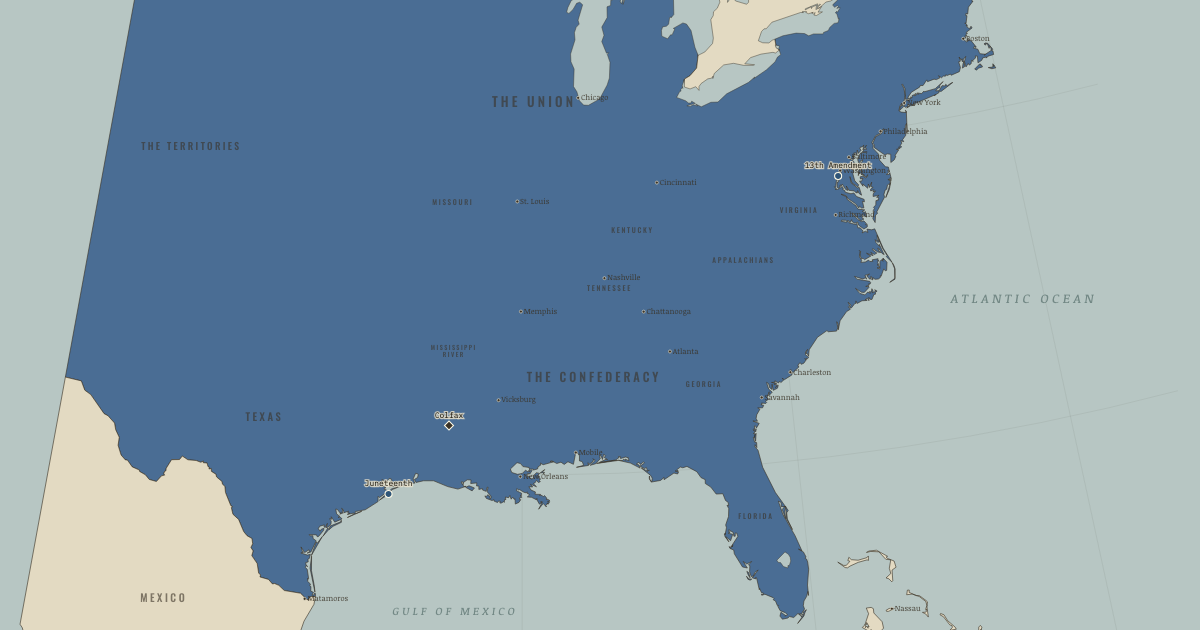
The map above is the world of DEC 1865 — The Thirteenth Amendment.
BRIEF EXPLANATION — THE ESSENTIAL ARGUMENT
Reconstruction remade the Constitution in the years after the war, and its achievements deserve to be understood before its collapse. The Thirteenth Amendment abolished slavery, the Fourteenth established birthright citizenship and equal protection of the laws, and the Fifteenth barred racial restrictions on voting. Under federal protection, freedpeople built families, churches, schools, and political institutions at a speed that had no precedent.
A white-supremacist counter-revolution then set out to overturn that new order by force. Its instruments were terror, disputed elections, and favorable court rulings, and it succeeded because Northern commitment weakened after the depression of 1873 and the last federal troops left the South in 1877. Reconstruction’s governments fell, but the amendments they had secured remained in the Constitution, available to the civil-rights movement that would return to them a century later.
GUIDED EXPLANATION
The achievements of Reconstruction came first, and they were genuinely revolutionary. Constitutional amendments ended slavery, defined national citizenship, and protected voting against racial exclusion, and beneath that legal frame freedpeople legalized marriages, searched for relatives sold away, built churches and schools, and entered politics. About 2,000 Black men held office, while new state governments created the South’s first public school systems. These gains rested in large part on federal law and the presence of the army.
The counter-revolution against them was organized violence. The Klan, the White League, and the Red Shirts attacked voters, teachers, and officeholders, and at Colfax in 1873 a white paramilitary force killed Black citizens defending a courthouse, many of them after they had surrendered. Federal prosecution was then weakened by the Supreme Court’s Cruikshank ruling, while economic depression and Northern fatigue reduced enforcement, until the settlement of 1877 removed the last troops. Sharecropping, convict leasing, disfranchisement, and eventually Jim Crow developed over the years that followed. The failure was produced by choices and violence rather than by any natural return to an older order.
Land and enforcement were the two constraints that shaped everything else. Freedom gave families control of their own persons and labor, but most received no independent economic base, so they entered sharecropping on their former masters’ fields, where unequal contracts, crop liens, and hostile courts often produced debt and dependence. President Andrew Johnson restored plantations and pardoned former Confederate leaders while resisting civil-rights legislation, so that by the time Congressional Reconstruction began in 1867 the old order had already reorganized. Congress then imposed military Reconstruction and federal protections, and Grant’s government broke the first Klan through the Enforcement Acts, which shows that intervention could work. It did not remain strong enough everywhere or for long enough, because the depression after 1873, Northern racism, adverse court decisions, and political bargaining steadily narrowed protection. The amendments survived in the Constitution even as governments abandoned their enforcement, preserving the legal tools that later movements would use.
DEEP EXPLANATION — EVIDENCE & INTERPRETATION
Freedom without an economic base
Emancipation changed legal status without usually providing land, tools, or credit, so many freed families entered sharecropping agreements on the plantations where they had been enslaved. In principle, sharing a crop could divide risk between landowner and farmer. In practice, unequal contracts, merchant credit, crop liens, and manipulated accounts often trapped families in debt and limited their ability to move. Real alternatives existed and were rejected, since Sherman’s Field Order No. 15 had temporarily reserved coastal land and Radical Republicans proposed confiscation or broader homesteading, yet Johnson restored much of the land to pardoned owners while Congress never adopted large-scale redistribution. Historians debate whether land reform was politically possible and whether it alone could have secured equality. The central mechanism is clear enough: political rights were far harder to exercise when employers, landlords, merchants, and local courts could jointly control a family’s livelihood.
How Reconstruction was dismantled
The phrase “Reconstruction failed” can hide the agency behind the outcome. White paramilitary organizations made political participation dangerous, state and local officials often refused protection, Supreme Court decisions narrowed federal enforcement, presidents and Congress reduced their commitment, and Northern voters accepted the retreat. These forces reinforced one another, as terror changed election outcomes, disputed governments invited national bargaining, and legal limits made intervention harder. Colfax is especially revealing because violence and doctrine formed a sequence: Black citizens were killed after a contested election, and United States v. Cruikshank then overturned key federal convictions by reading national power narrowly. Full Jim Crow did not arrive immediately in 1877, since Black political participation continued in places into the 1880s and 1890s, which shows that the outcome remained contested for years. Reconstruction was dismantled through repeated decisions under unequal force rather than simply exhausted by time.
New here? Chapters 1–2 of every atlas are free to sample, and the WW2 atlas is free in full. One membership opens all thirteen — the Cartographer’s Circle.
THE SITES
ON THIS DAY
WHY IT HAPPENED
Land was the revolution not attempted. Freedom without property meant renting your old master’s fields. Sharecropping’s slide into debt peonage was visible by 1870. The alternatives were real and rejected: Field Order 15’s forty acres revoked by Johnson within months. The Southern Homestead Act sabotaged. Thaddeus Stevens’s confiscation bills never passing. A political revolution was attempted without an economic one. Measure most of what followed against that decision.
Johnson’s presidency as the pivot. For two critical years the president pardoned the planter class wholesale, ordered land returned, vetoed the civil-rights bills (Congress overrode. The first veto overrides of major legislation in US history), and encouraged the South to reject the Fourteenth Amendment. By the time Congressional Reconstruction began in 1867, the old order had reorganized. Contingency matters: the assassination put the one high official most hostile to the freedpeople in charge of their freedom.
The occupation the North would not sustain. Enforcing the amendments meant soldiers at courthouses indefinitely. And the Northern electorate, taxed, depressed after 1873, and tired, would not pay for it (the whole US Army by 1876: about 25,000 men, most of them out West). Rights enforced by bayonets last exactly as long as the bayonets. The true failure was building no enforcement that could survive demobilization. A lesson every later occupation relearns.
The courts as counter-revolution’s partner. Cruikshank (1876) held the Fourteenth Amendment restrained states, not mobs. So the federal government could not punish Colfax’s killers. Plessy (1896) blessed “separate but equal.” Terror did the work in the streets, but doctrine ratified it. When you read “the failure of Reconstruction,” insist on the passive voice being unpacked: failed by whom, at which desks, in which opinions.
THE TURN
Colfax, Easter Sunday 1873. A contested Louisiana election. Black citizens defending a courthouse. A white paramilitary force with a cannon. Between 60 and 150 dead, most after surrender. And, three years later, a Supreme Court ruling that set the killers free and hollowed the amendments’ enforcement for nine decades. Choose this, not 1877, as the hinge: the deal that ended Reconstruction only ratified what unpunished violence had already decided. Where law will not protect its winners, the losers of the war can win the peace.
WHAT IT CHANGED
Jim Crow — but not immediately. Full disfranchisement and segregation statutes arrive mostly in the 1890s, a generation after 1877. Black men kept voting, and winning offices, in parts of the South through the 1880s. The window closed slowly, which is the point worth teaching: outcomes felt as inevitable were choices, contested and reversible, for twenty years.
The Great Migration is loaded here. Sharecropping, terror and disfranchisement made the South a place six million Black Americans would eventually leave for Northern cities (1916–70). Remaking American music, politics, and every city on your map’s northern edge. The war’s demography plays out for a century.
The lever survives. Brown v. Board (1954) is argued under the Fourteenth Amendment. The Voting Rights Act (1965) enforces the Fifteenth. The civil-rights movement called itself the Second Reconstruction advisedly. Its statutes were the first one’s promises, finally armed. When Maps of History builds its civil-rights atlas, its first chapter will be this one.
FIELD QUESTION — Could Reconstruction have succeeded — or was failure structural once the war ended?
Line up the levers that existed: confiscation and land distribution (proposed, defeated). Indefinite military occupation (unsustainable politically). Northern colonization of Southern institutions (tried in fragments). Disenfranchisement of ex-Confederates for a generation (briefly done, quickly abandoned). Each had a real constituency and each failed the same test. It required the Northern majority to keep paying, for years, for other people’s rights, against its own fatigue and racism. Yet “structural” lets too many individuals off: Johnson’s pardons, Cruikshank’s doctrine, and the 1877 bargain were choices by nameable men against available alternatives. The defensible verdict: success as full equality was probably beyond the politics of any 1865. Success as durable Black voting citizenship in large parts of the South was within reach into the 1870s, and was killed, not lost. Note how much turns on defining “success” before you argue. That discipline transfers to every historical judgment you will ever make.
AN INTERESTING FACT
Among Reconstruction’s casualties was a bank. The Freedman’s Savings and Trust Company, chartered by Congress in March 1865, drew the deposits of tens of thousands of Black veterans, washerwomen, farmers and churches — the first savings many families had ever held in law — until white trustees speculated the funds away in railroad and real-estate loans and the Panic of 1873 finished the job. Frederick Douglass, installed as president in its final months, put in $10,000 of his own money and could not save it; when it closed in June 1874 some 61,000 depositors were owed about $3 million, and years of piecemeal reimbursement returned at best three-fifths of it — many families got nothing. Douglass’s epitaph was exact: it had been “the black man’s cow, but the white man’s milk.”
THE DISPATCH
One short letter when a new atlas opens — and the printable study guide for The American Civil War is yours now, free.
NO TRACKING · YOUR ADDRESS IS USED FOR THE DISPATCH AND NOTHING ELSE · UNSUBSCRIBE ANYTIME