MAPS OF HISTORY · The Road to War · ALL CHAPTERS · CHAPTER 10
CHAPTER 10 · 1939–1941 · 1940
The Turn South
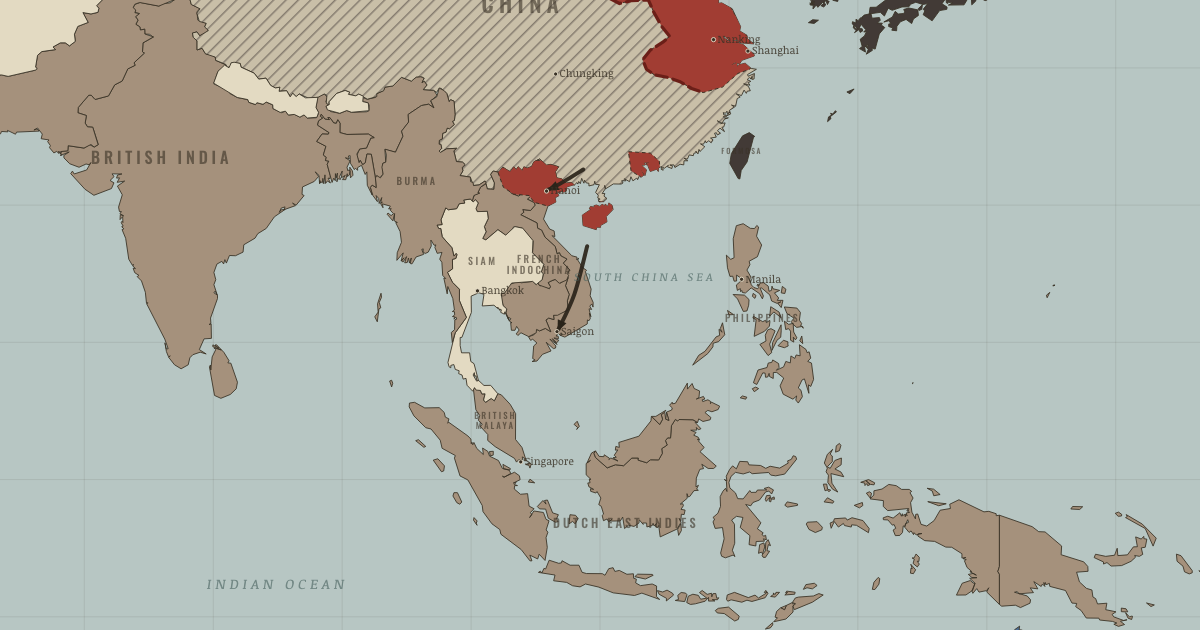
The map above is the world of SEP 1940 — Tonkin occupied; the Tripartite Pact.
BRIEF EXPLANATION — THE ESSENTIAL ARGUMENT
Japan’s road to Pearl Harbor was set by a series of pressures that steadily narrowed its options, and the first was a battlefield defeat. When Soviet forces under Zhukov crushed a Japanese army at Khalkhin Gol on the Manchurian border, they discredited the faction that wanted to expand northward against the Soviet Union. The war in China ground on meanwhile, devouring men and resources without forcing a surrender. Then the defeats of France and the Netherlands in 1940 left their rich Southeast Asian colonies suddenly defenceless, which made a southern advance look both necessary and possible.
Japan therefore occupied French Indochina, first to cut the supply routes that kept China fighting and then to gain bases for a wider move south. The United States replied with escalating trade controls, and after the seizure of southern Indochina in July 1941 it imposed a freeze that amounted to an oil embargo. The pressure was meant to deter further conquest, but because Japan imported almost all of its oil, it instead created a fuel deadline that made every month of peace a month of growing weakness. The embargo did not remove Japan’s freedom to choose, yet it sharply changed the cost of waiting and strengthened those who argued for war while reserves lasted.
GUIDED EXPLANATION
At Khalkhin Gol in 1939, Soviet forces under Zhukov defeated a Japanese army on the border between Manchukuo and Mongolia, and the defeat carried strategic weight far beyond the steppe. It undercut the case for expanding north against the Soviet Union and strengthened those who looked south instead. Japan’s unresolved war in China still consumed men and materials without result, so its leaders increasingly sought supply routes and resources in Southeast Asia.
After France fell, Japan occupied northern Indochina and joined Germany and Italy in the Tripartite Pact. The United States responded by restricting exports of aviation fuel, scrap and other materials. When Japan occupied southern Indochina in July 1941, Washington, Britain and the Dutch froze Japanese assets, which created in effect an oil embargo. Because Japan imported roughly 90 percent of its oil, every month of delay now drained its military reserves, turning a failed attempt at deterrence into a countdown toward a decision.
The China war connected all of these moves. Japan wanted to close the supply routes that sustained Chiang and to seize resources that would make its empire immune to blockade. The defeat of France and the occupation of the Netherlands left the southern colonies exposed and available. Washington chose graduated pressure because Roosevelt hoped that rational leaders would stop before war, yet Tokyo read the same steps as encirclement and slow strangulation. Each side called its own policy deterrence, and each new measure strengthened the hardliners on the other side. The oil cutoff did not remove Japan’s choices, since it could still withdraw from China, accept a compromise, or let its military strength decline. Army leaders, however, treated withdrawal after years of sacrifice as an unbearable humiliation, so navy planners came to prefer a war begun while the fuel reserves still held. Economic pressure set the clock, while ideology, the power of the army, and the unwinnable war in China closed off the exits.
DEEP EXPLANATION — EVIDENCE & INTERPRETATION
The north–south choice
Japanese strategy is often described as a single decision between Siberia and Southeast Asia, but in practice the balance shifted over time under the pull of army and navy interests, the China war, and changing opportunities. Khalkhin Gol demonstrated the cost of fighting a mechanised Soviet force, damaged the prestige of the Kwantung Army, and strengthened the advocates of a southern advance. The Nazi–Soviet Pact then reduced Japanese confidence in Germany, while the collapse of France and the occupation of the Netherlands created vulnerable targets to the south. The resources Japan most needed, above all oil, were more accessible in that direction, yet reaching them meant conflict with the European empires and probably with the United States. The southern choice therefore traded a demonstrated military risk for a political and industrial one that Tokyo badly underestimated. Strategy followed the perceived balance of cost and opportunity at that moment, rather than any fixed cultural preference for one direction over the other.
The embargo escalation spiral
Washington expected economic pressure to make Japan halt or reverse its expansion, reasoning that a nation so dependent on imported oil could not risk a fight. Tokyo read the very same measures as evidence that the United States intended a gradual strategic strangulation. Each side therefore believed it was deterring the other. The Japanese occupation of southern Indochina triggered the asset freeze, and the resulting oil cutoff meant that every additional month of peace reduced the navy’s fighting capacity. Japan still had alternatives, including withdrawal or a compromise in China, but army leaders regarded those as the destruction of the nation’s honour and a betrayal of its sacrifices. American leaders, after years of reports from China, could not easily accept the continued conquest either. The embargo did not mechanically cause Pearl Harbor, but it changed the timing and strengthened the voices arguing that war now offered better odds than delay. This is an escalation spiral driven by two incompatible definitions of an acceptable status quo.
New here? Chapters 1–2 of every atlas are free to sample, and the WW2 atlas is free in full. One membership opens all thirteen — the Cartographer’s Circle.
THE SITES
ON THIS DAY
WHY IT HAPPENED
Khalkhin Gol re-priced the northern option. The Soviet Far Eastern army was supposed to be purge-gutted and brittle; instead it delivered Japan’s worst defeat since the modern army was founded — combined arms, deep artillery, armor massed at the point of decision. The Kwantung Army’s prestige, and the “strike north” faction it housed, never recovered. Strategy follows demonstrated cost: the resources Japan needed existed in two directions, and after August 1939 only one direction had an un-demonstrated price.
The China war could not pay for itself. By 1940 the “incident” consumed the bulk of Japan’s army and budget while the fronts froze (the ink line on your map). The planners’ conclusion was not withdrawal — the army would tolerate no such loss of face after three years of sacrifice — but escalation of scope: cut Chiang’s supply lines (Indochina, the Burma Road), and seize the southern resources that would make the empire blockade-proof. Every southern move was sold internally as a way to end the China war. Each one instead widened the coalition against Japan.
Europe’s catastrophe was Asia’s vacancy. The timing is not subtle: France falls in June 1940, Japan is in Tonkin by September; the Netherlands is occupied in May, and Tokyo’s demands on the Dutch East Indies’ oil begin that summer. Only two Pacific powers could still say no — Britain, fighting for its life, briefly closed the Burma Road rather than add an enemy; and the United States, which now had to decide whether the Pacific status quo was worth an oil war. The southern advance was opportunism in the most literal sense: doors held open by someone else’s defeats.
Washington believed pressure would deter; Tokyo experienced it as siege. American policy 1940–41 was escalation with a theory: Japan, rational and resource-starved, would balk before the abyss. Japanese decision-making inverted the theory: each embargo strengthened the faction arguing that America meant to strangle Japan slowly, so better to fight while stocks lasted. Two rational actors, each deterring, produced a spiral neither controlled — the escalation-trap case study international-relations courses still open with.
THE TURN
The freeze, 26 July – 1 August 1941. The oil embargo is the hinge on which “eventual war” became “war this winter.” Intriguingly, the total cutoff may not even have been Roosevelt’s intention: he approved a freeze under which Japan could apply to release funds for oil purchases — a valve, hawks in the bureaucracy (Assistant Secretary Acheson among them) then kept shut while the President was at sea meeting Churchill; by the time the fait accompli surfaced, reopening the valve would read as retreat. Whether by design or bureaucratic capture, the effect was arithmetic: the navy’s planners calculated roughly two years of oil at war rates, less every idle day. From August, Japan’s choice was structured as capitulation on China (unthinkable to the army), a slow rot of capability, or war before the reserves fell too far. The Hull–Nomura talks that autumn were real, but they were negotiating against a fuel gauge.
WHAT IT CHANGED
The southern war is planned as one strike. Because the objective (Indies oil) required neutralizing the flanks (British Malaya, the American Philippines), Japan’s planners concluded the southern advance meant simultaneous war with three empires — and Yamamoto added the demand that the US Pacific Fleet be paralyzed at the outset. The next chapter’s single morning is the output of this chapter’s arithmetic.
The Soviet rear is secured — for both signers. The April 1941 Matsuoka–Molotov neutrality pact freed Japan to face south and, in December 1941, freed Zhukov’s Siberian divisions to save Moscow (Ch. 11). It held, remarkably, until August 1945 — the last week of the war it had helped shape.
The Tripartite Pact backfires completely. Designed to deter America by threatening a two-ocean war, the pact instead fused two conflicts in American planning: aid to Britain and pressure on Japan became one policy (the “Europe first” strategy was agreed with London in early 1941, before a shot). Deterrents that raise the stakes without raising fear are provocations on layaway.
FIELD QUESTION — Did American economic pressure prevent a war, provoke one, or merely date-stamp one that was coming anyway?
Three defensible answers, each with a constituency. Provocation: the embargo school notes that Japan’s cabinet had approved southern expansion only “so long as war with America is avoided,” and that the oil cutoff converted a preference into a countdown — without August 1941, no December 1941. Date-stamp: the structural school answers that Japan’s program (China subjugated, the Indies taken, the Co-Prosperity Sphere built) was itself incompatible with any Pacific order America would accept; oil set the calendar, not the collision. Prevention-that-failed: the deterrence school holds that pressure nearly worked — the Konoe government sought a summit, the navy doubted victory, and only the army’s refusal to leave China closed the exit; Hull’s November note demanding withdrawal was the last form of a real negotiation. The richest seminar version asks what each side believed the other could concede: America never grasped that “leave China” meant, to Japan’s army, national dishonor worth dying against; Japan never grasped that “abandon the victim” was, after four years of atrocity photographs, no longer sellable in Washington. Wars begin where empathy of estimation ends.
AN INTERESTING FACT
Khalkhin Gol was where the Soviet Union learned it could trust its Far Eastern intelligence. The Tokyo spy Richard Sorge — a German journalist inside the German embassy, working for Moscow — reported in autumn 1941 that Japan had definitively chosen the southern option and would not attack Siberia; Stalin, who had ignored Sorge’s warning of Barbarossa, this time acted, releasing the Siberian divisions that counterattacked before Moscow in December. Sorge was arrested in Tokyo that October and hanged in 1944; the USSR acknowledged him only in 1964, with a posthumous Hero of the Soviet Union and a Moscow street.
THE DISPATCH
One short letter when a new atlas opens — and the printable study guide for The Road to War is yours now, free.
NO TRACKING · YOUR ADDRESS IS USED FOR THE DISPATCH AND NOTHING ELSE · UNSUBSCRIBE ANYTIME