MAPS OF HISTORY · The Road to War · ALL CHAPTERS · CHAPTER 3
CHAPTER 3 · 1933–1935 · 1935
Germany Turns Charcoal
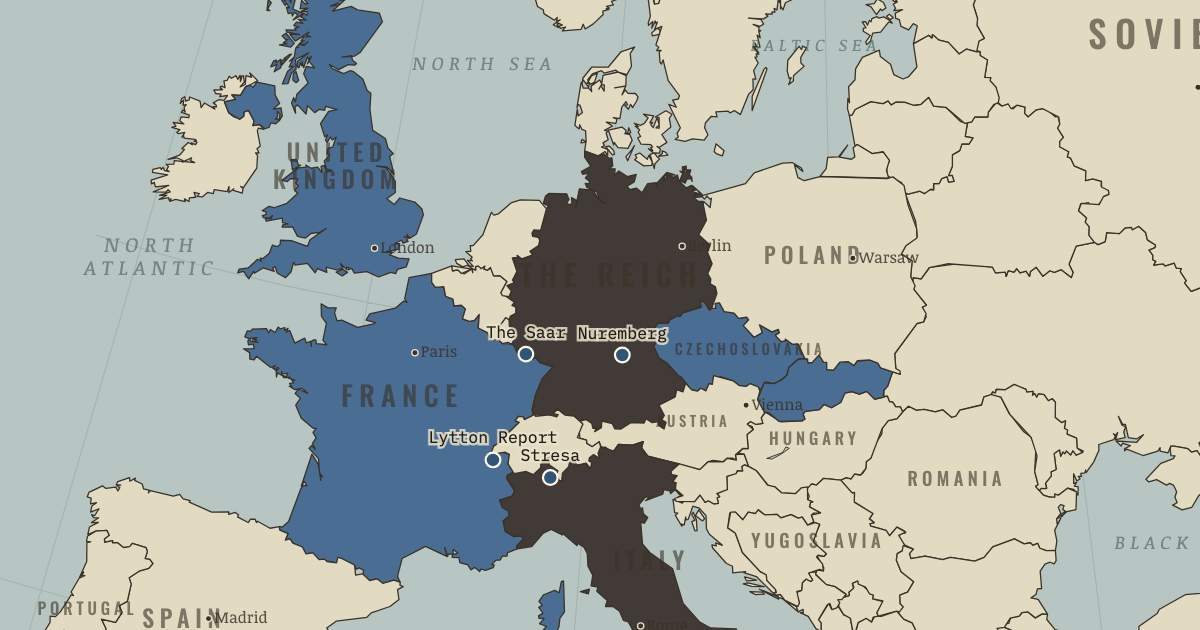
The map above is the world of JAN 1933 — Hitler is handed the chancellery.
BRIEF EXPLANATION — THE ESSENTIAL ARGUMENT
Germany turned from a troubled democracy into a rearming dictatorship in barely two years, and the process began with a miscalculation by the men who thought they were using Hitler rather than being used by him. Conservative politicians around President Hindenburg handed Hitler the chancellorship in January 1933, confident that a cabinet in which Nazis held only a few posts would keep him boxed in. Within weeks the new government used emergency decrees, street intimidation and the Enabling Act to dismantle the constitution’s limits on its own power. Germany then withdrew from the international disarmament talks and the League of Nations and began to rebuild its armed forces openly. Not every step broke a treaty, however, and the return of the Saar coalfield to Germany in early 1935 came through a genuinely free plebiscite.
Hitler’s method was to mix lawful revision with outright treaty-breaking so that each move looked too small to justify a war. By keeping every demand limited and wrapping it in a plausible grievance, he made it hard for his opponents to agree on when resistance was worth the risk. Britain, France and Italy did briefly close ranks, forming the Stresa Front to condemn German rearmament, but the coalition dissolved almost at once. Britain broke away to sign a separate naval agreement with Germany, and Italy turned toward its own war of conquest in Africa. Collective restraint existed for a few weeks and then came apart along the differing interests of the very powers that were supposed to uphold it.
GUIDED EXPLANATION
Conservative politicians made Hitler chancellor on 30 January 1933 because they believed his movement could be tamed and turned against the left, and this misjudgment is where the disaster begins. Once in office, the Nazis moved with a speed their sponsors had not imagined. Emergency decrees, organised intimidation and the Enabling Act swept away the constitution’s limits within weeks, converting a coalition post into a dictatorship. Germany left the League and the disarmament conference that same year, began rebuilding its army in defiance of Versailles, and made the persecution of its own citizens a matter of state policy.
Hitler then advanced in careful steps, each calibrated to look smaller than a war was worth. The Saar returned to Germany through a fair plebiscite, which let treaty revision appear compatible with popular consent. He next announced conscription and an air force, both forbidden by Versailles, and dared his neighbours to respond. Britain, France and Italy condemned the rearmament together at Stresa, but the front broke before it could impose any cost, because Britain soon signed a separate naval agreement with Berlin. The pattern that made this work combined a limited demand, a believable grievance, and opponents whose interests never quite aligned.
Historians call this revision by salami slice, cutting away the postwar settlement one thin piece at a time so that no single slice seemed to justify a general war, even as all of them together transformed the balance of power. The Saar vote made revision look like democracy in action, and rearmament could be defended as mere equality once other states had failed to disarm. The three watching powers wanted incompatible things, since Britain sought a predictable naval limit, France a united continental front, and Italy a free hand in Abyssinia. The Anglo-German Naval Agreement gave Britain its bilateral rule but shattered Stresa’s common threat. Hitler’s ultimate aims remained radical while his timing stayed flexible, and that combination is why officials could read each move as negotiable even when the direction never changed. The problem was never that Hitler hid his goals; it was that acting on them demanded costs democratic electorates were not yet willing to pay.
DEEP EXPLANATION — EVIDENCE & INTERPRETATION
Fixed ends, flexible means
The long debate over Hitler’s foreign policy pits a leader following a fixed programme against an opportunist seizing whatever chances appeared, and the evidence supports elements of both. Racial empire in eastern Europe, the destruction of the Versailles settlement, and preparation for a great war ran consistently through his writings and his private remarks. Yet he also signed agreements, accepted temporary limits, and pulled back when the risk was too high. That combination made him genuinely hard to counter, because each early demand could be dressed as national equality or fair treaty revision, and any restraint he showed on one issue could be read as moderation overall. A helpful way to describe the pattern is programmatic improvisation, in which the objectives stay fixed while the tactics exploit whatever opportunities arise. The phrase guards against two errors at once, since it neither assumes every event followed a precise timetable nor mistakes tactical ambiguity for an absence of intent.
The Stresa coalition problem
Britain, France and Italy all agreed that German rearmament threatened the European settlement, yet they ranked their other interests so differently that agreement on the danger never produced agreement on the response. Britain wanted naval predictability and dreaded an arms race, France wanted a solid continental security bloc, and Mussolini wanted his great-power status recognised along with a free hand in Abyssinia. The Anglo-German Naval Agreement handed London a bilateral limit but weakened the common bargaining position of all three. The Abyssinian crisis then forced Britain and France to choose between defending collective security in Africa and keeping Italian cooperation against Germany, and their attempt to hold both at once failed. Stresa illustrates a recurring coalition problem, in which states concur about the threat while disagreeing about the price and the sequence of resistance. Hitler gained less from superior strength than from opponents who could not make their priorities compatible in time to act together.
New here? Chapters 1–2 of every atlas are free to sample, and the WW2 atlas is free in full. One membership opens all thirteen — the Cartographer’s Circle.
THE SITES
ON THIS DAY
WHY IT HAPPENED
A republic died of its rescuers. Weimar’s final crisis was managed by men who despised it: from 1930 chancellors governed by presidential decree, and the conservative clique around Hindenburg — Papen above all — decided the mass movement they could not beat could be hired. “Within two months we will have pushed Hitler so far into a corner that he’ll squeak,” Papen promised. The lesson historians draw is institutional: the Nazis never won a majority in a free election; they were installed by elites who preferred an authoritarian gamble to a left-leaning democracy.
Versailles was a grievance engine. The 1919 settlement was severe enough to enrage Germans and lenient enough to leave Germany potentially the strongest state in Europe — the worst of both calibrations. Every party in Weimar sought revision; Hitler’s innovation was to pursue it by threat instead of conference, and to want infinitely more than revision. Because his early demands (equality of armaments, the Saar, later the Rhineland) could each be dressed as fairness, the democracies kept granting what looked like justice to what was actually a timetable.
The disarmament trap. Britain and France had promised at Versailles that German disarmament would begin general disarmament. When the world conference finally met in 1932–33, France (twice invaded in living memory) demanded security before cuts, Britain demanded cuts before security, and Hitler walked out claiming Germany alone had been denied equality — a propaganda gift the conference’s failure gift-wrapped. His rearmament could thereafter be sold at home and abroad as catching up.
The audience was divided by its empires. Nothing coordinated the potential restrainers. Britain’s priority was its global empire and its treasury; France’s was its border; Italy’s was its Mediterranean ambitions; the USSR was outside the system; America was outside the continent. Hitler’s foreign policy in 1933–35 consisted largely of offering each watcher a separate reassurance — a pact with Poland (1934), naval limits for Britain (1935) — so that no two of them ever moved together. Divide the audience and the stage is yours.
THE TURN
Stresa, April 1935. The conference on Lake Maggiore is the moment collective containment of Hitler exists on paper — Britain, France and Italy, jointly condemning German rearmament, reaffirming Austria’s independence. It is also the moment the paper is tested and fails: within ten weeks Britain has cut its separate naval deal, and within six months Mussolini — a founding member of the front — has invaded Abyssinia and been sanctioned by his co-signatories, driving him toward Berlin. Historians argue whether the Stresa Front ever could have held; what is certain is that Hitler never again faced three great powers standing together until 1941.
WHAT IT CHANGED
The arms race resumes with one runner. By 1936 Germany is spending perhaps ten times what Britain spends on its army. The democracies begin serious rearmament only in 1936–37, and their programs mature — Spitfires, radar chains, the French tank divisions that came too late — on a schedule that makes 1938–39 the window in which Germany is relatively strongest. Hitler knows this; it is why he keeps accelerating.
Mussolini reads the room. The Duce concludes from Stresa’s collapse and the naval agreement that the old powers are unserious — and that his own imperial moment has arrived. The next chapter is his.
The Rhineland is now thinkable. With the Saar banked, conscription unpunished and the Stresa Front broken, the demilitarized Rhineland — Versailles’ last physical restraint on Germany — becomes Hitler’s obvious next slice.
FIELD QUESTION — Hitler wrote his program in Mein Kampf a decade before power. Why did so few statesmen believe him?
Partly because he kept behaving, tactically, like a normal statesman: signing pacts, invoking fairness, taking plebiscites. Partly because believing him was expensive — if Mein Kampf was the plan, the only answers were rearmament or preventive war, and no democracy’s electorate in 1934 would fund either. And partly because of a genuine interpretive problem historians still argue: A.J.P. Taylor’s Origins of the Second World War (1961) claimed Hitler was an improviser who took what blundering opponents offered, while the intentionalist school (Trevor-Roper, Hillgruber) points to the book, the Hossbach conference and the consistent eastward drive as evidence of program. The record of 1933–35 supports a synthesis: fixed objectives, opportunist timing. Which means the statesmen’s error was not misreading any single move — each was ambiguous — but assuming ambiguity meant innocence. When an actor tells you his goals, weight the telling.
AN INTERESTING FACT
The Saar plebiscite of January 1935 was policed by the League’s first true international peacekeeping force — 3,300 British, Italian, Dutch and Swedish troops — and the vote itself was scrupulously fair: secret ballots, international counting, no German troops within miles. The irony is complete: the League’s single most flawless operation delivered its territory to Hitler, and thousands of Saarlanders who had voted against him (or merely organized the No campaign) fled across the French border within the year.
THE DISPATCH
One short letter when a new atlas opens — and the printable study guide for The Road to War is yours now, free.
NO TRACKING · YOUR ADDRESS IS USED FOR THE DISPATCH AND NOTHING ELSE · UNSUBSCRIBE ANYTIME